Transforming office bathrooms into spaces of creativity

Many bathrooms are associated with small, simple and functional rooms,
without specific design characteristics.
Historically, they have been conceived as mere functional environments meticulously programmed,
for cleanliness, privacy, ease of maintenance, and often without scope for creativity.
As lifestyle changes put health and wellness as a top priority, contemporary bathroom design has been reimagined accordingly.
With a shift towards spacious personal retreats dedicated to rest, relaxation and recuperation,
an escape from the chaotic outside world.
Recent discussions naturally revolve around residential bathrooms, since we tend to spend most of our time indoors.
It overlooks another place, where we also spend a large number of hours (about a third of our lives to be exact): the workplace.
Bathrooms also play a major role in any office or workplace, not just for sanitation purposes.

But also because it acts as a space for solitude, without distractions, promoting creative thinking.
A British survey found that 74% of workers intentionally visit the bathroom to obtain solitude during the workday. At the same time.
54% of designers feel that mental health is not considered in the built environment,
while 78% of them intentionally design the office bathroom as a space for creative thinking.

Reinterpreting ritual hygiene
With all this in mind, Splash Lab designs and produces modular bathroom products and bathroom systems.
It seeks to reinterpret rituals related to hygiene, and to challenge traditional norms through innovation.
Thus, workplaces have become more than just places for jobs.
It turns into a multi-use space that meets the physical and psychological needs of the user.
According to that previous study, more than 500,000 workers experienced work-related stress,
depression or anxiety in 2016 and 2017.
This reinforces the need for a neutral space, where workers can process their thoughts, c
onsolidate ideas, and have mental time off.
This can have a significant impact on mental health, productivity and creativity.
After all, as psychologist and author Dr. Scott Barry Kovma suggests,
solitude and a distraction-free environment have been shown to increase creative ideas.

تركيبات تعزز رفاهية العمال
Formulations that enhance worker welfare
So, how can architects promote wellness and creativity in office bathrooms through design?
Of course, factors such as design, roominess, wall and floor finishes, ventilation, lighting and biophilic features are critical to consider.
But it’s also important to incorporate the right equipment, products and fixtures, smaller details like faucets, soap dispensers, hand dryers and sinks.
It can definitely make a huge difference, inspiring architects and designers during the selection process.
Below we explore three office washrooms designed to enhance worker welfare, which implement innovative formulations from the Splash Lab.
Since the bathrooms do not make use of windows to maintain their connection with nature,
it was important for their design to convey a sense of harmony, balance and tranquility.

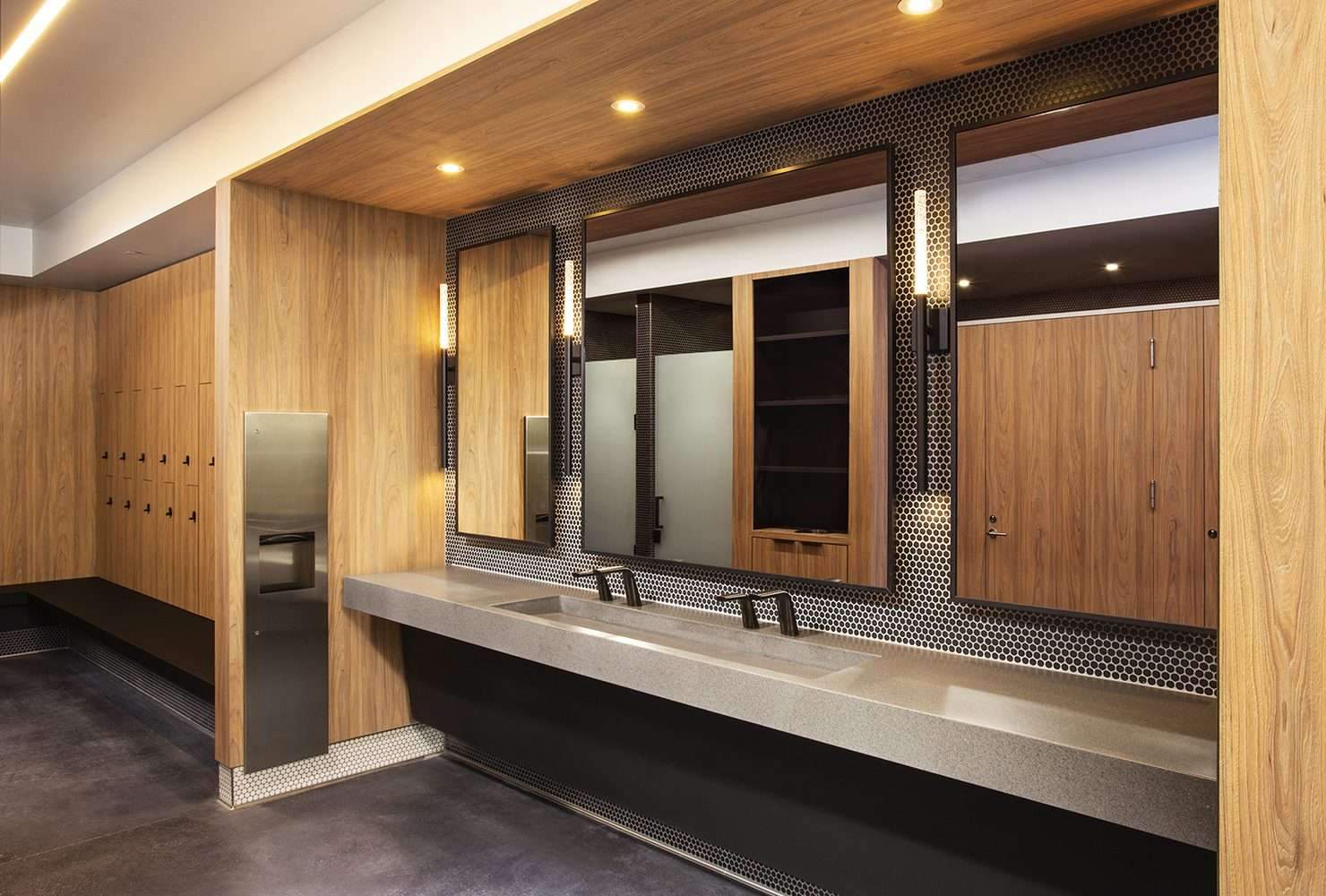
This was addressed by playing with the contrast between the restrooms, showers, and locker areas.
Wood creates warmth and a clean, bold look with hexagonal black tiles.
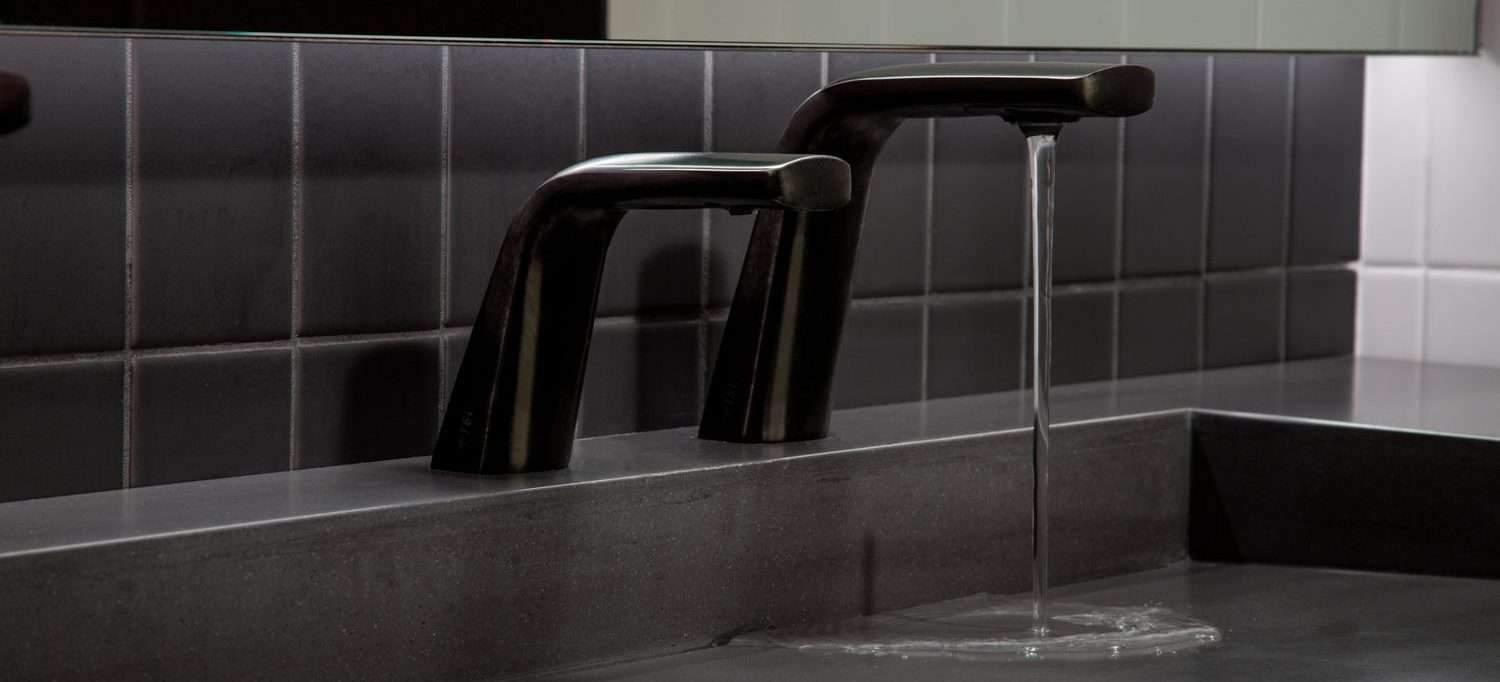
In keeping with this aesthetic, the architects chose the soap dispenser, faucet, and hand dryer from the tape system (all in a black PVD finish).
Plus a dark gray Monolith Type A sink and black powder-coated piping flanges to fit under sinks.
By combining innovative technology with sustainability,
these products are able to integrate seamlessly into the contemporary environment.
This contributes to the mission of creating a functional and inviting spaces,
where workers can feel comfortable, relaxed and enhance their creativity.
For more architectural news