AI Transformer Home Project: Redefining Expandable and Mobile Living Spaces

The Legacy of Pininfarina Design and the Shift Toward Smart Homes
Pininfarina’s design legacy spans over eight decades, historically focusing on crafting vehicles that combine performance and elegance. In recent years, however, the company has witnessed a clear shift in focus, expanding its attention to designing the spaces people live in, not just the vehicles they drive.
This evolution is embodied in the AI Transformer Home series, representing an ambitious step toward modular, expandable housing design, where mobility becomes an integral part of the living experience rather than a mere secondary detail.
Engineering Collaboration and User Experience
Through collaboration with AC Future, Pininfarina applied its signature approach to balance, surface treatment, and user experience. This is evident in how the homes are designed to be both attractive and comfortable, whether in compact travel mode or expanded for full-time living.
Variety of Models and Their Uses
The three models share a flexible platform but are designed to meet different needs:
- AI-THu: A smart residential unit spanning 400 sq. ft., suitable for backyard installation or temporary use.
- AI-THt: A cab-less model featuring patented expansion technology that increases interior space once deployed on-site.
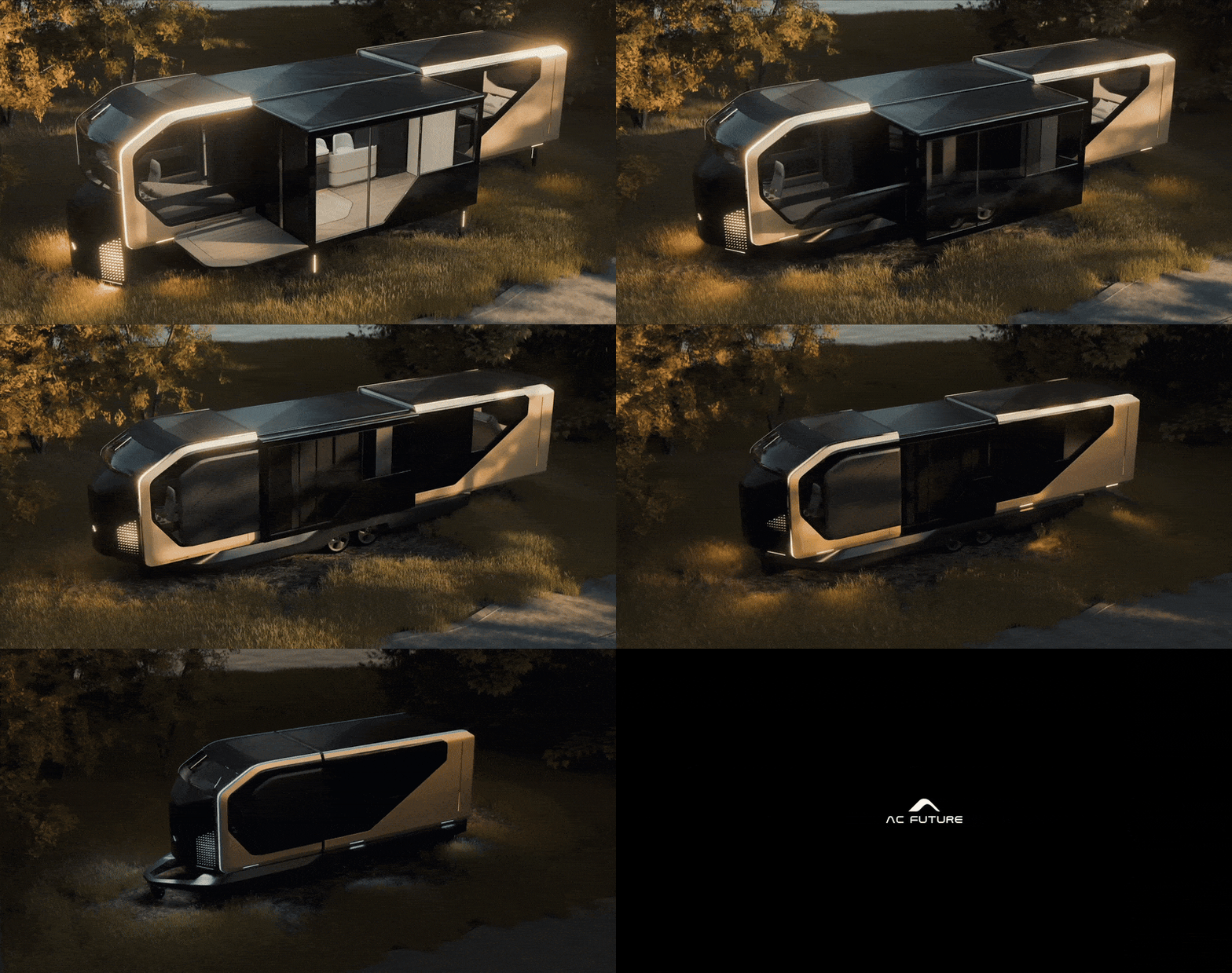
- AI-THd: Combines autonomous mobility with electric or diesel power, featuring triple-side expansion that transforms the small mobile unit into a surprisingly spacious home.
Innovation and International Recognition
All three models excel in combining engineering innovation with design aesthetics. They were awarded the 2025 Red Dot Concept Design Award, reflecting international recognition of Pininfarina’s creativity in redefining the mobile living experience.

AI-THd Model: Redefining Luxury Mobile Homes
The drivable AI-THd stands out as an innovative challenge in the luxury mobile home market. Its design features three-sided expansion, transforming the 26-foot vehicle into a living space of approximately 400 sq. ft. This expansion nearly doubles the interior space compared to conventional mobile homes, where extensions are often limited to a few lateral feet.
Intelligent Space Utilization
One striking feature of this model is the conversion of the driver’s cabin into a separate room once the vehicle is stationary, reflecting a clever use of space typically wasted in most mobile homes. This flexibility makes the design more efficient and comfortable than traditional models.
Mechanisms and Engineering Technologies
The AI-THd concept relies on a complex mechanical expansion system that far surpasses conventional setups. For instance, the AI-THt trailer, which lacks a driver’s cabin, embodies this technology in its purest form, transforming a 24-foot unit into a fully equipped tiny apartment.
Engineering Challenges and Solutions
The main engineering challenge lies in integrating plumbing, electrical systems, and ensuring structural safety while walls and floors are in motion. However, AC Future’s patented system appears to provide a fully insulated and sturdy living space that can be deployed within minutes, a rare innovation in the field of expandable mobile homes.
Off-Grid Self-Sufficiency
Beyond mechanical innovation, this project stands out in an entirely new category due to its ability to operate off the electrical grid and traditional utilities. The homes feature automatically deploying solar panels during expansion, along with an advanced system that extracts potable water from the atmosphere, allowing residents to obtain drinking water directly from the air.
Artificial Intelligence and Resource Management
An integrated AI system manages these resources efficiently, learning user habits to anticipate energy and water needs, reducing the need for constant meter monitoring. This feature provides true autonomy, making long-term off-grid living possible without sacrificing comfort or the luxury of a modern home.
The Mobile Living Experience
The design combines a full-sized kitchen and a dual-zone climate control system, delivering a self-contained living system on wheels that merges technical innovation with complete self-sufficiency. It offers an unprecedented mobile living experience, enabling freedom and flexibility while maintaining a high level of luxury.

Target Audience: A Specialized Niche
Despite its advanced technologies and unique features, this innovation remains out of reach for most “van life” enthusiasts due to its high price, and traditional mobile home fans may feel intimidated by its technical complexity.
Digital Nomads and Design Enthusiasts
The primary target audience appears to include affluent digital nomads, tech entrepreneurs, and design aficionados seeking a mobile base that blends work and daily life while reflecting their aesthetic and technological values. This innovation is not just a means for travel or visiting parks, it is a moving art piece representing a complete lifestyle that enables living and working from anywhere.
Symbolic Innovation and Design Future
This project can be seen as a symbolic product rather than a mere commercial commodity, designed to demonstrate the potential of integrating automotive engineering with smart architecture. In doing so, it inspires the entire industry to move beyond conventional mobile home models toward a more ambitious and elegant future, opening new horizons for mobility and independent living innovation.

✦ ArchUp Editorial Insight
The AI Transformer Home project represents an intriguing step in exploring the relationship between spatial flexibility and mobility. It provides a practical example of how engineering innovation can be integrated with off-grid, independent living. The expansion capability and smart resource management may inspire architects and planners to explore the potential of reconfigurable housing and to incorporate similar concepts into temporary housing units or urban projects with limited space.
However, several aspects warrant critical consideration. Firstly, the very high price makes the project unlikely to be widely replicated, limiting its practical impact on the mobile home industry or modern residential trends. Additionally, the technical and mechanical complexity may pose challenges in long-term maintenance and resource management, reducing the likelihood of applying this concept outside financially and technically capable users.
From an urban architecture and planning standpoint, the focus on independent, expandable mobile units may be less suitable for conventional urban contexts, where community infrastructure and regulatory frameworks impose specific requirements. The heavy reliance on smart systems for energy and water management also raises questions about technological dependence and potential environmental impact.
Overall, the project can be seen as a design exploration tool rather than a practical architectural model for population expansion or sustainable urban solutions. Architects can benefit from studying it to understand smart scalability in small spaces and the integration of mechanical and engineering design, yet it remains a limited-application example outside the context of luxury markets and specialized investors.
Prepared by the ArchUp Editorial Team
Don’t miss the chance to explore more from Architecture in fields like Buildings and Design on the ArchUp website.