
The Basketball Development Center: Redefining the Relationship Between Sports and Historic Urban Context

The Center’s Location and Historical Significance
The Basketball Development Center (BDC) is situated at the point where Istanbul’s historic walls meet the Sea of Marmara, opposite Yedikule Gardens. It is bordered by the Greek Balıklı Hospital and the historic fortification line, giving the site a unique historical and architectural value.
Organization of the Sports Campus
The center relies on the east–west grid established by the Greek Balıklı Hospital, organized around internal and external courtyards connected through an organic circulation network. This design reflects a balance between sports functions and social and cultural spaces, allowing users a seamless and flexible experience while moving between the center’s various facilities.
Architectural Character and Spatial Strength
The center derives its form from the strength of its location, integrating architectural design with the surrounding historic environment. This approach enhances the user experience, making the center more than just a sports facility, it becomes a comprehensive campus blending sports, culture, and history.


The Heart of the Center and the Main Plaza
The main plaza is located at the heart of the Basketball Development Center, forming a central axis that coordinates visitor movement and various activities. Surrounding this plaza are multiple spaces connected by a gently curving internal street, providing functional diversity and enhancing the circulation experience within the center.
Master Plan and Gradual Revelation
The master plan reflects a cohesive urban cluster that gradually unfolds for visitors over time. This approach creates a sense of discovery, as the details of the site reveal themselves progressively, offering users a rich visual and sensory experience.
Heights and Architectural Massing
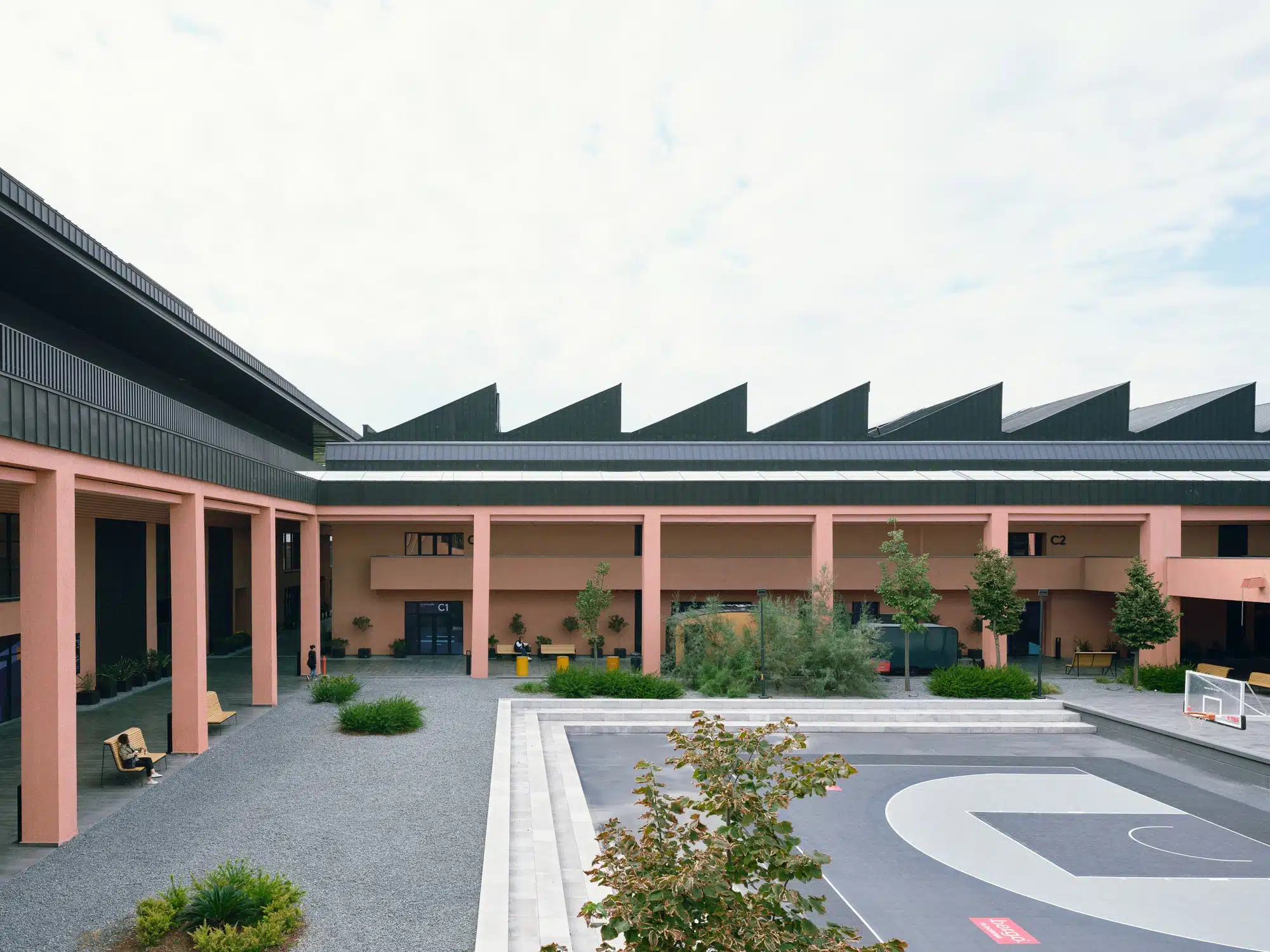
Seven distinct architectural masses extend within the center, with cornice heights ranging from 4 to 21 meters. These elements, together with the historic walls, form a unified envelope covered by a consistent exterior layer, enhancing visual harmony and highlighting the balance between old and new.

Dynamics of Architectural Masses
The architectural masses within the center shift forward and backward, creating an integration of streets, plazas, and green pockets. This movement infuses the site with vitality and breaks the monotony of the long façade, enhancing the visual and spatial experience for users.
Variety of Roofs and Their Visual Impact
The variation in building roofs, ranging from low to high slopes, helps reduce the visual heaviness of the street-facing façade. This design approach creates visual balance and gives the center a more dynamic and fluid appearance.
Technical Functions and Massing Gradation
At the same time, the sequence of modestly scaled roofs alongside taller ones near the fortification line provides the necessary space to accommodate technical equipment. In this way, aesthetics and functionality are efficiently combined, reflecting the design’s attention to practical and technical details without compromising architectural harmony.


Balance Between Interior and Exterior Facades
The interior and exterior facades create a balanced architectural expression, with the protected internal street and arcade acting as a secondary ground layer that facilitates spatial transition between the staggered masses. This arrangement enhances the user experience both aesthetically and functionally, making movement within the center smoother and more fluid.
The “Anonymous Identity” Architectural Approach
This treatment of facades and the master plan reflects an “anonymous identity” architectural approach, relying on context and program rather than imposing a rigid architectural style. Unlike massive, introverted sports buildings typically found on city outskirts that dominate their surroundings, this design offers flexibility and seamless integration with the environment, making the center more harmonious with its location.

The Main Multi-Purpose Arena
The Basketball Development Center features a main multi-purpose arena with a capacity of up to 10,000 spectators. This arena is designed to host a wide range of events, from international sports tournaments to events organized by prestigious global organizations, reflecting the center’s adaptability to diverse needs.
Youth Training Halls
In addition to the main arena, the center includes three training halls dedicated to youth, each accommodating around 500 spectators. This distribution encourages youth participation and nurtures athletic talent, providing a suitable and safe training environment.


National Teams Building
A separate building within the Basketball Development Center is dedicated to the Turkish national teams, where athletic, technical, and administrative staff carry out preparation and planning activities under one roof with the Turkish Basketball Federation. This arrangement enhances coordination in sports operations and facilitates the exchange of expertise.
Additional Training and Competition Court
The building includes a court with a seating capacity of 1,000, designed to host both tournament matches and training sessions. The court is arranged according to practical needs for players before and after competitions, providing a flexible environment that meets diverse athletic performance requirements.
Accommodation and Educational Activities Center
The campus also includes an accommodation center for specialists from Turkey and abroad, hosting seminars, conferences, workshops, and meetings throughout the year. This approach enhances the educational and cultural dimensions of the center, transforming it into a comprehensive environment that combines sports training with professional learning.


The Basketball Development Center as a Sports Village
The Basketball Development Center (BDC) is not merely a sports facility; it represents a fully integrated basketball village. It is a campus where diverse scenarios and age-appropriate alternatives intertwine, making sport part of daily life and enhancing its integration into the city’s social and cultural activities.
Balance Between Sports and Culture
The center’s program balances sports, commercial, and cultural functions, strengthening its connection to the city and making it a versatile attraction. The sports facilities are supported by multiple social and cultural elements, including:
- Basketball Museum
- Library
- Event Courtyard
- Food & Beverage Areas
Hybrid Structure and Societal Impact
This hybrid structure diversifies the users and increases the frequency of their engagement with the space. A comprehensive spatial and programmatic setup extends the influence of basketball from the court to the streets and plazas, enabling the center to foster sports awareness and participation across all ages and backgrounds.

✦ ArchUp Editorial Insight
The efforts made to integrate the historic environment with architectural design are appreciable, as evidenced by the careful attention to fluidity between corridors, plazas, and various building masses, as well as the gradation of heights that reduces the visual heaviness of the long façade. The multiple facilities, such as training halls, courts, and the accommodation center, provide ample opportunities for sports and cultural interaction, reflecting a thoughtful understanding of diverse user needs.
However, some aspects remain open to question or improvement. For instance, the variety of roofs and building masses may impose complex operational and maintenance requirements in the long term, especially in buildings interacting with the surrounding historic environment. Similarly, the strong emphasis on open spaces and gradual transitions between masses could present challenges in managing visitor flow during major events, necessitating further study to ensure operational efficiency.
Moreover, despite the project’s ambitious integration of sports, culture, and education, certain gaps exist regarding everyday flexibility for local residents. The design appears better suited for organized activities or major tournaments, while sustained, everyday use by the community may require additional administrative intervention.
Overall, the project provides an architecturally rich model with detailed spatial interaction and could serve as a reference for future designs aiming to integrate sports facilities within urban and historic contexts. Nevertheless, achieving the full potential of this model requires careful operational planning and continuous management to ensure functional sustainability and avoid practical issues in the long term.
information about the project
- Architects: TEGET
- Area: 150000 m²
- Year: 2024
- Photographs:Egemen Karakaya


