
Bloomberg Student Center: Architectural Innovation Redefining Campus Life at Johns Hopkins

Bloomberg Student Center: A Milestone in Johns Hopkins University’s Journey
On the occasion of its 150th anniversary, Johns Hopkins University inaugurated the new Bloomberg Student Center, marking the first facility entirely dedicated to student life on campus.
Responding to a Renewed Need
For generations, the university’s students have expressed a desire for a space that allows them to connect and interact beyond the lecture halls. The center thus emerges as a genuine response to these aspirations, combining a stimulating educational environment with dynamic social interactions.
More Than Just a Building
The architectural role of the center extends beyond being a new structure in the historic Homewood campus; it represents a symbolic step toward enhancing the student experience. It brings together spaces for social interaction, performing arts, and student activities under one roof, fostering a sense of belonging while encouraging creativity and self-expression.


A Design Reflecting Collaboration and Architectural Creativity
The Bloomberg Student Center’s design is the result of a collaboration among several leading global architectural firms. BIG – Bjarke Ingels Group led the overall architectural design, while Rockwell Group handled the interior design, with the executive office Shepley Bulfinch participating, and the landscape design crafted by Michael Van Valkenburgh Associates (MVVA).
A Space Embracing Campus Life
The new building spans approximately 150,000 square feet, carefully designed to meet the diverse and evolving needs of Johns Hopkins University students at both undergraduate and graduate levels. The center houses a wide array of facilities that blend study, recreation, and creativity.
Comprehensive Facilities Supporting Interaction and Expression
The center includes a modern dining hall offering a variety of local restaurant options, along with a café, a bar, and open seating areas within a spacious central atrium.
Additional facilities include a flexible auditorium accommodating around 250 people, dance and recording studios, student club meeting rooms, a digital media center, as well as an Esports Lounge, reflecting the contemporary approach to campus life design.
Behind the Name
The building is named the Bloomberg Student Center in honor of one of the university’s most distinguished alumni, Michael R. Bloomberg (Class of 1964, Engineering), founder of Bloomberg L.P. and Bloomberg Philanthropies, and former Mayor of New York City. This recognition honors his contributions and ongoing support for the Johns Hopkins community.

A Hub Pulsating with Campus Life
The new Bloomberg Center forms the heart of campus life at Johns Hopkins University, connecting members of the academic community from different campuses, disciplines, and backgrounds. In doing so, it becomes a university space that unites intellectual and social diversity under one roof.
A Design Enhancing Openness and Interaction
The architectural design is based on the principles of openness and flexibility, allowing rooms and facilities to serve multiple purposes without permanent designation. This approach creates a dynamic environment that encourages participation and collaboration among various student groups.
Spaces Tailored for Daily Life
The center’s halls and gathering areas are designed to meet students’ daily needs while simultaneously accommodating special events and activities. The interior layout encourages spontaneous encounters, naturally fostering communication among individuals in an informal setting.
Connection to Environment and Nature
The center is characterized by abundant natural light that fills its spaces, along with interior greenery and open outdoor terraces providing comfortable spots for gathering and relaxation.
Commitment to Sustainability
Aligned with the university’s vision for a more sustainable future, the project aims to achieve LEED Platinum certification, the highest level in sustainable design evaluation, reflecting a genuine commitment to environmental responsibility in every aspect of construction and operation.


A Strategic Location Connecting the University to the Community
The Bloomberg Student Center is situated at the intersection of 33rd Street and Charles Street, a key point linking the Homewood campus with the surrounding neighborhood. This location was carefully chosen to strengthen the connection between academic life and the local community, providing opportunities for continuous interaction between students and visitors.
Architecture Inspired by Nature
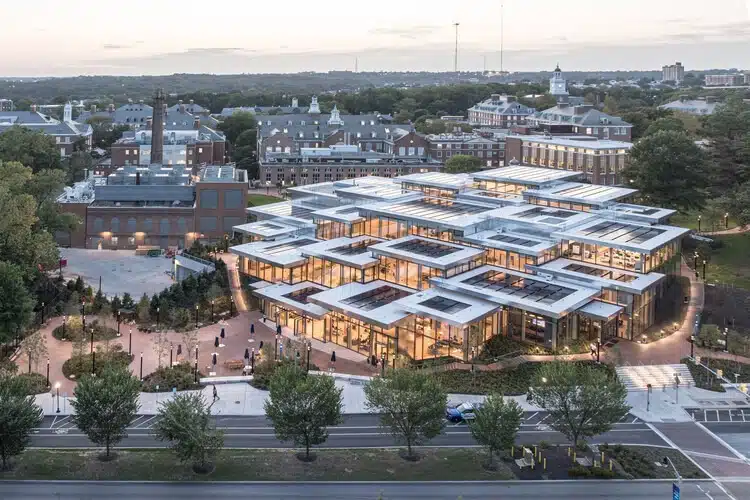
The design features a series of terraced blocks made of massive wooden frames with flat, cantilevered roofs, giving the building a warm visual character that harmonizes with its surroundings. Above these blocks, approximately 1,000 solar panels generate nearly half of the building’s electricity needs, underscoring the project’s commitment to sustainable design principles.
An Academic Village on a Natural Slope
The overall design resembles a “miniature village,” consisting of 29 wings integrated into a 30-foot sloped site. This innovative concept allows for direct entrances to all four floors, facilitating easy access while giving the building a comfortable and human-scaled presence.
Transparency Integrating Interior and Exterior
Exposed wooden columns and roofs are connected to a wide glass façade extending along the length of the building, flooding interior spaces with natural daylight from all directions. The façade also allows passersby to glimpse the evolving scenes of student life, making the building itself a living reflection of campus activity and human interaction.

Integrating Student Activities at the Heart of the Design
Bjarke Ingels, founder and creative director of BIG, explained that the Bloomberg Student Center represents a fundamental shift in organizing student activities at Johns Hopkins University. Previously, activities were scattered, but now they are consolidated in one location within a series of terraced wooden wings ascending the natural hill at the campus’s edge.
A Multi-Use Terraced Space
At the core of this design, beneath the solar-paneled roof, lies an open terraced space used year-round. This area is entirely dedicated to students for social, creative, and non-academic activities, fostering interaction among individuals while encouraging creativity and self-initiative.
Wood Construction: Sustainability and Warmth
The design prominently features massive wood, a choice that carries dual value:
- Reducing the building’s carbon footprint significantly, in line with sustainability goals.
- Creating an atmosphere of warmth, hospitality, and spontaneity, making the spaces more inviting for students and contributing to a comfortable and inspiring daily experience.

Interior Design: The Heart of Student Life
The interior design of the Bloomberg Student Center serves as an integrated hub for campus life, combining essential non-academic services with educational activities while fostering collaboration, dining, social interaction, creativity, and performance arts.
Organizing Spaces Through an Innovative Structure
The distribution of different spaces is based on the building’s unique structural grid, with lounges and multipurpose rooms arranged around a shared central staircase connecting all four floors. These rooms serve multiple functions, including student exhibitions, community meetings, recreational games, and health and wellness activities. Seating areas and indoor planter beds add vibrancy to the interior spaces.
The Atrium: The Center’s “Living Room”
The tall, open atrium serves as the center’s “living room,” encouraging relaxation, study, and group interaction. It becomes a space that blends practical functions with everyday social experiences.
Natural Materials and Architectural Warmth
Exposed wooden ceilings, columns, and acoustic beams (ADLT) harmonize with natural materials and warm color tones, including limestone and white oak. This combination creates a comfortable and balanced environment, merging elegance with warmth and making students’ daily experiences more inviting and inspiring.

Integrating the Building with Its Surroundings
The Bloomberg Student Center is carefully integrated into the hill along Charles Street, enabling a seamless connection between the main Homewood campus and the student residences on the opposite side. This location ensures visual and functional continuity among the university’s various elements, creating a cohesive campus life experience.
Diverse Indoor and Outdoor Spaces
The four accessible floors extend to include outdoor terraces, indoor and outdoor gathering spaces, and open-air seating areas. These features enhance opportunities for social interaction and provide a versatile environment for daily activities.
Landscape Design: Artistic Touch and Sustainability
The greenery is part of the landscape design by Michael Van Valkenburgh Associates (MVVA), a firm renowned for its innovations in landmark projects such as:
- Brooklyn Bridge Park
- The Presidential Centers of George W. Bush and Barack Obama
- The National September 11 Memorial & Museum at the World Trade Center
This extensive expertise demonstrates the design’s ability to merge natural beauty with academic functions while creating a sustainable and comfortable environment for students and visitors alike.

Interior Architecture: Enhancing Social Interaction
David Rockwell, founder and principal of Rockwell Group, explained that the interior architecture approach at the Bloomberg Student Center focuses on creating a series of flexible social spaces that reflect the daily rhythm of student life beyond the classroom.
Dynamic Spaces Inspired by the Wooden Structure
Designers drew inspiration for the interior layout from the building’s wooden framework and column grid, resulting in a dynamic environment where different spaces harmonize with one another. Natural materials, warm color tones, and layered lighting further enhance the sense of connectivity among the functional areas.
An Environment Promoting Collaboration and Creativity
This design fosters an environment that encourages collaboration, artistic performances, and social interaction, making the center a comprehensive hub of student life that blends informal learning, daily creativity, and collective experiences.


Student Participation in Space Design
The Bloomberg Student Center reflects years of active student contributions, with over 1,500 students from across the campus participating. Their input had a direct impact on the design team’s choices and the organization of spaces.
Integrating Creative and Wellness Activities
These contributions were essential in shaping the building’s program, particularly in incorporating versatile creative spaces. These areas accommodate activities such as:
- Dance
- Music rehearsals
- Painting
- Pottery
In addition, other spaces were dedicated to health and wellness, catering to students’ diverse daily needs.
Natural Elements to Enhance Environmental Connection
The design also incorporates indoor trees, plants, and other natural elements aimed at strengthening the connection to nature and bringing vibrancy to the interior environment, contributing to an improved quality of experience for students within the building.

Students’ Perspective: A Renewed Heart of Campus
Scott Coleman, a fourth-year undergraduate student, noted that the Bloomberg Student Center represents an unprecedented addition to campus life:
“Up until this point, there hasn’t been a space like this at Hopkins. I believe this building will become the heart of the campus, even the heart of the university community, where people can truly connect with each other, create, and express themselves. It expands the possibilities for what you can do here at Hopkins in just one day.”
A Design Serving the Entire Student Community
Matthew Gifford, AIA-certified architect and principal partner at Shepley Bulfinch, explained that the center reflects a comprehensive vision shaped directly by students themselves:
- The building is designed to meet the evolving needs of students, balancing academic engagement with opportunities for creativity, interaction, and relaxation.
- The design includes diverse spaces, ranging from club activities and quiet contemplation to varied dining options and social interaction.
- Thanks to its flexibility and adaptability, the center ensures continuity in its vital role for years to come, reflecting both the spirit and future of Johns Hopkins University.

✦ ArchUp Editorial Insight
The Bloomberg Student Center leaves a strong impression in terms of architectural innovation and the harmony between interior and exterior design, as well as attention to the students’ daily experience and the integration of nature into interior spaces. The diverse facilities and flexible areas demonstrate the project’s capacity to effectively support student and creative activities, reflecting a focus on enhancing social interaction and a sense of belonging.
However, the project’s large scale and complex design present potential challenges, such as the difficulty of managing open spaces continuously or the ongoing need for maintenance to ensure the sustainability of the wood and complex infrastructure. Some students may also feel that the contemporary, multi-level architectural character requires time to adapt to, especially when navigating between floors and different facilities.
Overall, the center represents a prominent and inspiring addition to the campus, while simultaneously raising organizational and practical considerations that can inform daily use and future development plans.
Prepared by the ArchUp Editorial Team
Don’t miss the chance to explore more from Architecture, Archive, and Buildings on the ArchUp website.


