

Centre des financespubliques in Corbeil-Essonnes / Lemoal Lemoal Architectes

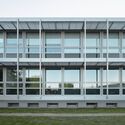
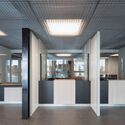
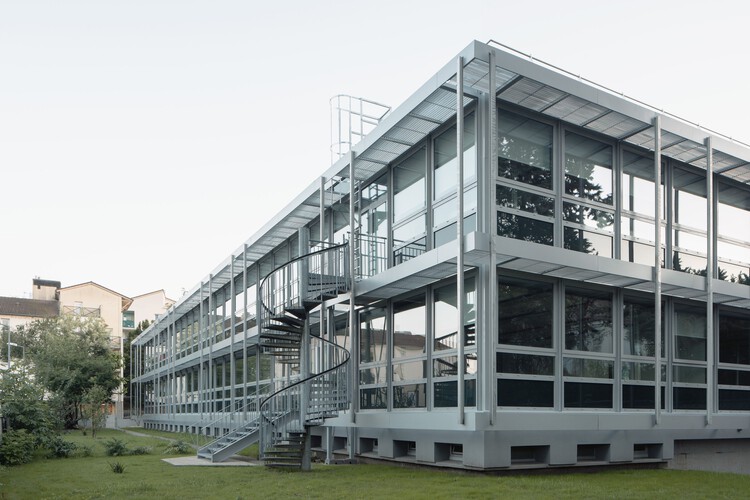
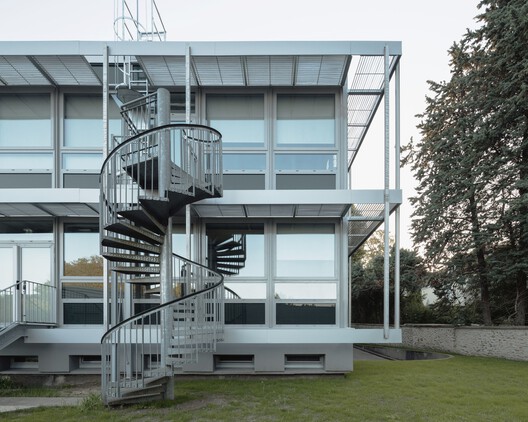
Text description provided by the architects. Located in the heart of a sparsely populated urban area in the town of Corbeil-Essonnes, the building, constructed in 1971, is positioned in the center of the plot. This “Pailleron-type” structure – owing to its similarities with the modularconstruction process – is composed of metal posts and beams clad in glazed facadepanels, and an exterior steel assembly supporting fixed horizontal sunshades. The straightforward geometry of a rectangular parallelepiped is determined by theprocess of construction. The regular facades are marked by a horizontal grid signalingthe three levels of the building, and a vertical grid formed by the modules of identicalwindow units. The building consists of a basement housing technical areas and a car park, a groundfloor with a public reception desk in an area of the lobby, and related functions(lunchroom, a caretaker’s apartment), offices and archives, and finally another flooralso containing offices and archives.
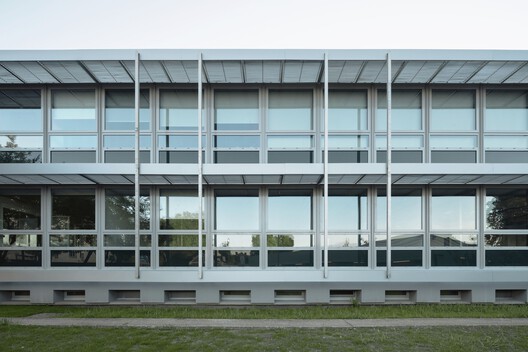
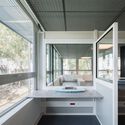
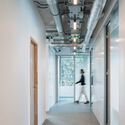
Principles of intervention – The primary structure was completely stripped down to expose its system of postsand beams, their assemblies, and floor slabs. The facades underwent a full asbestos removal process and were then dismantled. This stripping phase justified the prior research on the existing structure andvalidated the desired refurbishing principles. For example, slabs of the false ceilingwere reused and installed in the islands of acoustical tiles to enhance theirperformance. The sunshades have been reemployed, after being dismantled,sandblasted, and then reinstalled. The grid of the new facades defines the interior reorganisation. The generous volumesof the floors and their open plans made it possible to install all the technical areas,services, and archives at the center of each floor. The corridor, serving as a buffer between the central spaces and offices, receivesdaylight thanks to the transparent glass partitions and the building’s location at thecenter of the lot. Outside, the approaches and accesses have been reorganised tocreate a more welcolming experience.

Application of tertiary decree – The project is part of the Dispositif Éco Énergie Tertiaire (DEET, or Tertiary EcoEnergy Programme), aimed at improving a building’s energy performance, usingseveral specific measures.
The process is focused on improving the qualities of the building’s envelope. Tominimise energy loss, reinsulating certain parts of the structure was considered. Eachinterior floor was completed with insulation on its underside and parallel to the façademodules. The installation of external insulation was decided upon in order to enhance the performance of the concrete foundations. The adaptations planned for the façademodules made it possible to replace the quality of existing windows in order to reducethe effects of overheating in summer/or a cold wall in winter. All these interventions have made it possible to cut primary energy in half from theexisting state to the one of the completed project (existing: 2.74 kilowatt-hours ofprimary energy/m² versus project: 1.14 kilowatt-hours of primary energy/m²).

Controlled carbon impact – The project, accompanied by the office of ECO + Carbone, provided an opportunity totry out the application of a complete Life Cycle Assessment (LCA), in other words,from competition phase through completion. This work was designed to raise the awareness of the client as well as thecontractors, by setting up an approach of “preventive removal”, something many ofthem had never done before.
During the diagnostic phase, elements that could be reused or recycled were listedand inventoried. As well as saving 1.4 tonnes of material, this process preserved thebuilding’s architectural identity.


