

Chuck Davis: When Architecture Becomes a Human Legacy

Charles “Chuck” Medley Davis: An Enduring Human-Centered Architectural Legacy
When a visionary architect passes away, the loss becomes a societal matter that extends far beyond the individual. This perfectly applies to Charles Medley Davis, affectionately known among his peers as “Chuck,” who passed away on May 7, 2025, at the age of 90, leaving behind an exceptional architectural legacy in California.
Roots and Early Formation
Chuck was born in Omaha, Nebraska, in 1934, then moved with his family to San Francisco at the age of twelve. This move played a significant role in shaping his architectural vision and social values. In 1951, he enrolled in the School of Architecture at the University of California, Berkeley, where he was influenced by William Wurster’s renewed curriculum and learned from renowned architects such as Charles Eames and Paul Rudolph.
Early Career Milestones
After graduating in 1955, Chuck joined Roger Lee’s office, where he designed residential projects in Berkeley and San Leandro. By 1958, he had gained hands-on experience that strengthened his ability to combine aesthetic and functional dimensions in his designs.
A Turning Point: An Inspiring Encounter
In 1961, Chuck reached a defining moment in his career when he attended the “Eyes West” conference in Monterey. There, the words of Louis Kahn deeply influenced his thinking and inspired him to return to academic study. He enrolled in a master’s program, where he studied under Joseph Esherick, who later became his mentor and professional partner.
From Collaboration to Leadership
At the start of the 1960s, Chuck joined Esherick Homsey Dodge & Davis (EHDD) and became a partner in 1972. What distinguished his work was his passion for reviving historic structures and transforming them into vibrant spaces that serve the community.
Among his most notable achievements was the rehabilitation of the Fisherman’s Wharf Cannery Building in San Francisco in 1967, transforming it into a bustling commercial center while preserving its historical value.
A Balanced Approach: Architecture Serving Society
Chuck was not just a conventional architect; he firmly believed that architecture plays a vital social role. He consistently worked to protect his vision from negative influences without ever losing the humility and kindness that left a positive mark on everyone who worked with him.
A Legacy That Endures
Over seven decades, Chuck proved that architecture is not merely about constructing buildings—it is a means to enhance quality of life and strengthen community belonging. Among his significant independent projects was the Farwest Laboratories in San Francisco, completed in 1974, demonstrating his ability to blend innovation with a respect for the spirit of place.

Monterey Bay Aquarium: The Defining Turning Point
Despite his many career milestones, the Monterey Bay Aquarium project marked a transformative moment in Chuck’s professional journey. In 1978, he and his team were awarded the opportunity to design this landmark, which finally opened its doors in 1984.
His close collaboration with the client, David Packard, played a pivotal role; through this experience, Chuck learned that creating timeless architecture requires more than just good design—it also demands the active involvement of visionary patrons who truly believe in the project’s value.
Teamwork and Technical Challenges
During the design phases of the aquarium, Chuck worked hand in hand with his brother Harold, a structural engineer at Rutherford + Chekene. Together, they faced significant challenges, chiefly preserving the historic character of the old cannery site while accommodating the massive technical requirements of the new program.
Through this project, Chuck expanded his expertise to become a leading figure in the design of public aquariums and science and education exhibits—a specialty that would shape many of his future contributions.
Broadening Horizons: Local and Global Projects
The success of Monterey Bay Aquarium opened new doors for Chuck’s practice, leading to standout projects across the country and abroad. Notably, he played an influential role in the development of the Shedd Aquarium in Chicago, skillfully blending neoclassical building elements with fluid, modern aquatic environments.
Internationally, he brought his design philosophy to the Taiwan Water Resources Museum, contributing to the creation of engaging educational exhibits in a prime location on the island’s southern tip—always ensuring that architecture remained connected to its social context.
A Human Touch in Coastal Spaces
Chuck remained devoted to his vision of architecture as a tool for reviving urban waterfronts. This is evident in his work on the Exploratorium Relocation Project at Pier 15 in San Francisco, where he helped transform part of the city’s historic waterfront into a vibrant destination with both educational and cultural dimensions.
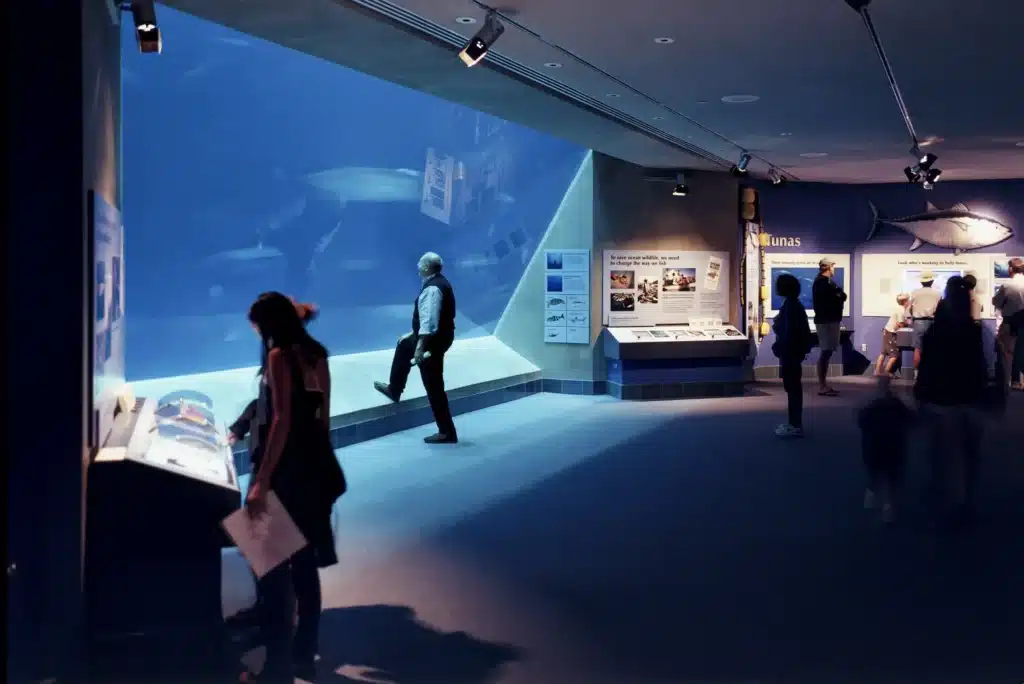
His passion for integrated design also shone through in the Long Beach Aquarium, one of his final major contributions before retirement. In this project, Chuck successfully balanced architectural form with cutting-edge exhibit presentation, all while staying true to the aquarium’s educational mission.
Academic Architecture: A Constant Chapter in His Legacy
Alongside his remarkable work in designing aquariums and museums, Chuck Davis maintained a strong and lasting presence in the realm of higher education. From his early days learning under Joseph Esherick, academic buildings became a steady cornerstone of his architectural contributions.
One of his most notable achievements in this field is the Science and Engineering Library at the University of California, Santa Cruz (UCSC). This project embodied his core principle that “structure serves nature,” with a building that blended seamlessly into its surrounding landscapes while respecting the campus’s ecological spirit.
Respecting History and Adaptive Reuse
At the University of California, Berkeley, Chuck designed the Department of Energy Library, a thoughtful reorganization of existing structures that preserved their historical integrity. His sensitive approach extended to his longstanding relationship with Stanford University, where he carefully intervened in iconic locations like History Corner, Building I-120, and the renovation of the Stanford Geology Corner, all within the heart of the campus.
An Unforgettable Human Legacy
Beyond his architectural achievements, Chuck left a deep void among his family and those closest to him. He is mourned by his son Hayden Davis, his brother Harold (Hal), and his sister Caroline Davis. To them, he was not only an extraordinary architect but a man who combined earned authority with genuine warmth and kindness.
Wisdom and an Ever-Young Spirit
Chuck was known for rare qualities: a natural artistic talent paired with a boundless generosity of spirit. His remarkable memory allowed him to recall names, places, and stories in vivid detail, always ready to share his insights with heartfelt enthusiasm. He never stopped designing, visiting buildings, or speaking passionately about architecture—as if he were still that eager student who first stepped into architecture school, ready to shape spaces and inspire minds.
✦ ArchUp Editorial Insight
Chuck Davis’s joining of Esherick Homsey Dodge & Davis (EHDD) in the early 1960s was never just a job—it was the beginning of a lifelong mission. From the moment he became an official partner in 1972, he dedicated himself to reviving neglected spaces and breathing new life into forgotten structures. One early example is the transformation of Fisherman’s Wharf in San Francisco—a once-abandoned industrial shell that he turned into a vibrant marketplace alive with community spirit.
Chuck Davis taught generations that a building can become a language. Every time people walk through its halls, gardens, or waterfronts, they carry a piece of his vision with them: that design is never just about walls—it is an ongoing dialogue between people and place. That was Chuck.
Explore the Latest Architecture Exhibitions & Conferences
ArchUp offers daily updates on top global exhibitions, conferences, and professional art and design forums.
Follow key competitions, check results, and stay informed through the latest news worldwide.
ArchUp is your encyclopedic hub for discovering events and design-driven opportunities across the globe.


