

Shenzhen Cultural Nexus A Unified Landmark of Art, Knowledge, and Urban Life

Shenzhen: A City Redefining the Dialogue Between Architecture and Culture
At the heart of Shenzhen, the Shenzhen Cultural Nexus, an integrated art museum and public library, rises as a new Cultural architecture hub.
This civic complex transforms a traditional institution of books and exhibitions into a vibrant urban forum.
Here, art, knowledge, and community meet, encouraging daily interaction and shared experiences.

Design Vision: A Single Architectural Language for Thought and Space
The concept centers on the fusion of two cultural functions museum and library under one expansive roof.
This continuous canopy becomes a symbolic threshold leading into the world of ideas, art, and shared knowledge.
Architecturally, it unifies the two distinct volumes and visually frames the civic plaza below, expressing the project’s ambition to make culture accessible and interconnected.
The plaza beneath is conceived as a space of encounter, linking building and city through movement, light, and collective experience.

Interior Experience: Reading Within Light
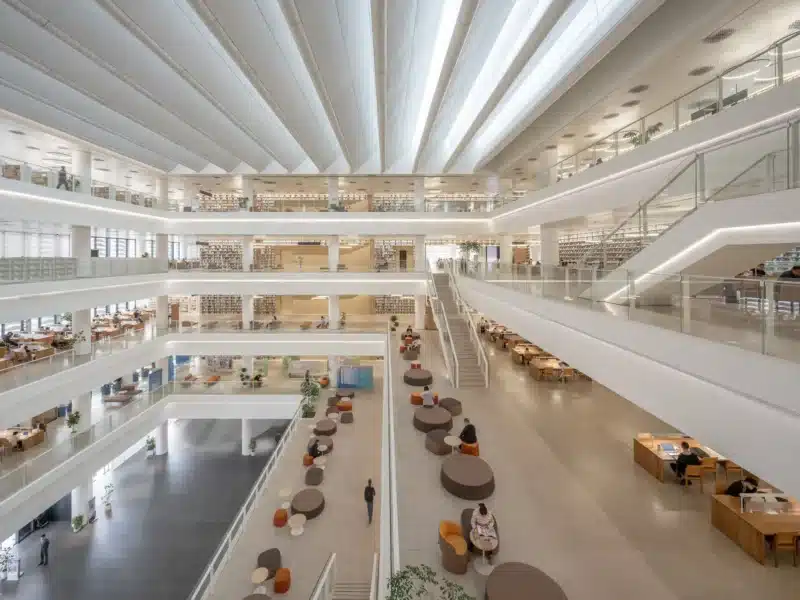
The library’s interior is flooded with soft daylight descending from skylights above, producing an atmosphere of calm introspection.
At its core, an open vertical atrium organizes the reading terraces across several levels, fostering a sense of openness and visual connection.
Here, the visitor is neither isolated nor exposed the design offers a delicate balance between solitude and participation.
The library becomes not merely a place for study, but an urban living room that welcomes the community to engage with knowledge as a shared human experience.
The Museum: A Transparent Dialogue with the City
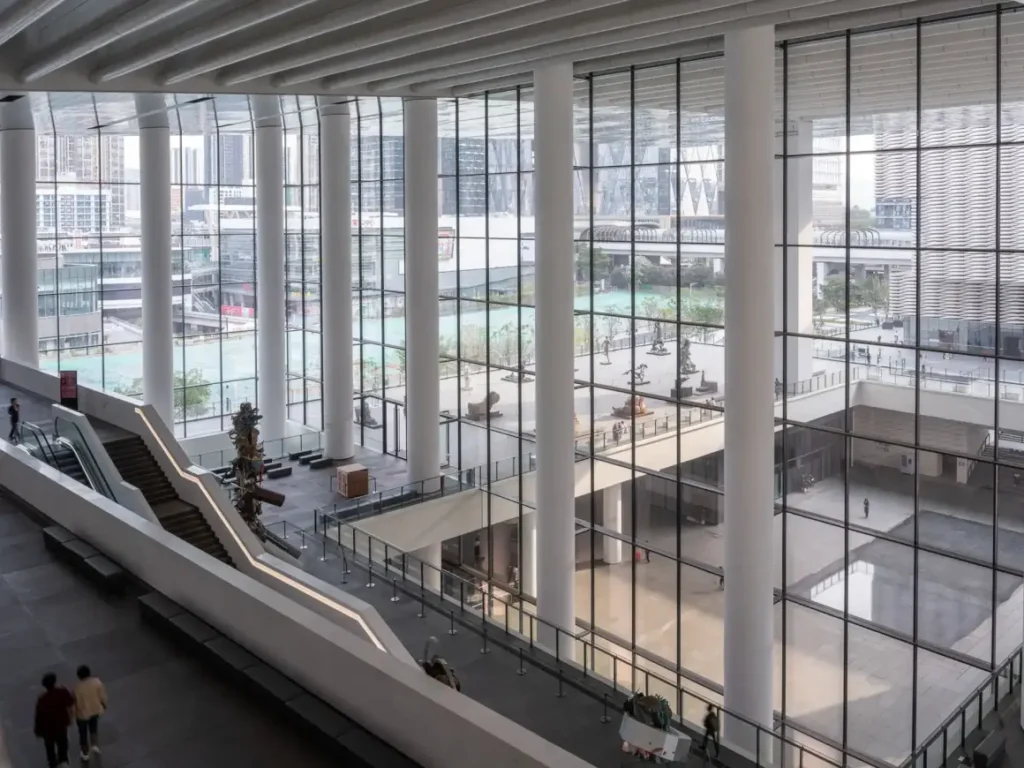
Opposite the library, the museum embodies the creative and imaginative dimension of the project.
Large glazed façades dissolve boundaries, allowing passersby to perceive exhibitions as part of the city’s visual field.
The interior galleries cascade down toward the public square, doubling as viewing platforms that frame both the artworks and the surrounding skyline.
This spatial strategy turns architecture into a medium of dialogue between art and the urban realm, making Cultural architecture experience an extension of city life itself.

Sustainability as Architectural Ethic
The project’s sustainable approach relies not on technology alone but on architectural intelligence.
Natural stone and double glazing ensure thermal comfort while maintaining a timeless, tactile quality.
The expansive roof acts as a climatic filter providing shade, regulating airflow, and extending outdoor life beneath.
Rather than asserting itself through spectacle, the building integrates quietly with its surroundings through measured form and material honesty.
Meaning and Urban Relevance
The cultural complex is envisioned as part of the urban continuum rather than a detached landmark.
Its central plaza serves as a civic platform for spontaneous gatherings, performances, and informal exchange.
By connecting public life with spaces of learning and art, the project reimagines the city as a network of Cultural architecture interactions rather than zones of separation.
It is a model of architecture that prioritizes human experience over formal expression, placing thought and community at the center of design.
Structural and Sustainable Systems
The Shenzhen Cultural Nexus uses a hybrid structural system of reinforced concrete and steel.
It is supported by 42 main columns, each 1.2 meters in diameter.
The lighting design includes 156 roof openings with adjustable angles.
Light reflectors distribute illumination gradually, ranging from 200 to 800 lux, enhancing comfort and architectural effect.
Materials are chosen for durability and aesthetics.
These include 4 cm-thick local granite floors and double-insulated glazing with a U-value of 0.6 W/m²K.
Sustainability is integral to the design.
A rainwater harvesting system collects up to 3.5 million liters annually.
Natural ventilation reduces energy consumption by 55%, showing a careful integration of technology and environmental responsibility.
Conclusion
The Shenzhen Cultural Nexus represents a new paradigm in civic architecture one that unites intellect, emotion, and place within a coherent architectural language.
Through the quiet light of the library and the openness of the museum, the project fosters a dialogue between introspection and collective identity.
Here, light becomes knowledge, space becomes thought, and architecture becomes a medium for civic imagination.
It is not a monument to culture, but a living framework through which the city learns to think, see, and connect.
For verified updates on global activities, visit ArchUp’s architecture events section, featuring documented coverage of leading exhibitions and conferences, along with continuously updated architecture competitions and official results.
Project Summary
| Element | Description |
|---|---|
| Location | Central Shenzhen, China |
| Function | Integrated art museum and public library |
| Total Area | Approximately 138,000 m² |
| Floors | Five main levels |
| Key Features | Unified roof canopy, central public plaza, transparent façades |
| Design Approach | Fusion of art, knowledge, and urban life in a single architectural gesture |
| Architectural Goal | To create a cultural identity that redefines the relationship between people and the city |
✦ ArchUp Editorial Insight
The Emerson Cultural Museum shows a rare balance of visual simplicity and intellectual depth, with concrete forms intersected by carved voids that bring in natural light. The spatial sequence transitions from open exhibition halls to intimate reflective chambers, creating a holistic sensory and intellectual journey. The material treatment of the façades embodies a design philosophy that balances solidity and openness, silence and symbolism. Critically, the project transcends the conventional museum as box paradigm, evolving into an experiential dialogue between light, shadow, and time. Its enduring value lies in transforming architectural space into a contemporary journey of thought and perception.




ArchUp Editorial Management
The article provides a profound philosophical analysis of the relationship between architecture and culture, with a distinguished focus on the human dimension and sensory experience. To enhance its archival value, we would like to add the following technical and structural data:
We would like to add that:
· Structural System: Hybrid system (reinforced concrete + steel) with 42 primary columns of 1.2-meter diameter
· Lighting System: 156 roof openings with controlled angles, using light reflectors to distribute illumination at 200-800 lux gradient
· Materials: 4 cm thick local granite flooring, with double insulated glass achieving 0.6 W/m²K U-value
· Sustainability: Rainwater harvesting system with 3.5 million liter annual capacity, providing 55% energy savings through natural ventilation
Related Link:
Please review for a comparison of cultural complex projects:
[Designing Integrated Cultural Institutions in Global Cities]
https://archup.net/transforming-a-hospital-complex-into-a-cultural-center-with-a-movable-roof/