
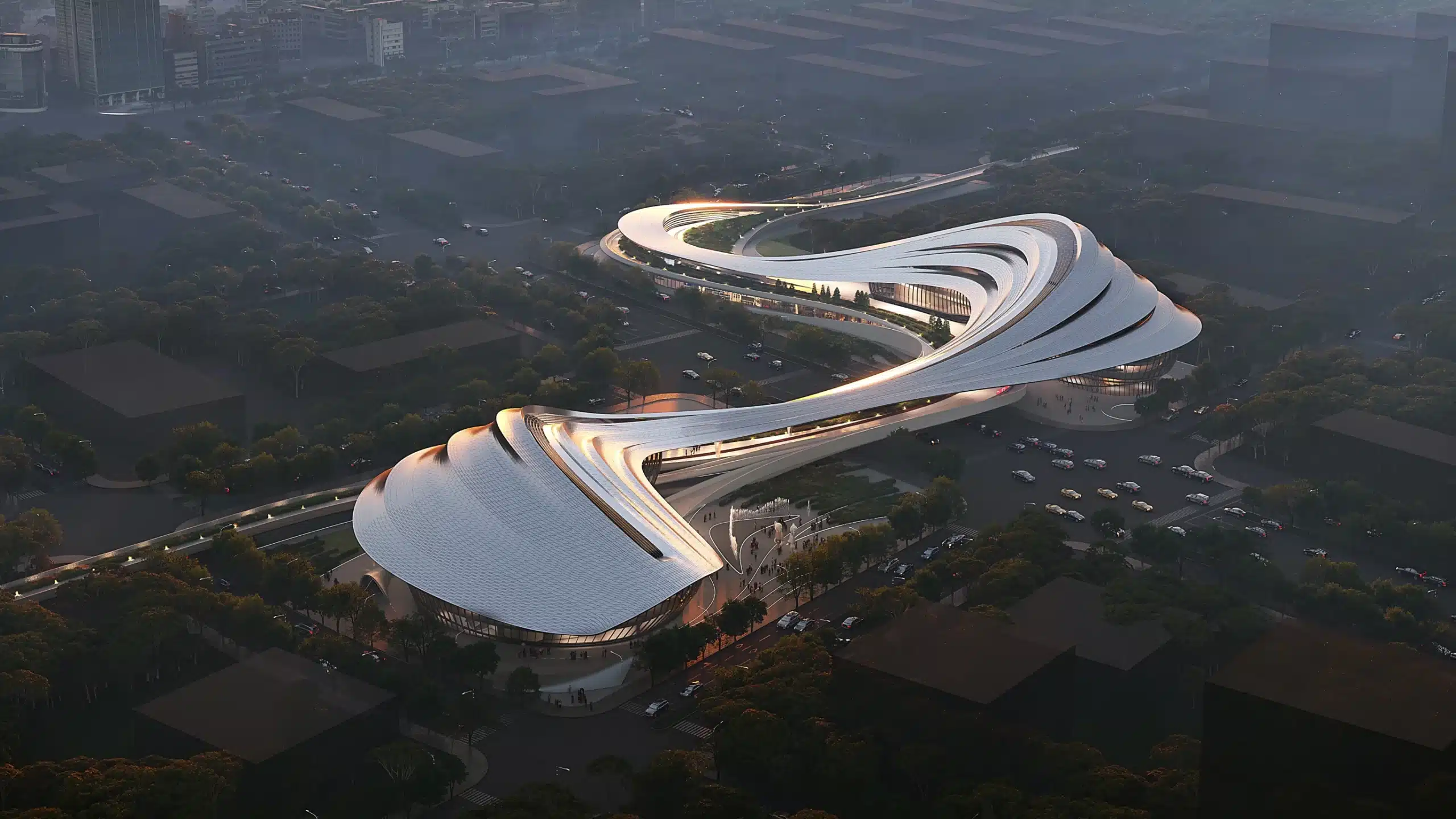
New Structural Progress at the Culture and Arts Center Transforms Movement in Jinghe

Opening paragraph
The Culture and Arts Center welcomes visitors with an experience shaped by movement and light. The building stretches as an open path that wraps around the city and reshapes its flow. The visitor enters the upper plaza through a rising walkway that links nearby districts. Large openings let natural light slip between layers of polished concrete. Hanging gardens blend with the pathways and create a smooth shift between inside and outside. Curved surfaces respond to the site and local climate. From the first steps, the visitor senses that the Culture and Arts Center is a living urban space.

1. Site and Design Concept
An elevated route that redefines how the city meets the building
The Culture and Arts Center stands between northern districts and the green landscape to the south. It rises above eight traffic lanes and turns a hard boundary into an active public link. Courtyards and bridges move around the building and create a sense of continuous flow.
The design connects the northern library with the southern cultural spaces. Open paths guide fresh air and daylight through the entire project. The building becomes a clear urban spine that supports movement across the city.

2. Visitor Experience and Internal Circulation
A journey that begins outdoors and moves through layered interiors
The visitor starts on a wide ramp that opens onto the elevated plaza. The network of paths helps people move easily between different zones. Higher walkways offer views of lower gardens and the flow of visitors.
Inside, the lighting shifts gradually from soft to bright. The passages lead to flexible halls without forcing a single direction. The space reacts to how each visitor moves. The Culture and Arts Center guides people naturally toward its central areas of display and interaction.

3. Architectural Details and Materials
Curved surfaces that capture light and express movement
The volumes curve and overlap to highlight the organic nature of the project. The building touches the ground lightly, which gives the structure a floating quality. Shadows move across the façades during the day and reveal fine surface changes.
The material palette supports the climate and strengthens the building’s connection to its surroundings. The key materials and systems include:
Materials & Technologies List
- Polished concrete – 60% of the structure for smooth, light-responsive surfaces.
- High-performance glass – 25% to improve visual transparency.
- Recycled aluminum – 10% for exterior edges and pathway cladding.
- Solar panels – 40% of roof surfaces for on-site energy.
- Rainwater harvesting – 70% of catchment zones for garden irrigation.
- Natural ventilation system shaped by solar-radiation analysis to reduce cooling demand.

4. Sustainability and Environmental Integration
Architecture shaped by climate, airflow, and natural light
The project aligns itself to capture wind and sunlight. Large openings draw air into interior spaces and reduce mechanical cooling. Lower gardens help absorb heat and create cooler outdoor pockets.
Elevated routes connect the city’s parks with surrounding neighborhoods. This path network keeps movement continuous between built and natural areas. Visitors feel that the Culture and Arts Center belongs to the landscape rather than standing apart from it.

5. Final Vision for the Project
A place where daily movement meets cultural energy
The Culture and Arts Center offers an environment where human activity blends with artistic programs. The building welcomes visitors through clear pathways and opens spaces for exploration. Some areas host social interaction, while others support quiet reflection.
The project creates a clear vision built on fluid circulation, natural light, and sensory experience. Local materials, passive ventilation, and open terraces work together to shape the atmosphere. These elements redefine how visitors connect with the city. The building becomes a dynamic point where culture, movement, and community meet.

✦ ArchUp Editorial Insight
The project presents a strong visual presence shaped by sweeping curves and elevated paths that reorganize movement across the site. Its volumes reveal a refined play between light and shadow, while suspended gardens introduce layers of depth and flexibility. The design approach seeks to create a building that acts as an extension of the city, though it occasionally leans toward formal expression rather than a fully integrated urban system. Still, the project succeeds in blending visitor movement with cultural activity, offering the city an interactive space that strengthens its connection to contemporary architecture.
Architecture professionals can follow ArchUp’s events section for verified updates on exhibitions, conferences, competitions, and results.




ArchUp Editorial Management
The article provides an exceptional poetic description of the sensory experience in the Culture and Arts Center, with a focus on the relationship between movement and space. To enhance its archival value, we would like to add the following technical and structural data:
We would like to add that:
· Structural Data: Hybrid structural system combining 35 cm thick precast concrete panels and 600×300 mm steel beams, with 5 kN/m² load capacity
· Environmental Systems: 1,200 m² of solar panels generating 280 MWh annually, with 450 m³ rainwater harvesting capacity supplying the vertical gardens
· Materials & Finishes: Self-cleaning polished concrete with 0.7 reflection coefficient, and Low-E glass with 1.2 W/m²·K thermal transmittance
· Spatial Distribution: 12,500 m² total area, with 3,200 m² exhibition spaces and 1,800 m² vertical gardens, featuring ceiling heights up to 15 meters in the main atrium
Related Link:
Please review for a comparison of contemporary organic architecture techniques:
[Circulation Engineering]
https://archup.net/physical-composition-of-crushed-stone-in-railway-tracks/