Düsseldorf Opera House Opens Its Doors with a Design Linking the City to Music and Culture

The Düsseldorf Opera House takes visitors on a sensory journey between music and architecture. The design flows seamlessly with the city and the nearby Rhine River. Upon entering the cave-like ground floor, visitors feel natural light streaming through open pathways. These paths connect public spaces with the urban surroundings. Natural materials with varying textures of stone and wood reflect the earth’s layers and the site’s history. Large openings frame views of the city. Smaller windows provide precise ventilation and shading. The tripartite roof creates dynamic visual movement. It symbolizes the unity of the three cultural institutions within. Planted terraces offer a continuous connection between interior and exterior. In this way, the building becomes more than an opera house. It is a living architectural experience, interacting with both visitors and the environment.

Visitor Journey Begins in the Heart of the City
The cave-like ground floor welcomes visitors with wide open pathways to the city. This creates a seamless entrance experience from street to building. Interior routes allow movement between the lobby, rehearsal halls, and meeting spaces. Visitors can observe musical activities from multiple angles. Each step immerses the visitor in a connection between interior and exterior. Planted terraces offer places to rest and enjoy views of the Rhine and surrounding urban landscape. The sloping roof guides the eye. It creates a sense of movement and dynamism. This enhances the visitor’s experience and makes them part of daily city life.

Harmony with the Environment and Urban Design
The design of the Düsseldorf Opera House emphasizes harmony with its surroundings through open facades and porous urban spaces that encourage public engagement. The building is divided into three asymmetrical volumes, allowing natural light to penetrate deep into the ground floor. The sloping roof aligns with neighboring buildings, lowering at junctions and rising to assert the cultural presence of the opera. Large openings frame exterior views, while smaller windows precisely control ventilation and daylight within the interior spaces.

Architectural Details and Materials
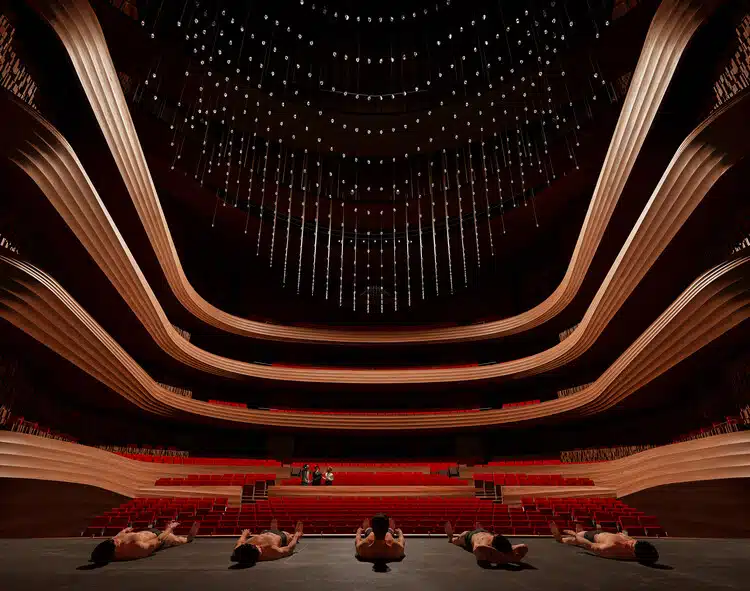
The project relies on natural and high-quality materials to reflect the geological character of the site. The variation in texture between rough and smooth surfaces creates continuous visual vitality from the ground floor to the facade. The main auditorium accommodates 1,300 visitors, featuring smoked oak paneling and red seating reminiscent of the previous opera house. The roof integrates a biosolar system with photovoltaic panels, skylights, and planted terraces with local plant species.
Summary of materials and techniques used in construction:
- Natural stone – 60% for facades with rear ventilation to reduce summer heat
- Smoked oak wood – 20% for floors and interior walls
- Large windows – 10% for open views and public spaces
- Small windows – 5% for ventilation and shading control
- Planted terraces – 5% to enhance sustainability and provide relaxation areas

A Sensory Experience from Inside to Outside
Walking through the building, visitors feel constant interaction between light, materials, and open spaces. The design allows viewing activities from multiple levels while maintaining privacy in the music halls. Planted terraces and open pathways enhance circulation, creating visual and physical stopping points that immerse visitors in the Düsseldorf Opera House experience. Every corner tells the story of how architecture and music converge in a culturally vibrant space.
Sustainability and Integration with Nature
The building demonstrates sustainability through the integration of solar panels on the roof and planted terraces with native species, helping to regulate temperature, improve air quality, and support biodiversity. Natural light penetrates deep into interior spaces, reducing the need for artificial lighting. The integration of exterior and interior spaces strengthens the dialogue between the building and the city, transforming the opera house into an active and engaging cultural arena.
A Comprehensive Cultural Vision
The Düsseldorf Opera House exemplifies contemporary cultural design, with interior and exterior spaces seamlessly interacting with visitors. The building connects music, architecture, and daily life while showcasing a distinct architectural identity through the sloping roof, large openings, and planted terraces. The opera house becomes more than a performance venue; it is a fully immersive architectural experience, allowing visitors to engage with culture, art, and music in a harmonized urban environment.
ArchUp continuously documents leading architecture exhibitions and conferences, offering verified coverage of international competitions and official results within an open-access database.
✦ ArchUp Editorial Insight
The Düsseldorf Opera House features a visually dynamic design, combining the tripartite roof and open pathways to create a continuous sense of movement and fluidity. Natural materials, such as stone and smoked oak, reflect the earth’s layers and provide a warm contrast to sunlight filtering through large openings. Critically, visitors might face some challenges navigating the multiple spaces, yet the asymmetrical volumes introduce an innovative architectural dimension that enhances interaction between the three cultural institutions. Overall, the project successfully delivers a comprehensive cultural experience, linking music, architecture, and daily urban life.