
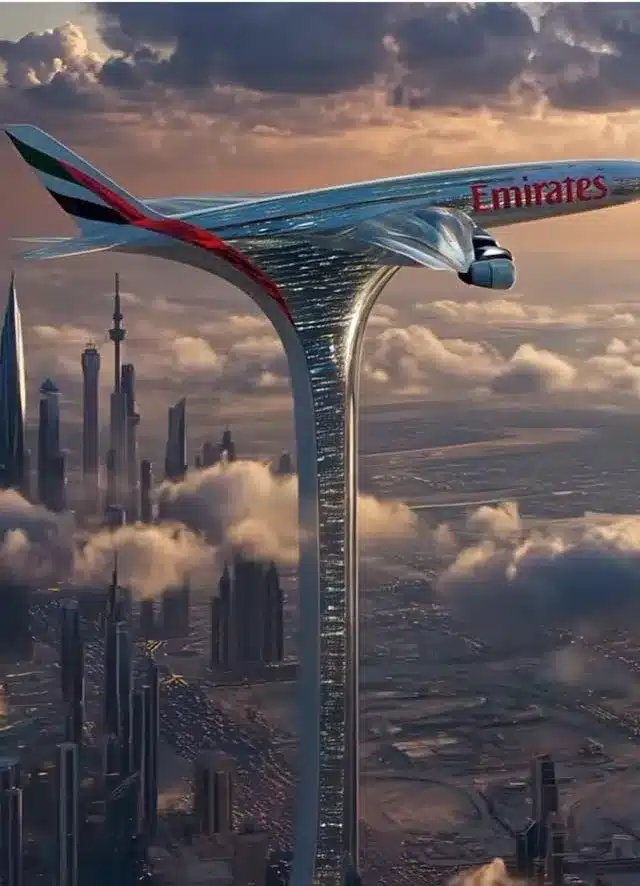
Proposed 580 Meter Emirates Air Hotel in Dubai: Aviation Themed Skyscraper Sparks Debate

Plans for a 580 meter hospitality tower in Dubai dubbed the Emirates Air Hotel have emerged. The concept features a static Airbus A380 mounted atop a 125 floor structure. This proposal centers on experiential architecture, not conventional hotel use. The Emirates Air Hotel keyword appears repeatedly in early materials as both brand and typology, though municipal approval remains unconfirmed.

Design Concept
The tower’s defining element is a decommissioned A380 fixed at its summit. It would host a sky bar, a restaurant in the cockpit, and glass bottom walkways on the wings. Elevators would connect upper suites to the aircraft interior. The design blends entertainment, hospitality, and aviation symbolism. Such hybrid forms resemble themed resorts more than urban buildings. Similar experiments appear in the archive, though rarely at this scale.

Materials & Construction
No detailed engineering plans are public. Yet mounting a 560 ton aircraft above 500 meters implies heavy use of high-strength building materials, like reinforced concrete and structural steel. Core drilling for utilities through such a complex mass poses major challenges. These issues echo concerns raised in studies of high rise construction. Aerodynamic testing would be essential to manage wind loads on the wings.

Sustainability
No energy models, water-recycling systems, or sustainability certifications have been disclosed. The focus on ultra luxury seven single floor suites, three high end restaurants, a sky pool diverts from global efficiency norms. Dubai’s desert climate makes the aircraft’s aluminum shell and extensive glazing thermally problematic. This contrasts sharply with principles promoted in sustainability frameworks.

Urban Impact
If built, the Emirates Air Hotel would extend Dubai’s pattern of spectacle driven cities development. Yet its program offers minimal public access beyond paid observation decks. Unlike inclusive models from recent design competition entries, this originates from private developers without civic input. No demolition plans or phased timelines have been released.
Does architecture shaped by branding enhance urban life or simply replicate outdated models of vertical tourism?
Architectural Snapshot: A 580 meter Dubai hotel concept integrates a static Airbus A380 at its apex, merging aviation aesthetics with high-rise hospitality in an unverified $3 billion proposal.
ArchUp Editorial Insight
The Emirates Air Hotel proposal exemplifies Dubai’s enduring obsession with branded vertical spectacles. While marketed as a hospitality innovation, its reliance on a static A380 as a luxury gimmick reveals a deeper architectural void form dictated by corporate iconography rather than spatial intelligence. The narrative leans heavily on experiential buzzwords, masking unresolved engineering and environmental questions. Yet credit is due for confronting the limits of structural audacity in an era of diminishing returns on height. If such projects persist without urban reciprocity, they risk becoming obsolete curiosities in tomorrow’s more critical architectural archive.




⚠️ Editorial Warning:
This content reads as promotional and speculative, offering little to no analytical or architectural value. The project is not built, lacks verified sources, and the writing strongly suggests AI-generated or reassembled material without critical framing. We caution the editorial team against publishing similar content, as it does not align with ArchUp’s editorial mission. At best, it may be discussed as a conceptual or superficial design idea, not as serious architectural coverage.
🔴 Editorial Warning:
The ✦ ArchUp Editorial Insight section presented here does not meet the required ArchUp editorial standards, nor does it display the approved icon and symbol. Presenting the analytical insight without its corresponding icon is a clear violation, as this formatting is a fundamental part of ArchUp’s editorial identity and must be strictly adhered to in all articles without exception.