
Forest Architecture: Rethinking the Relationship Between Humans and Nature

Cyclists’ Rest Station: A Balance Between Architecture and Nature
This rest station offers a unique experience for cyclists, providing a space to pause and unwind amidst the local forest. The café and floating pavilions serve more than just a functional purpose, they form a bridge between humans and nature through thoughtful architectural design.
Floating Pavilions: Integrating Art with the Environment
The floating pavilions represent an innovative architectural intervention within the forest. They consist of small public structures designed to allow visitors to engage with the surrounding natural environment. By blending architecture, art, and nature, these structures offer a place for contemplation and relaxation away from the hustle and bustle of daily life.
Environmental and Architectural Impact
The design reflects respect for the local forest, aiming to integrate humans into the environment without imposing intrusive elements. This architectural experience encourages visitors to reconsider the relationship between human activities and natural spaces, emphasizing the importance of harmony between architecture, art, and the environment.


Transforming the Forest into an Innovative Rest Station
Nestled within the dense forest near the village of Guoqian, close to Xiangang Reservoir on Luofu Mountain in Huizhou, this project stands out as a remarkable architectural transformation. It replaces two old public toilets, responding to the growing needs of cyclists in the area.
A Design Balancing Comfort and Nature
The site has been reimagined as more than just a stopping point. The design includes a small café for revitalization, restroom facilities to meet essential needs, and spaces that allow visitors to recharge and regain energy. Through this approach, the project demonstrates a deep understanding of how to harmoniously integrate human functions with the natural environment.
Enhancing the Visitor Experience
The design contributes to a holistic experience for cyclists, offering a place to relax and contemplate amidst nature, away from the bustle of daily life, thereby strengthening the connection between humans and their surrounding environment.

Floating Pavilions: A Lightweight Design Harmonizing with the Forest
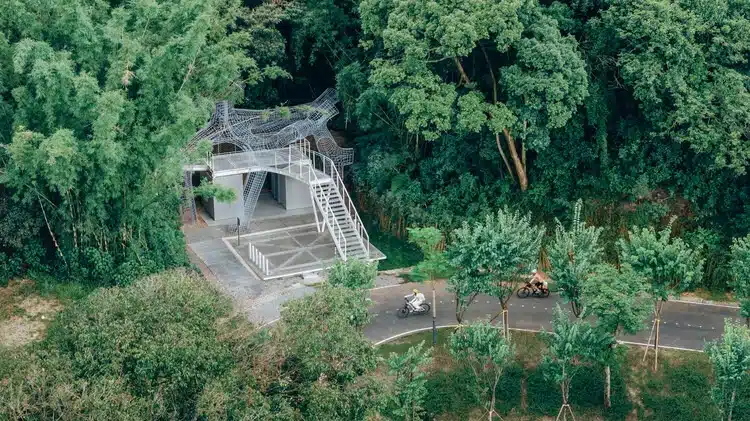
The forest features seven semi-transparent pavilions that appear to float gently among the trees. These pavilions are made of PTFE/Ferrari membranes stretched over steel structures, suspended at varying heights and angles, forming a lightweight artificial layer above the forest floor. In this way, the pavilions provide shelter for visitors while reflecting the layered rhythms of the forest, creating a constantly changing experience of light, shadow, and space.
Connected Walkways and a Cohesive Experience
A steel lattice walkway extends between the trees and beneath the pavilions, linking the café area with the essential facilities. This walkway does more than just connect spaces, it guides movement through the forest in a smooth and natural manner, enhancing the overall visitor experience.
Observation Deck and Scenic Views
At the end of the walkway, an observation deck offers expansive views of the reservoir, extending the experience from a purely functional stop to full immersion in the landscape. This design allows visitors to combine rest, activity, and visual contemplation, deepening their connection with the forest and the surrounding site.

Flexible and Sustainable Infrastructure
The café was constructed using the “Plugin House” system developed by People’s Architecture Office, coupled with prefabricated restroom units. These elements combine flexibility and efficiency, allowing for rapid installation and seamless integration into the surrounding environment without disrupting nature.
Comprehensive Facilities for Cyclists
The station provides cyclists with a range of essential amenities, including rest areas, refreshments, restroom facilities, and basic repair services. This design balances the practical needs of visitors with a low environmental footprint, reinforcing the concepts of sustainability and integration with the forest.
Integrating Environment into Design
The architectural approach focuses on harmony between humans and nature. By relying on prefabricated units and lightweight materials, the project allows visitors to enjoy the facilities without harming the natural surroundings, making the station an exemplary model of sustainable and environmentally responsive design.


Art in Harmony with Infrastructure
Above the restrooms, artist Xu Ziwei’s work, “Forest Woven with Light”, interacts with the surrounding pavilion structures. This artwork is made of woven materials that respond to changing light, creating dynamic visual effects throughout the day.
Creating an Unexpected Poetic Atmosphere
The piece adds an unexpected aesthetic dimension, transforming the area into a poetic and atmospheric space. This interplay between art and functional structures blurs the boundaries between infrastructure and public art, offering visitors a unique experience that combines utility with beauty.
Enhancing the Visitor Experience
By integrating art into the infrastructure, the project goes beyond providing basic services, it also creates moments of contemplation and inspiration, highlighting the creative potential of designing public spaces within nature.


An Integrated Environmental Approach
The project employs a dual wastewater treatment system, comprising an underground purification tank and an open-air sedimentation pond. This system reflects a clear environmental commitment, directly contributing to the protection of Xiangang Reservoir’s water quality and ensuring the sustainability of natural resources.
Balancing Humans and Nature
This closed-loop methodology demonstrates a delicate balance between human presence and surrounding natural systems. By integrating infrastructure technologies with the landscape, the project enables sustainable use of resources while preserving environmental integrity and biodiversity.
Promoting Environmental Awareness
The design also underscores the importance of environmental thinking in contemporary architectural projects, highlighting that incorporating sustainable solutions can be part of the daily visitor experience without compromising comfort or aesthetics.

Architecture as a Dialogue with Nature
By replacing outdated infrastructure with a sensitive, spatially rich design, the floating forest pavilions become more than just a stopping point. This approach reflects architecture’s ability to create experiences that go beyond basic functions, becoming an integral part of the natural environment itself.
An Invitation to Contemplation and Interaction
The design allows visitors, cyclists and walkers alike, to engage in a quiet dialogue between architecture and the forest. Through these spaces, the project encourages a reconsideration of the human-nature relationship, providing moments of reflection and relaxation away from the bustle of daily life.


✦ ArchUp Editorial Insight
The Floating Forest Pavilions project can be seen as a tangible attempt to explore the relationship between architecture and nature, offering a comfortable and integrated space for cyclists while taking into account essential environmental considerations. The use of floating pavilions and connected walkways adds an experimental dimension to interaction with the environment, allowing visitors to experience a rest stop that goes beyond the traditional functions of infrastructure.
However, some potential reservations can be noted in this type of design. While the pavilions are lightweight and transparent, the long-term impact of infrastructure on the forest and surrounding ecosystem may require ongoing evaluation, particularly regarding material maintenance and continuous human interaction. Additionally, reliance on prefabricated units may limit design flexibility and future expansion on the site.
From a broader architectural perspective, the project can serve as an experimental basis for studying the integration of infrastructure with the natural environment. At the same time, it highlights the need for sustainable maintenance strategies and integrated natural resource management. Consequently, designers and researchers can benefit from it as a case study to understand the challenges of incorporating temporary or semi-permanent architecture into forests, balancing human comfort with the preservation of the surrounding environment.
Prepared by the ArchUp Editorial Team
Don’t miss the chance to explore more from Architecture, Archive, and Buildings on the ArchUp website.


