

Hanoi Launches First Two Metro Lines as Part of Ambitious Urban Transformation Plan

Vietnam’s capital, Hanoi, is set to begin construction on the first two lines of its long-awaited metro network in the final quarter of 2025. This step marks the initial phase of a broader plan to establish 14 metro lines by 2030. The aim is to reduce the city’s overwhelming dependence on motorcycles and promote the use of safe, reliable public transportation.
From the City’s Edge to Its Heart: First Line Breaks Ground in October
Construction on the first line will kick off in October. It stretches 11.5 kilometers from Nam Thang Long in northern Hanoi to Tran Hung Dao in the northeast.
The route includes:
- 8.9 kilometers underground
- 2.6 kilometers elevated
The line will feature 10 stations in total — seven underground and three elevated. It has a projected cost of $1.4 billion.

The Longest Metro Line to Begin in December
A second line, the longest in Hanoi’s future network, will follow in December. Spanning 38 kilometers, it will connect Van Cao in the city center to Hoa Lac on the western outskirts.
The alignment consists of:
- 30 kilometers at ground level
- 6 kilometers underground
- 2 kilometers elevated
This line will include 21 stations — six underground and 15 at-grade. It has a total estimated cost of $2.4 billion.
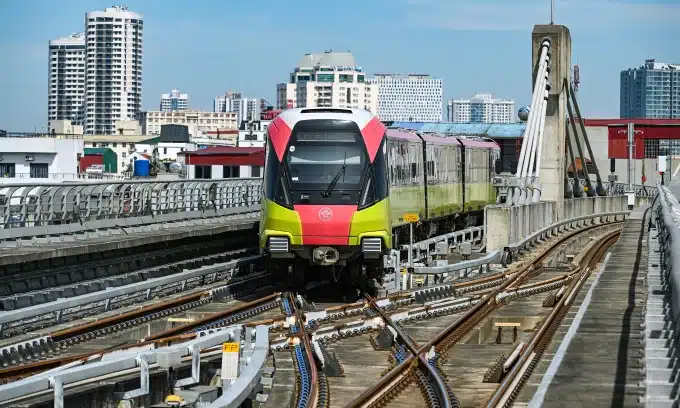
A Renewed Push to Limit Motorcycle Use
For years, Hanoi has struggled with traffic congestion and pollution caused by its heavy reliance on motorcycles. In response, the Vietnamese government announced a comprehensive transport plan in December 2024. This plan envisions 14 metro lines covering over 550 kilometers, alongside seven major roadway upgrades.
These efforts support a 2017 municipal resolution that aims to restrict motorcycle use in urban districts by 2030.
However, implementation has been slow. Authorities point to low public transport adoption as a key obstacle. Studies indicate that reducing motorcycle use will only be feasible once public transit usage reaches 30–50%. Current figures remain below 20%.

ArchUp Tracks Hanoi’s Urban Shift
As Hanoi advances its metro infrastructure, the city is redefining its urban identity toward a more connected and sustainable future.
ArchUp continues to monitor and document this transformation through its expanding archive. The focus is on construction, urban projects, and the evolution of cities worldwide.
From architecture to mobility design, our platform provides in-depth insight. We explore the developments shaping tomorrow’s urban landscapes.


