

Installation of 27-Meter Pharaonic Statue at the Entrance of the Grand Egyptian Museum

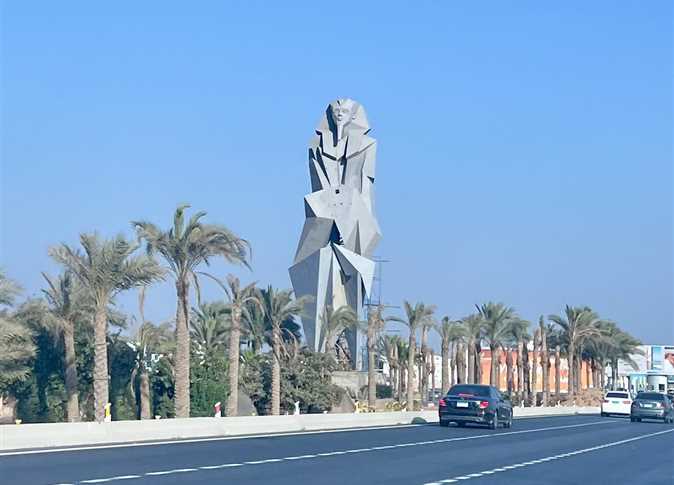
A 27.5-meter-tall pharaonic statue, including its four-meter-high base, has been installed at the entrance of the Grand Egyptian Museum along the Cairo-Alexandia Desert Road. This installation marks one of the final stages of preparations ahead of the museum’s opening.
Architectural Design and Symbolism
The statue was designed by Professor of Sculpture at Minia University. It does not depict a specific pharaoh but reflects the general characteristics of ancient Egyptian art.
The design blends traditional Egyptian heritage with contemporary sculptural techniques, incorporating three interlaced pyramid-like structures to form the final composition. This approach demonstrates a careful architectural understanding of Egyptian symbolism.
Materials and Construction Techniques
The statue is entirely constructed from treated iron, ensuring durability against environmental factors while preserving the precision of the design details.
The layout also considers the interaction of light and shadow across the surface. This creates a three-dimensional effect that enhances the architectural details when viewed from different angles.

Location and Spatial Impact
Situated strategically along the Desert Road, the statue serves as a prominent visual landmark for visitors approaching the museum. It establishes a clear architectural marker, linking the modern urban environment of the museum with the historical motifs of ancient Egyptian architecture.
The design carefully considers lines of sight and proportional distances. This allows observers to appreciate the details both from afar and up close.

Current Project Phase
The statue installation represents the final stage of construction after nearly two years of work. It contributes a significant architectural presence to the museum surroundings, highlighting the integration of heritage architecture with contemporary artistic interpretation.
✦ ArchUp Editorial Insight (English)
This article examines the pharaonic statue at the Grand Egyptian Museum entrance as an architectural study of heritage and modern integration. The statue, reaching 27.5 meters, constructed from treated iron, and featuring three interlaced pyramidal forms, emphasizes ancient Egyptian motifs and the play of light and shadow across its surfaces. However, despite its visual impact, questions arise regarding the depth of the spatial experience for visitors relative to the museum’s interior spaces. In addition, it is uncertain whether the statue fully communicates Egyptian architectural identity. Nonetheless, the installation provides a clear visual landmark, enhancing the connection between traditional architecture and contemporary sculptural expression.
Explore the Latest Architecture Exhibitions & Conferences
ArchUp offers daily updates on top global architectural exhibitions, design conferences, and professional art and design forums.
Follow key architecture competitions, check official results, and stay informed through the latest architectural news worldwide.
ArchUp is your encyclopedic hub for discovering events and design-driven opportunities across the globe.


