Kinderspace Competition Celebrates Designs Inspired by Nature and Imagination

The Kinderspace competition has revealed a set of innovative visions, including a new glass tower, that redefined early childhood learning environments. Moving away from the conventional classroom model, the proposals explored designs that weave deeper connections with nature while opening space for imagination and creativity. The structural design of the new glass tower exemplifies a modern approach to educational architecture.

Nest – Gabriola Island, Canada
The Nest project draws inspiration from the idea of a bird’s nest, with a gently curved structure that follows the island’s natural contours and gradually opens toward the surrounding forest. Learning areas are organized in sequence, from enclosed spaces for younger children to more open settings that foster independence. The integration of gardens, timber walkways, and open thresholds allows fluid movement between inside and outside, while the use of wood and natural daylighting ensures strong environmental performance. However, unlike the new glass tower, the Nest blends with its surroundings through organic forms rather than transparent façades.
Outside-In – Brussels
Outside-In was conceived as a bridge between the city and nature, creating an architectural framework that immerses children in their environment. The design eliminates traditional corridors, instead offering flexible transitional spaces that shift with the seasons. Classrooms open outward, softening the boundary between indoors and outdoors, similar in intent to the new glass tower concept which blurs distinctions between interior and exterior through transparency.

Playful Past – Adaptive Reuse of an Industrial Site
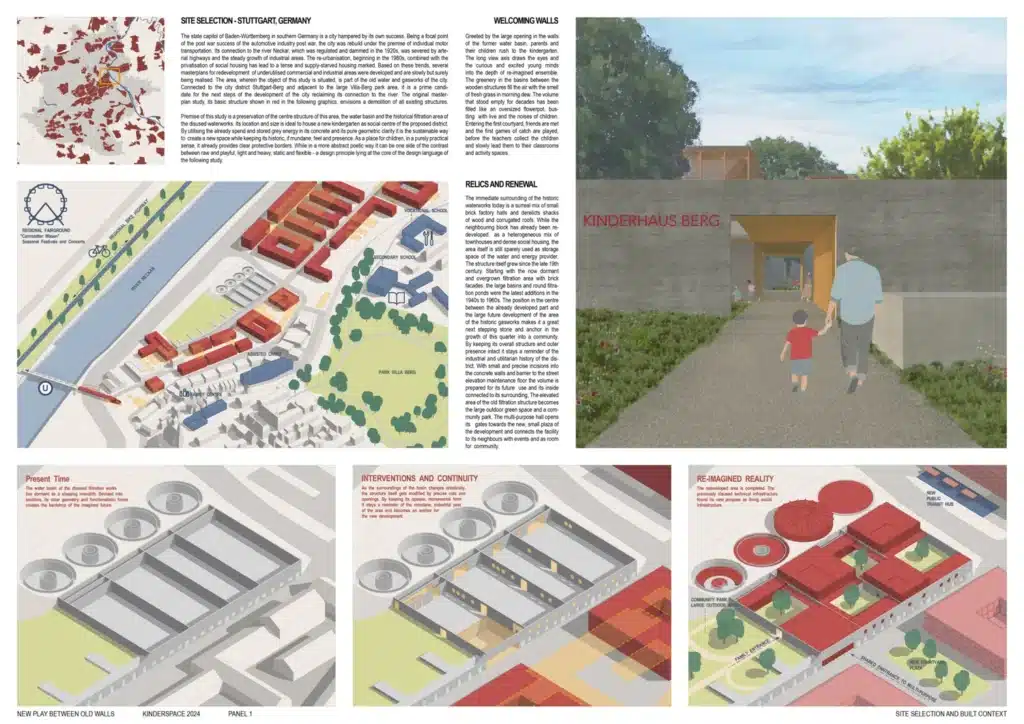
Playful Past transformed a former industrial site into a vibrant learning campus. The project emphasized adaptive reuse, retaining the existing structural framework while introducing contemporary elements inspired by village and cottage typologies. Through this approach, the industrial memory of the site is reimagined as a child-centered environment that blends storytelling, play, and landscape. In contrast, the new glass tower seeks to establish a groundbreaking educational experience through modern materiality and design.

Brick Bond – Timișoara
The Brick Bond project drew from the local tradition of brick-built neighborhoods to shape a modern educational and community hub. The design incorporates familiar features such as gabled roofs and perforated masonry, organized around a central street that links the kindergarten to multipurpose halls and outdoor gathering areas. The architectural expression reflects an everyday connection with its urban surroundings but takes a different approach than the new glass tower’s sleek and transparent design.
Growing Confident – California
Growing Confident proposed a learning environment that grows with the landscape instead of enclosing itself within strict boundaries. The classrooms extend outward as branching wings, connected by communal areas that encourage interaction across different age groups. The design references local Craftsman architecture through its choice of materials, while the site plan reflects California’s regional plant biomes, reinforcing ecological awareness within the learning experience.
✦ ArchUp Editorial Insight
The article showcases educational designs that redefine children’s relationship with nature through flexible and layered spatial concepts. The visuals highlight timber use, curved forms, and gradual openings to surrounding landscapes, creating immersive learning atmospheres. However, some proposals appear more visually appealing than contextually grounded, raising questions about long-term adaptability in diverse settings. One such example is the new glass tower, which, despite its striking appearance, must prove its environmental integration in varying climates. While this may limit their immediate applicability, the projects’ strength lies in merging natural environments with architectural form, offering a valuable direction for developing educational design strategies rooted in environmental awareness.
Explore the Latest Architecture Exhibitions & Conferences
ArchUp offers daily updates on top global architectural exhibitions, design conferences, and professional art and design forums.
Follow key architecture competitions, check official results, and stay informed through the latest architectural news worldwide.
ArchUp is your encyclopedic hub for discovering events and design-driven opportunities across the globe.