Hospitality as a Showcase: A Design Analysis of the Lagrasse Guest House Experience

Design as a Narrative Tool: How Does a Trash Can Enter the Museum of Modern Art?
In 2009, a simple design, a pedal trash can, was added to the permanent collection of the Museum of Modern Art (MoMA) in New York. This rare event highlights the profound impact of industrial design on the visual arts. Remarkably, the product’s inclusion wasn’t solely due to its form or function, but also thanks to a smart marketing strategy that reimagined the product beyond its daily utility.
From Exhibitions to Living Experiences: The Shift to Hospitality Models
Beginning in 2015, a new direction emerged in the world of industrial design: moving away from traditional product displays toward integrating them into real-life experiences. This concept took shape as bookable “guest houses,” designed to offer visitors a genuine, day-to-day experience of living among the curated objects. This approach not only promotes the products but also reflects the broader philosophy behind the design itself.
Diverse Settings, Deepened Experiences
The locations of these guest houses were carefully chosen, each serving a distinct purpose in showcasing different facets of industrial design. For example:
- An old pencil factory built in Bauhaus style in Denmark.
- A traditional 19th-century wooden cottage in Latvia.
Each location is more than just a backdrop, it plays an integral role in the experience, allowing design to interact organically with the surrounding architectural and natural context.
Latest Stop: A 14th-Century House in Southern France
The latest addition to this project highlights the twelfth guest house, located in a 14th-century home in the village of Lagrasse, in southern France. This site brings a rich historical dimension to the experience, blending contemporary design with centuries-old architecture.
A Restoration that Respects the Past and Speaks to the Present
Located in the French village of Lagrasse, the house dates back to the 1350s. During its restoration, strict heritage preservation guidelines were followed, allowing the original Gothic character of its exterior façade to remain intact.
But while the outside remains loyal to its history, the interior design team chose to offer a fresh reinterpretation of the space from within.
Interior Design: A Balance Between Authenticity and Rebellion
Interior designer Julie Cloos Mølsgaard was tasked with redefining the home’s internal spaces. She described the result as a charming rebellion against traditional expectations. Rather than mimicking the past literally, Julie sought to integrate contemporary elements that reflect the soul of the place from a new perspective.
Material Philosophy: A Silent Design Language
The interior design relied on a carefully curated palette of materials, selected to enhance the sense of authenticity without falling into excessive ornamentation. These included:
- Wood: to create visual warmth and link past with present.
- Stainless steel: to add a balanced modern touch.
- Marble: as a luxurious element suggesting permanence and elegance.
- Plastered walls: evoking the feel of natural textures.
- Pebble flooring: a nod to the surrounding village landscape.
Julie remarks:
“The idea was to create a home that uses the site’s history as a foundation for its design.”


Visual Cues That Connect the Interior and Exterior
On the ground floor, a coarse pebble floor was used, not merely a design choice, but a conscious homage to the village’s cobblestone streets. It gives the interior a visual continuity with the surrounding environment.
Meanwhile, the warm-toned white walls were inspired by the stone of the nearby Lagrasse Abbey, reinforcing the connection between the interior design and the region’s historical landmarks.
Sculpture as Architecture: Function Meets Aesthetic
One of the most striking features is the sculptural staircase, crafted by local artisan Alejandro Berconsky.
Beyond simply connecting the floors, it is viewed as an integrated art piece that pays tribute to the region’s traditional craftsmanship. This blending of function and beauty offers a vivid example of how design can honor local culture without merely replicating it on the surface.
The Kitchen: The Beating Heart of the Experience
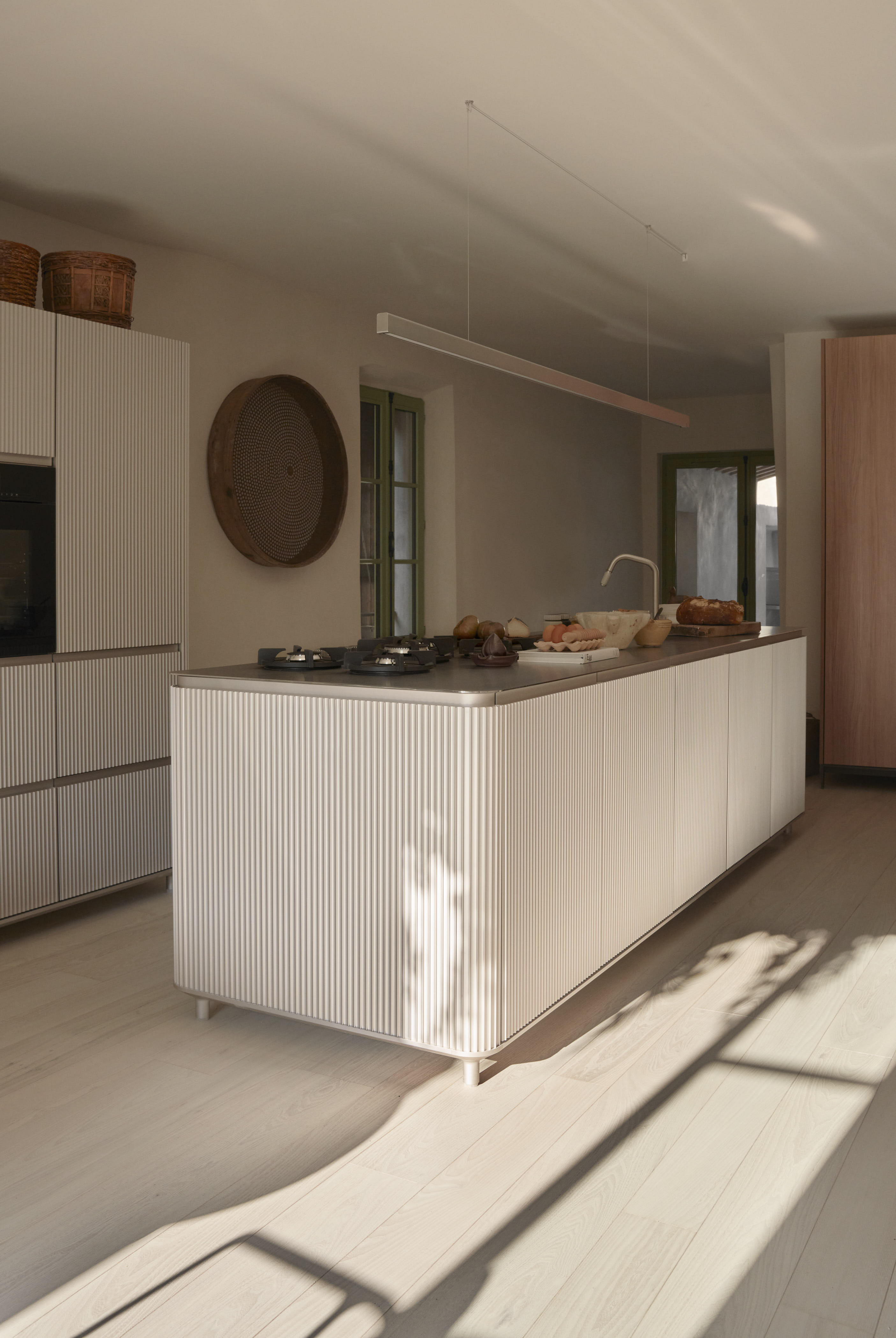
Moving up to the second floor, visitors arrive at the kitchen and dining area, spaces where the design philosophy merges utility with history. Key pieces include:
- The V3 kitchen island, with a minimalist and functional design.
- The Cabin round table, which encourages social interaction.
- The Swivel chair, in a special edition upholstered with fabric by Pierre Frey, featuring a pattern inspired by a medieval coat of arms, subtly nodding to the home’s historical roots.
Imagining Daily Life Within the Design
From the moment she entered the house, designer Julie Mølsgaard envisioned the space as a central gathering point within the home.
She shares:
“I imagine guests bringing fresh produce from the village square to the kitchen to prepare it, then heading out to the terrace for a meal.”
This vision goes beyond the visual identity of the place, it offers a full narrative of daily living, where design becomes the backdrop for a simple yet detail-rich experience.

The Bedroom: Redefining Traditional Use of Space
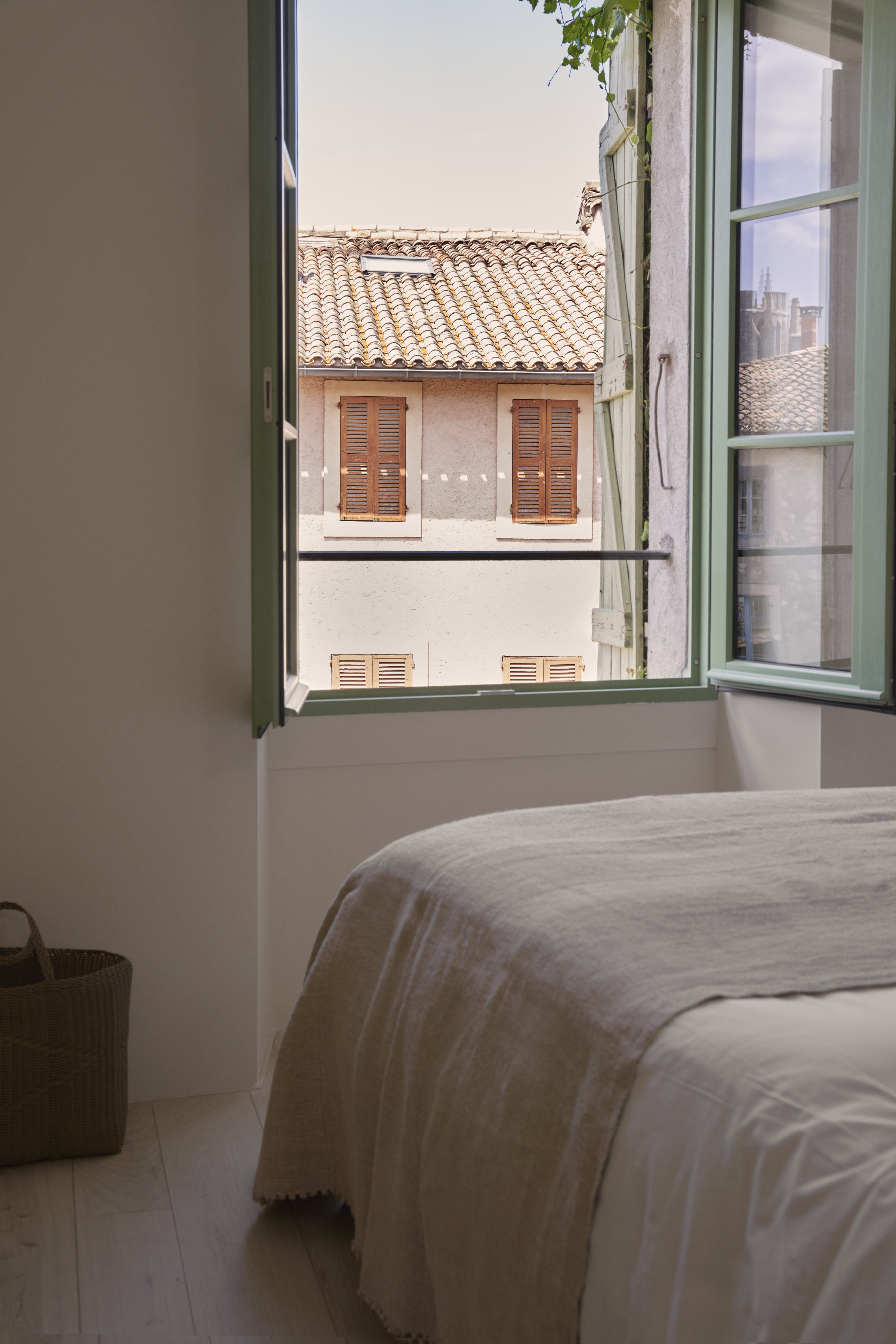
On the third floor, the master bedroom stands out as a blend of relaxation and boldness. This is most evident in the presence of a large, freestanding shower crafted from locally sourced red marble. It serves as a visual focal point, adding a distinct and unconventional character to the space.
A rectangular window offers panoramic views over the village of Lagrasse, connecting the interior with the surrounding landscape and creating a sense of openness and serenity.
An Integrated Personal Care Suite
The suite also includes:
- A Vipp shower unit
- A functional wash station
- An additional Cabin table, adding a layer of multifunctionality
This configuration reinforces the idea that the bathroom and bedroom are not just spaces for rest, but versatile zones adaptable to different lifestyles.
Breaking the Rules of Conventional Design
A particularly striking choice on this floor is the placement of a dining table within the bedroom, a decision that defies convention.
But as designer Julie Mølsgaard explains:
“Placing a dining table in the bedroom may seem unusual, but here it feels natural, the space invites you to live differently.”
This kind of design decision opens the door to new interpretations of how space can be used. The table might serve as:
- A vanity
- A workspace
- Or a cozy spot to enjoy a quiet snack at night
The message is clear: function isn’t fixed, it adapts to the context and to the person.

An Experience Beyond Observation: When Design Becomes a Way of Life
This guest house is not presented merely as a place to stay, but as a living model that embodies an architectural and experiential philosophy, one that aims to blur the boundaries between showroom and living space.
Rather than showcasing products in isolation, they are integrated into the rhythm of everyday life, allowing visitors to live the design and experience it firsthand, in all its sensory and practical dimensions.
In this way, design is no longer something to be observed from a distance, it becomes a tangible experience, one that is practiced and felt. It redefines the relationship between human and space, and between product and its context.
✦ ArchUp Editorial Insight
The guest house experience in Lagrasse undoubtedly presents an advanced model of design as a way of life rather than a mere display. It represents a significant evolution in how people interact with designed spaces, successfully transforming the product from a standalone object into part of an integrated living scenario.
The sensory approach, the attention to materials, and the openness to redefining function are all elements that play in favor of the project.
However, critical questions arise about how realistic this experience is beyond its idealized setting. Can this kind of design, requiring substantial resources and high-level coordination, be applied more broadly in everyday life? And is there a risk that the experience becomes so aesthetically refined that it loses touch with ordinary, spontaneous human use?
Moreover, presenting design within a luxury hospitality framework might limit the experience to a select group of users, restricting its accessibility and real-world interaction with local communities or wider audiences.
In the end, this project opens an important dialogue about the relationship between architecture and daily experience. It invites us to rethink the way we engage with the objects and spaces around us.
Must design always be luxurious and “display-ready”?
Or should it leave room for chaos, for the unexpected, for the unplanned human touch?
Prepared by the ArchUp Editorial Team
Don’t miss the chance to explore more from Design, Architecture, and Projects on the ArchUp website.