

Liu Jiakun and the 2025 Pritzker Prize: How Architecture Reflects Human Destiny and Inspires Healing

Architecture and Human Destiny: An Indissoluble Connection
“Architecture is closely intertwined with the destiny of humanity – it will evolve and renew itself, as it always has. As long as humanity does not perish, architecture will not either.”
With these emotional words, Chinese architect Liu Jiakun concluded his speech during the 2025 Pritzker Architecture Prize ceremony. This statement reflects a deep belief that architecture is not just a profession but a mirror reflecting the evolution of humankind and its interaction with its environment through time.
The Ceremony and Its Symbolic Location
This year’s celebration took place on the presidential steps of the “Jan Nomm” site, an exceptional occasion that marks only the second time the event has been held in the Middle East, following the ceremony that honored architect Rem Koolhaas in 2000 at the Jerusalem Archaeological Garden. Previous versions of the event were held in cities such as Chicago and Athens, and during impactful historical periods, such as the peak of the COVID-19 pandemic.
Liu Jiakun: A New Voice from China
Liu, who resides in Chengdu, Sichuan Province, is the second Chinese architect to win this prestigious award, after Wang Shu, who received it in 2012. In an interview earlier this year, Liu discussed various aspects of his architectural philosophy, ranging from the influence of literature to the importance of collective memory in shaping architectural designs.
It is worth noting that Sichuan Province, as Liu pointed out, is famous for its “giant pandas, spicy food, as well as its tolerant lifestyle and open culture.”
Prominent Attendees of the Evening
The ceremony gathered a select group of the most prominent names in architecture, including architects who had previously won the prize, such as:
- Anne Lacaton and Jean-Philippe Vassal (2021)
- Alejandro Aravena (2016)
- Kazuyo Sejima (2010)
- Jean Nouvel (2008)
The event also attracted significant attention from a number of distinguished personalities, including princes from the United Arab Emirates, a number of ambassadors, senior officials, and the 2025 Pritzker Prize jury, which included names like:
Barry Bergdahl, Deborah Burke, André Correa do Lago, Hashem Serks, Lacaton, and Sejima.

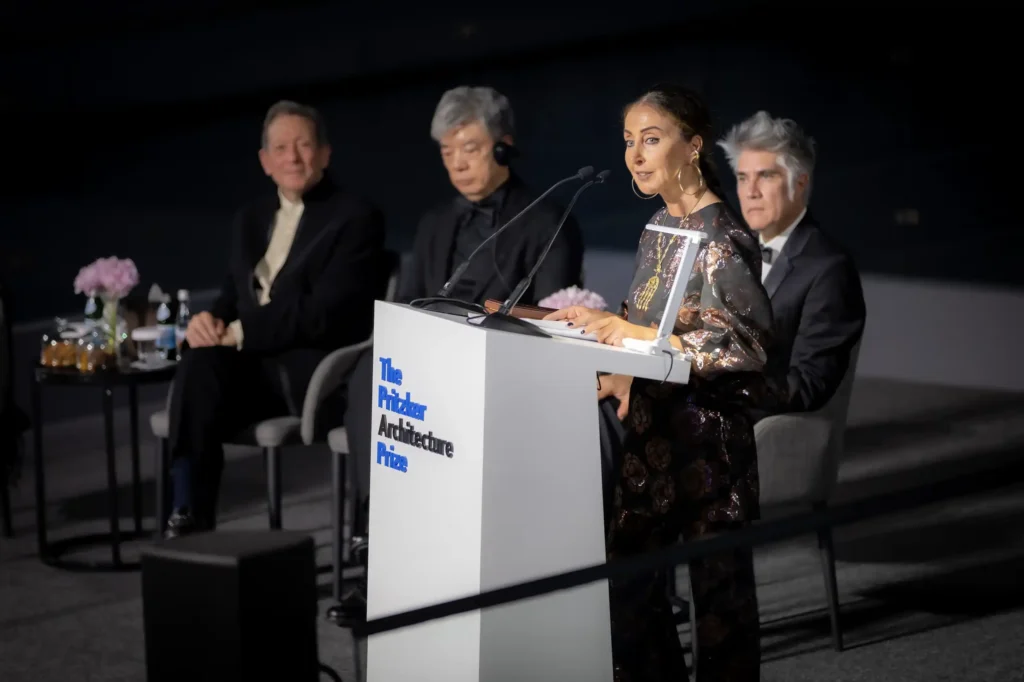
Moment of Gratitude: Beginning with Appreciation of Human Connections
Chinese architect Liu Jiakun began his speech with words of appreciation and gratitude directed toward the closest people in his life. He thanked his friends, family, colleagues, clients, and the jury for awarding him the honor of the Pritzker Prize. In a spontaneous moment reflecting his friendly nature, he even mentioned his three cats, who reside in his studio.
The Impact of the Award: A Mixture of Amazement and Healing
Liu humorously shared that he had been suffering from a headache when he received the call informing him of his victory, but the pain disappeared instantly upon hearing the news. He humorously concluded the moment:
“Clearly, architectural awards have a magical healing effect on architects – buildings are supposed to have the same effect on their users.”
This simple statement implicitly carries the vision that good architecture is not only about form but also emotionally and psychologically impacts people.
Reflection on Deeper Concepts: Spirituality, Traditions, and Style
Throughout his speech, Liu touched on profound themes, including spirituality, connections with local traditions, the relationship with nature, and architectural style. He described “style” as:
“A double-edged sword: it’s helpful to acknowledge it, but it can turn into a constraint that stifles creativity.”
This view reflects an advanced critical awareness, rejecting the trap of ready-made formulas, and calling for a search for the essence of architecture, not just its appearance.
Architecture as an Internal Refuge
Liu concluded his speech with a moving sentence that reflects his personal journey with the profession:
“On some sleepless nights, I realize how lucky I am to have participated in the field of architecture and how close I was to giving it up.
When I wondered what it could offer me, it had already given me something of a return. And when I asked myself what I could offer it, I discovered that I had gained so much more.
At times, it helped me overcome the feeling of nothingness.”
His words perfectly summarize how art can be a psychological refuge and a field for both giving and healing simultaneously.


