
Ibraaz: Living Architecture Shaped by Time and Social Interaction

The Design as a Living, Evolving Concept
This space was designed by architect and artistic director Sumayya Wali from Counterspace, a globally recognized studio known for redefining cultural typologies through concepts linked to community, memory, and daily rituals.
Project Concept: A Gathering that Forms and Grows
The project is based on the idea of gradual evolution, or what Wali describes as a “gathering of gatherings.”
This means that the headquarters is not seen as a complete entity from the start, but as a place that naturally evolves over time, according to how people use and interact with the space.
This concept brings architecture closer to everyday life, turning the space into a living entity shaped by human presence rather than a static building with a fixed function.
The Space as an Ongoing Dialogue
At its core, the project emphasizes continuous interaction rather than the physical structure itself.
Here, the space is not understood as walls and a roof, but as a platform for dialogue, learning, and exchange among individuals and communities.
In this sense, architecture becomes a medium of communication, not merely an aesthetic or structural goal.
A Living Framework and Renewed Experiences
The project treats the space as a living framework open to change.
Many of its elements can be reshaped in multiple ways, offering opportunities to create diverse experiences and new encounters that reflect the dynamic nature of usage.
This approach highlights how architecture can breathe and respond to time, rather than remain frozen in its initial form.
Sumayya Wali’s Vision: A Vibrant Approach
Regarding the new Ibraaz project, Sumayya Wali states:
“Given the extreme, almost feverish pace at which this project emerged, our approach mirrors this moment – a gradual, vibrant approach.”
Her words reflect a design philosophy that embraces flexibility and experimentation, where the space is not crafted as a final product, but as a changing journey in tune with the rhythm of life.


A Design Vision Redefining the Relationship Between Space and Community
Architect Sumayya Wali describes her experience with the Ibraaz project in terms that carry a deep philosophical dimension.
From the very first moment she was commissioned, she understood that the project would not be built all at once, but would gradually form, growing from the inside out like a living organism.
The Space as a Gathering of Gatherings
Wali explains that she began to see the project as a “gathering of gatherings”, a space where areas emerge from shared ways of life, such as the Aula, the library, the platform, and the council.
Each of these zones does not merely represent an architectural function, but embodies a social and cultural pattern that reflects how people interact with one another within the space.
The City as an Alternative Concept to the Building
Wali views the first iteration of the project as only a foundational layer that will grow over time, adopting a mentality closer to a city than a building.
Every new addition leaves its mark on the overall fabric, creating a shifting map of relationships and communities that develop within this living space.
The Language of Home at the Heart of the Institution
One of the key features of the design is that the project’s spaces are articulated using the language of home:
kitchen, council room, prayer room, library.
The infrastructure of these areas is inherently hospitable, designed to host artists’ work and encourage human interaction, not merely display or observation.
The Institution’s Architecture as a Hospitable Body
According to Wali, each space reflects the essence of its purpose, making the institution itself both architectural and generous.
She does not view architecture as a mere structure, but as an ethical and social system that enhances a sense of belonging and reciprocal generosity.
Belonging as the Core of the Architectural Experience
Wali concludes her vision by emphasizing the importance of fostering belonging within institutional spaces, noting that this sense can only be achieved when works are presented with care and in harmony with the communities for which they were created.

Extending Research from London to Tunisia
Sumayya Wali’s approach in the Ibraaz project builds upon research she presented in the 2021 “Serpentine” Pavilion, where she examined the gathering spaces of communities and immigrants in London as living archives of belonging and memory.
In this context, these spaces were not merely places of residence, but environments bearing the imprints of intertwined cultures, embodying the concept of fluid identity in contemporary cities.
Expanding the Research Scope to Tunisia
Wali extended this research framework in the Ibraaz project to include Tunisia, the home of the institution, situating the new headquarters within a culturally connected and multi-rooted context.
Thus, the project does not detach from previous experiences but continues to explore cross-border cultural practices that unite communities from Africa to the Arab world.
Regional Collaboration Enhancing Local Identity
So far, the development of the project has involved Counterspace studio in collaboration with Blocksfinj in Beirut and Local Industries in Bethlehem, Palestine.
This collaboration was not merely symbolic; it served as a bridge for artisanal and design expertise in the region, contributing to an architectural vision that blends traditional craftsmanship with contemporary innovation.
Flexibility as a Core Design Value
The project’s concept draws on traditional gathering patterns that have long been a cornerstone of community life in Africa and the Arab world.
From this heritage, the design derives its flexibility and diversity in composition, allowing each space to adapt its function and use over time.
This approach enables the building to evolve naturally alongside its growing community, remaining in continuous interaction with its users.


Open Spaces Reconnecting the City with the Institution
At street level, the library and the Aula (café) serve as an open invitation for the city to enter and engage.
They are not merely reception points, but a living façade embodying the spirit of Ibraaz, founded on openness, generosity, and dialogue.
Through this configuration, the building becomes a natural extension of the urban fabric, where boundaries between inside and outside, institution and community, dissolve.
The Council: The Heart of Gatherings and Creativity
The Council, the main gathering and exhibition hall on the ground floor, is designed to be as much a space for human interaction as it is for art display.
Here, artworks intersect with public discussions, redefining the concept of an exhibition as a social experience that invites collective participation and contemplation.
The Platform: A Space for Performance and Events
On the lower floor lies the Platform, a theater dedicated to film screenings and musical performances.
This space allows artistic performance and expression to become part of the institution’s fabric, emphasizing that culture is not static or merely displayed, but alive, dynamic, and performed before an audience.
“Iqra” Library: An Invitation to Reflection and Knowledge
On the second floor, the institution houses the “Iqra” Library, which serves as an invitation to reading, engagement, and contemplation.
The library is not just shelves of books; it is an intellectual space encouraging research and dialogue, complementing the project’s mission to expand the horizon of cultural belonging.
Harmony of Spaces and the Spirit of Openness
These spaces work together as a single entity, forming an interactive, performative façade that expresses the essence of Ibraaz.
They do not present culture in the traditional sense, but reframe it as an open and generous process, in which the city and its inhabitants participate equally.

Architecture Written by Its Community
The Ibraaz project embodies an architectural vision based on living participation, designed to be literally “written” by its community.
The space does more than host events; it allows every form of gathering, from rituals and discussions to celebrations and cultural exchange, to leave its imprint on the very fabric of the place.
Over time, the building transforms into a collective memory, recorded in its material and architectural details.
A Dialogue Between Past and Present
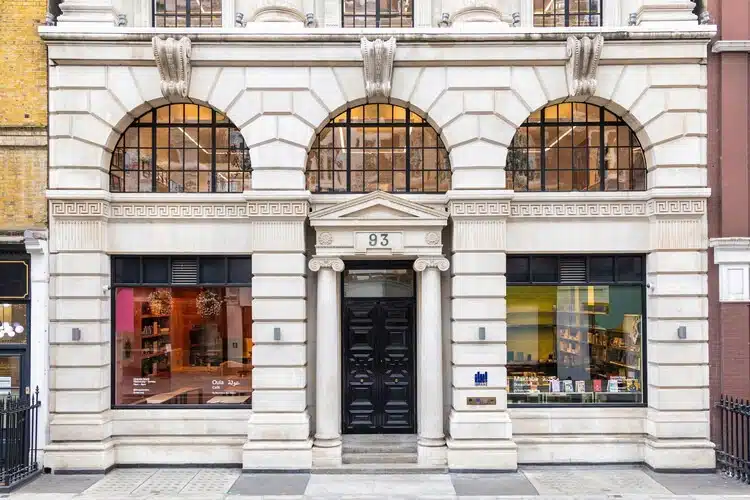
Shumon Basar, curator and strategic advisor to Ibraaz, describes the project as a transhistorical dialogue between architect Sumayya Wali and the Counterspace team on one hand, and the neo-classical second-grade façade of 93 Mortimer Street on the other.
Basar notes that the team’s approach gives fragmented parts a value equal to the whole, emphasizing that understanding architecture is not achieved solely through the final image, but through the partial details that form the complete meaning.
Architectural Transformation Witnessed in Real Time
Basar adds that what distinguishes this collaboration is the quiet, revolutionary method applied in transforming the new building.
Instead of waiting for the full renovation, including 43 Great Portland Street with its Venetian style, to be completed, visitors can witness the transformation as it unfolds.
In this way, the place becomes a living experience, revealing layers of architecture and meaning over time.
Gradual Time and Slowly Formed Meaning
Basar describes the project as a gradual deposition across time and space, where architecture is built layer by layer, and its meaning emerges through a continuous process of growth and reflection.
It is an invitation to view a building not as a final endpoint, but as an open journey formed alongside its communities, just as memory itself develops: slowly, warmly, and with an accumulation of meaning.

“Parliament of Ghosts”: Architecture as Living Memory
The Ibraaz approach allows artworks to become part of the living fabric of the space, as seen in Ghanaian artist Ibrahim Mahama’s work titled “Parliament of Ghosts.”
This piece offers an experimental, multi-layered reading of memory and history, transforming the ornate, whitewashed dance hall, now known as the Council, into a space inhabited by the specters of floors, shelves, and Ghanaian chairs dating back to the colonial era.
Through this transformation, the space itself bears witness to the intertwining of times, with the past reasserting its presence in the present through art.
Embodiment of Interwoven Maps of Africa
The inaugural exhibitions at Ibraaz symbolically extend this idea, mapping Africa in complex, intellectual, and cultural layers.
They trace Counterspace’s roots in Johannesburg, the origins of the Kamal Lazaar Foundation in Tunisia, and the future vision of The Otolith Group inspired by African imagination.
Through this interweaving, the project becomes a cross-border dialogue network, redefining the relationship between art, identity, and place.
Renewed Cultural Production and Future-Facing Vision
The project reinforces Ibraaz’s commitment to understanding cultural production as a living, evolving practice, rather than a final product or temporary display.
It honors the history of human gatherings as a fundamental source of inspiration while imagining new forms for the future grounded in collaboration, experimentation, and openness.
This vision regards culture as a means to build the future through memory, rather than as a separation from it.

A Global Extension: From Johannesburg to London
Counterspace takes pride in establishing a new foothold in London within the Ibraaz space.
The site is not merely an architectural headquarters; it provides a platform to embody, test, and share the studio’s core ideas and questions with the community in real time.
A Space for Dialogue and Cultural Exchange
Architect Sumayya Wali states:
“Aligned with our roots in Johannesburg, I am delighted to be situated in a space of discourse and community.
These spatial typologies, drawn from Tunisia, London, and geographies across Africa and the Arab world, carry resonances of shared cultural memory, offering continuity that transcends boundaries and time.”
Sustainable Creativity and Renewed Belonging
Wali adds that this geographical extension enables new forms of gathering to emerge in an era where the spirit of solidarity and belonging holds profound and decisive significance.
In this sense, architectural spaces transform into dynamic platforms for cultural and intellectual interaction, connecting past and present, local and global communities, and opening the way for continuous social and architectural experiences.

✦ ArchUp Editorial Insight
The Ibraaz project leaves a strong impression thanks to its ambitious vision and experimental approach in integrating architecture with social and cultural interaction. The team’s commitment to designing open, flexible spaces that allow for a living experience for users and redefine the relationship between space and community is highly appreciable, as is the cultural interplay between London, Tunisia, and Africa reflected in its research approach.
However, the project may face certain challenges in practical long-term implementation. The gradual and slow concept of development, while philosophically flexible, may be difficult to follow or assess directly, especially for visitors who prefer tangible and immediate results. Similarly, the social impact may remain limited if participation is not expanded to broader audiences beyond the artists and the institution’s immediate community.
Therefore, the project offers a unique and richly experimental experience, characterized by flexibility, yet in some aspects it requires careful monitoring to ensure that its cultural and social objectives are achieved sustainably and concretely.
Prepared by the ArchUp Editorial Team
Don’t miss the chance to explore more from Architecture, Buildings, and Cities on the ArchUp website.


