
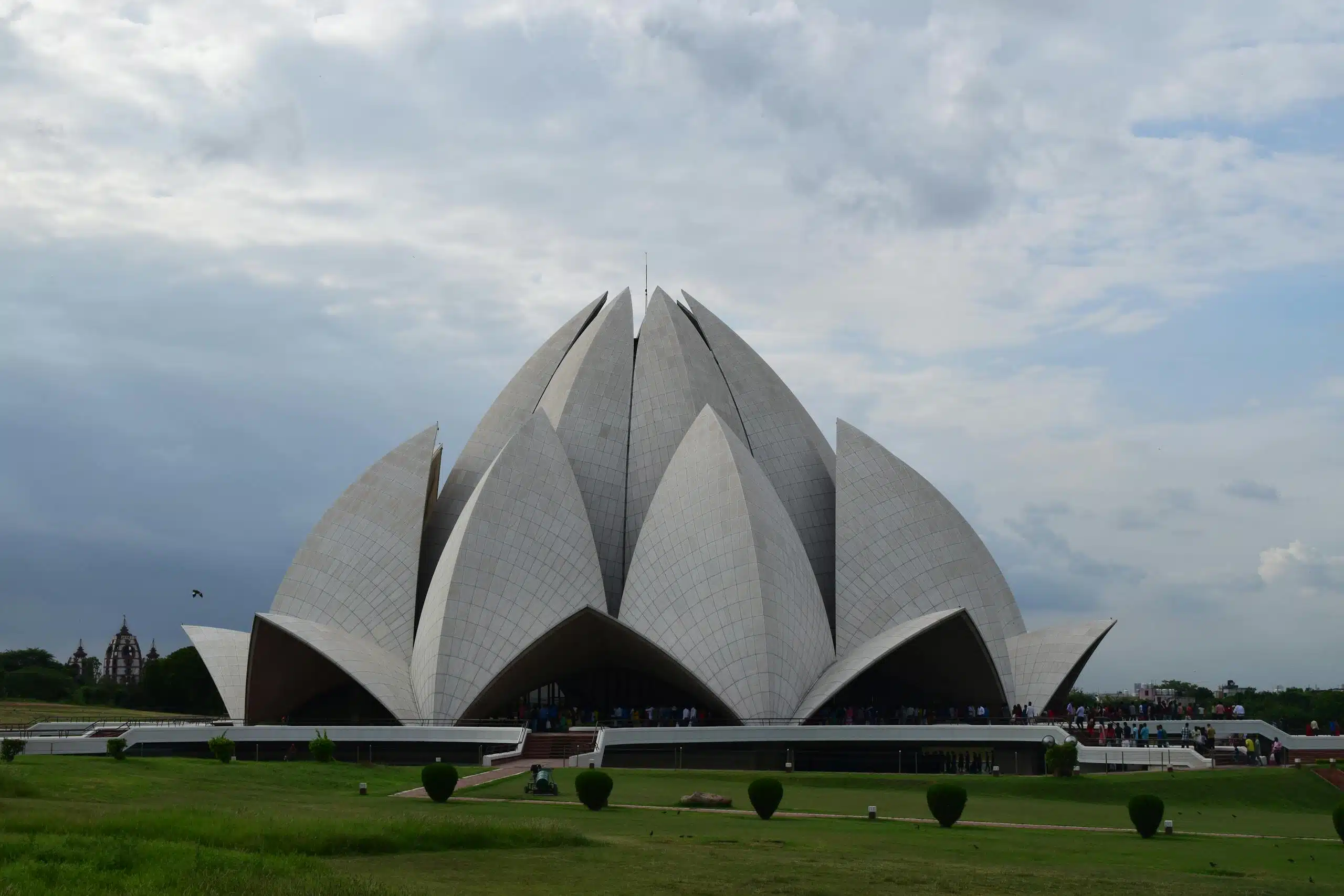
The Lotus Temple: Concrete Structure and Marble Design

General Introduction to the Engineering Design Principle of the Lotus Temple
The Lotus Temple represents a culmination of modern architecture. Iranian architect Fariborz Sahba designed the building. In essence, the temple is open to all faiths and symbolizes universal peace and unity. The Design Principle relies on precise, complex geometry. This geometry transforms the organic shape of the lotus flower into a unique concrete structural system. Consequently, the building’s beauty lies in the engineering ingenuity that allowed the creation of extremely thin concrete shells.
Temple Form and Structural Language
The temple adopts a circular form surrounding a soaring central hall. This form mimics a lotus flower in bloom. The structural language consists of 27 distinct “petals.” The builders grouped these petals into three consecutive layers: the outer (entrance) petals, the middle (hall) petals, and the inner (roof) petals. Furthermore, these three layers represent both structural engineering and aesthetic features. The entire design relies on repeating a single unit (a concrete shell) mathematically projected across different areas.
Surfaces and Façades: Geometry and Ornamentation
The exterior surfaces and façades are incredibly smooth. Workers covered them entirely with panels of imported Greek White Marble. In fact, they precision-cut the marble to fit the complex geometric curves of the concrete shells. The building lacks traditional ornamentation. Instead, the true decoration resides in the pure geometry. It features the interplay of light and shadow created by the petals’ curved contours, imparting a deep Architectural Art sense.
Essential Materials and Preparation Methods
The building’s essential material is high-quality reinforced concrete. The team prepared this concrete carefully to ensure the strength and durability required for the thin shell structures. Additionally, they used white marble for exterior and interior cladding. They also used stainless steel for joints and the double reinforcement needed for the cantilevered sections.

Reinforced Concrete and Admixture Usage
The reinforced concrete required the use of admixtures to achieve the thinness of the shells (6 to 12 cm) and the necessary durability. Specifically, engineers used materials to reduce water permeability and improve workability. This allowed the concrete to be poured efficiently into the complex curved molds. Moreover, this enhanced composition ensured high resistance to New Delhi’s harsh climate.
Concept of Single Dome Structural Engineering
The structural engineering concept focused on creating one single giant central dome. They achieved this by assembling the converging shells, avoiding a traditional self-standing dome. Essentially, each group of petals forms a double concrete shell structure. The shells function as self-supporting structural units. Consequently, the overall structure derives its strength from its curvatures and integrated geometric form, not from the material mass of the Building.
Balance and Loading: How Load is Distributed Across the Structure
Load distribution in the Lotus Temple relies on transferring compression and tension forces through the curves. The internal shells bear their self-weight and wind loads. They then transfer these loads to ring beams, and finally to just eight main supports beneath each petal group. Thus, engineers convert vertical loads into horizontal forces absorbed by the perimeter foundations, ensuring great stability.
Construction Techniques and Erection Phase
The erection phase demanded non-traditional techniques due to the complex forms. Engineers used advanced computational methods to calculate the geometric coordinates for each petal’s surface. Then, the team built massive temporary scaffolding. This formed the wooden framework where they poured the concrete. This pouring and leveling process demanded extreme precision to ensure the homogeneity of the thin shells before removing the supports.

High Sealing and Waterproofing Procedures
Applying high sealing and waterproofing procedures was critical. The structure consists of thin, jointed concrete shells. Workers used advanced insulating materials in all expansion joints between the petals to prevent water leakage. Furthermore, the surrounding water pools contributed to naturally cooling the façades. This reduced stress on the concrete Construction Materials.
Natural Ventilation and Lighting Systems in the Construction
The temple uses innovative and sustainable natural ventilation and lighting systems. Natural light penetrates the central hall through the glass gaps where the petals meet. Additionally, the temple employs the Stack Effect for ventilation. Cool air enters through lower openings, and hot air escapes through the upper oculus. This maintains a comfortable internal climate without extensive mechanical cooling.
Technical Challenges on Site and Overcoming Them
The on-site technical challenges were enormous. The main challenge was ensuring the precise assembly of 27 different-sized petals onto a single circular base. To overcome this, engineers used computer-generated 3D coordinates. These coordinates guided the placement of every point in the temporary scaffolding. This computational precision allowed for the successful execution of the sculptural form.
Sustainability and Recyclable Materials
Sustainability in the temple primarily comes from the passive energy efficiency of its natural ventilation. However, the marble cladding is a long-lasting natural material. They also used concrete mixtures designed for a very long lifespan. This minimizes the need for recycling or replacement.
Architectural Constraints and Quality Auditing in Execution
Architectural constraints were strict. They included the requirement for no supporting columns inside the main hall. This placed the entire load on the external shells. To achieve this, the team performed rigorous quality auditing during concrete pouring and marble fixing to ensure structural integrity. In the end, engineering precision adhered to the sculptural architectural vision.


Comparative Analysis Between Core Building Elements and Supporting Structure
The temple’s genius lies in the contrast between the core building elements (the thin concrete shells) and the external supporting structure (ring beams and supports). The supporting structure provides horizontal stability. Conversely, the shells themselves provide self-compression strength. This balance allowed the architect to effectively hide the structural support.
Conclusion: Structural Conclusions on the Lotus Building
The Lotus Temple is a breathtaking achievement. It marks the confluence of spiritual architecture and advanced engineering. The Engineering Project challenged the limits of using reinforced concrete in shell structures. The temple proves that precise engineering can translate complex organic forms into reality, while maintaining natural sustainability and profound aesthetic simplicity.
✦ ArchUp Editorial Insight
The Lotus Temple is a stunning engineering and architectural achievement in the Organic Innovative Engineering style, where Iranian architect Fariborz Sahba transformed the shape of a lotus flower into a giant, column-free dome. The Structural Innovation lies in using a system of Thin Concrete Shells; the 27 petals form three layers of converging and double shells (ranging from 6 to 12 cm thick) that function as self-supporting structural units. These shells efficiently transfer compression and tension forces to ring beams and ultimately to just eight main supports, ensuring tremendous stability through the curved form itself, rather than material mass.
Aesthetically and functionally, the temple succeeded in integrating structure and cladding, with the shells covered in Greek White Marble to enhance a sense of simplicity and sanctity. Its design also relied on principles of Passive Sustainability using the “Stack Effect” to draw cool air from below and expel hot air through the open oculus, ensuring effective natural ventilation and lighting. The temple is proof of the capability of precise engineering and complex computational calculations to translate difficult organic forms into reality, while maintaining an Architectural Function characterized by spiritual simplicity and thermal efficiency.
A deeper Architectural Discussion within modern Architecture explores how innovative Design and advanced Construction methods reshape global Projects in the pursuit of sustainability and human-centered environments.




ArchUp Editorial Management
The article provides an exceptional analysis of the engineering and structural dimension of the Lotus Temple, with a profound focus on the relationship between organic form and structural performance. To enhance its archival value, we would like to add the following technical and structural data:
We would like to add that:
· Structural Data: 27 concrete shells with 6-12 cm thickness, 35 MPa compressive strength, Grade 60 high-strength reinforcement, and support system of 9 primary buttresses
· Materials & Finishes: 3 cm thick Pentelikon Greek marble, 10,000 marble panels cut with ±0.5 mm precision, and white concrete with 40 MPa strength
· Environmental Systems: Natural stack ventilation with 22-meter height difference, natural lighting achieving 500 lux, and evaporative cooling from surrounding water pools
· Dimensions & Geometry: 70-meter diameter, 34-meter height, with 27 petals at 45-75 degree inclinations, and capacity for 2,500 people
Related Link:
Please review for a comparison of complex shell structure techniques:
[Shell Engineering:
https://archup.net/guggenheim-bilbao-engineering-analysis/