
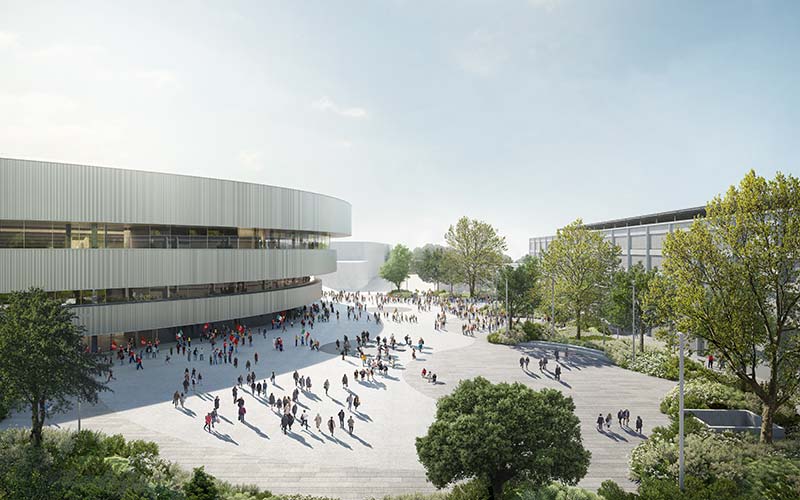
Milano Santa Giulia Arena Unveiled in New Images Ahead of 2026 Olympics

A fresh update from Milan reveals new images of the Milano Santa Giulia Arena, the striking venue set to host the Winter Olympics ice hockey events in 2026. The project, a collaboration between Arup and David Chipperfield Architects, is moving through its final testing phases. Situated in the Santa Giulia district, this new landmark is a central component of a large-scale urban planning initiative designed to revitalize the city’s south-eastern quadrant.
A Modern Colosseum for Milan
The arena’s design offers a contemporary reinterpretation of a classic form, echoing the elliptical shape of Milan’s ancient Roman amphitheater. Its defining feature is a series of three metallic rings that appear to float above a grand podium, creating a visually dynamic facade. During the day, shimmering aluminum building materials catch the light, while at night, integrated LED strips will illuminate the structure.

Inside, the Milano Santa Giulia Arena accommodates a massive audience, offering two main seating tiers for up to 16,000 spectators. The design also incorporates premium lounges, skyboxes, and versatile internal spaces for catering and services. A wide podium elevates the entire venue and includes a 10,000-square-meter piazza for outdoor public events.
Navigating Construction Deadlines
This new imagery arrives amid concerns over the project’s tight timeline. Following remarks from the International Ice Hockey Federation about potential delays, officials organized a series of test games to evaluate the venue’s readiness. The CEO of the Fondazione Milano Cortina 2026 confirmed the test was a success, praising the competition field and spectator logistics. While acknowledging that significant work remains on the broader construction site, the satisfactory outcome has helped restore confidence that the Milano Santa Giulia Arena will be ready for the games.

More Than an Olympic Venue
Beyond the 2026 Olympics, the arena is poised to become a premier destination for large-scale concerts, festivals, and other sporting events, ensuring its long-term value to the city. The project’s sustainability strategy includes a rooftop photovoltaic system designed to generate clean energy on-site. As one of the most geographically dispersed Winter Games in history, the Milan-Cortina Olympics relies heavily on adaptive reuse and existing infrastructure, and this arena represents a key piece of new architecture contributing to that legacy.
What role will this new arena play in shaping Milan’s cultural landscape after the Olympics?
A Quick Architectural Snapshot
The elliptical venue features a 16,000-spectator capacity and is located southeast of Milan’s city center. Its design is defined by three stacked rings with an aluminum tube facade, all resting on a raised podium. The podium itself creates a large public piazza measuring over 10,000 square meters.

✦ ArchUp Editorial Insight
The project is the logical outcome of event-driven urban development and risk-managed financing. The immovable 2026 Olympic deadline dictates a system where speed and budget adherence supersede all other architectural variables. This pressure produces a known solution: a large-capacity, multi-use container optimized for broadcast and post-event revenue generation through generic programming.
The form is a symptom of a decision-making framework that prioritizes the financial logic of a flexible venue over a more specialized, integrated urban component. Its visually complex facade and vast podium are tools to generate a marketable “landmark” status required for global media events. The simultaneous inclusion of mass parking and public transit connections reveals a system hedging its bets on mobility, embedding car dependency as a failsafe for managing peak spectator loads. The architecture is evidence of a timeline in control.

.jpg)


