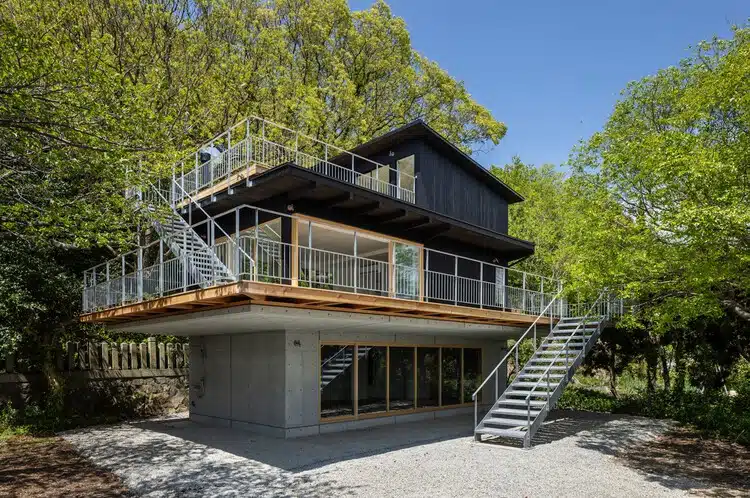
Reimagining Heritage: A Moganshan Homestay Blending Memory and Modernity

Reviving a Forgotten 70s Rural House
Zheng’s abandoned family home in Shang’ao Village, Moganshan, stood as a relic of 1970s 80s rural architecture a time capsule of weathered wood, uneven floors, and fading memories. By 2018, as China’s homestay boom peaked, Zheng saw an opportunity: to transform the decaying structure into a revenue-generating retreat while resolving its structural flaws. The original building, an extension of a traditional quadrangle, lacked stability and blurred boundaries with the northern neighbor’s property. Through a referral by Chuanzhang and Xiaoqing, our team took on the challenge of redefining the space balancing pragmatism, heritage, and innovation.

Design Philosophy: “A Room as a Building”
Zheng’s brief was deceptively simple: maximize rooms without sacrificing design quality. This led us to a radical approach: treating each room as an independent architectural entity. By dissecting the building into modular “room-buildings,” we optimized:
- Views: Mapping the site’s surroundings mountains, bamboo groves, streams, and neighboring homes we oriented windows to frame specific landscapes, creating a visual dialogue between interior and exterior.
- Daylight: To combat the limitations of the narrow plot, we sculpted room shapes to allow multi-directional light, inserting courtyards to amplify brightness and spatial fluidity.


The Courtyard: A Negotiation with History
The northern courtyard emerged as both a practical and poetic solution. It addressed:
- Privacy: Buffering the neighbor’s encroaching walls.
- Legacy: Preserving remnants of the original wooden framework as artifacts within the courtyard until Zheng’s last-minute demolition, citing safety concerns. This loss underscored the tension between preservation and progress.

Undisciplined Space: A Nod to Rural Spontaneity
Villagers’ improvisational use of space a chair becoming a living room, benches morphing into a dining area inspired our design. Pre-“modernity,” function followed human activity, not the other way around. We echoed this in flexible layouts, akin to the organic compositions in Zhou Wenju’s paintings, where furniture and nature carve intimate subspaces.

Material Paradox: Timber Columns and Mountain Stones
Two symbolic gestures bridged past and present:
- Timber Columns: Once structural, they were repurposed as decorative illusions, their rough concrete bases and hidden steel joints masking their original role.
- Mountain Stones: Borrowing from classical Chinese gardens, these served as structural supports for staircases, blurring the line between ornament and utility.

A Six-Year Journey: Patience and Compromise
From 2018 to 2024, the project weathered delays, design evolutions, and the final erasure of the old wooden skeleton. Yet, the homestay now stands as a testament to adaptive reuse where memory lingers in courtyards, and modernity negotiates with tradition.
✦ ArchUp Editorial Insight
This Moganshan homestay project deftly navigates the duality of preservation and reinvention, treating each room as a microcosm of architectural intent. The “room as a building” concept cleverly decentralizes design priorities, though the abrupt demolition of the original wooden structure reveals a missed opportunity to anchor the space more deeply in its history. Material choices, like the playful timber columns and stone supports, inject ambiguity but risk feeling superficial without deeper integration. Still, the project shines in its homage to rural spontaneity proving that the most compelling spaces often emerge from unplanned, human-centric interactions.
Explore the Latest Architecture Exhibitions & Conferences
ArchUp offers daily updates on top global architectural exhibitions, design conferences, and professional art and design forums.
Follow key architecture competitions, check official results, and stay informed through the latest architectural newsworldwide.
ArchUp is your encyclopedic hub for discovering events and design-driven