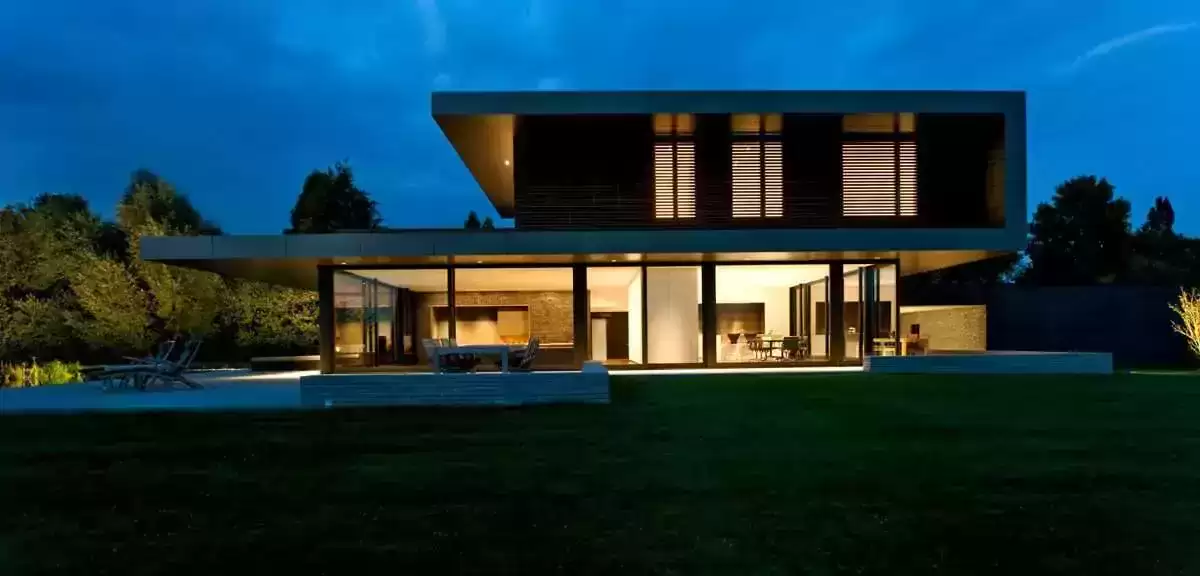
Tamanás House: Integrating Topography and Architecture

| Element | Details |
|---|---|
| Architects | Ateliê Amanhã |
| Area | 490 m² |
| Year | 2025 |
| Photographs | Camila Alba |
| Category | Residential Architecture, Houses |
| Coordination | Luiza Tripoli |
| Landscape Architecture | Trevo Trevi |
| City | São Paulo |
| Country | Brazil |
The Relationship Between Architecture and Natural Topography
The site’s characteristics and topography play a significant role in guiding architectural decisions in many residential projects. In the case of Tamanás House, the presence of a sloping terrain and several standing fruit trees were key factors in shaping the project’s design concept.
Using Architectural Cuts to Organize the View
Rather than treating the building mass as a closed volume, the design relied on creating precise cuts within the building’s form. These cuts do not merely function as conventional openings; they act as visual frames that highlight specific elements of the surrounding natural landscape.
Enhancing Visual Connection with Nature
Thanks to this approach, the framed views vary between treetops and ground-level gardens. As a result, a visual continuity is established that links the interior space with its natural surroundings, reinforcing the presence of nature within the building’s spatial experience.


Functional Distribution According to Site Topography
The design process responded to the land’s slope by distributing functions across multiple levels, aligning the organization of spaces with the residents’ daily rhythms. Within this framework, the ground floor houses the garage and pedestrian entrance, making it the primary point of access to the home.
Daily Spaces and Social Activities
On the first floor, daily social spaces are concentrated, where the kitchen and dining room are connected within an open layout that facilitates movement and encourages shared use of these areas.
Levels of Privacy and Connection to the Garden
The second floor is dedicated to more private spaces, including bedrooms and a TV room that opens onto the garden. In contrast, the upper floor provides a space intended for recreational use during weekends, emphasizing the connection with the outdoors through a large terrace, a barbecue area, and an additional living room.


The Reflecting Pool as a Unifying Element
At the heart of the design, a reflecting pool serves as a unifying element, connecting different parts of the project and imparting a sense of tranquility. Its reflective surface not only adds a visual dimension by mirroring light and sky but also contributes to improving the thermal comfort of the immediate surroundings.
Reusing Materials as a Design Opportunity
Alongside the pool, broken bricks transported to the site were repurposed to build a wall. These bricks were transformed not merely into a closure element but also into a cobogo screen in front of a window, allowing light and air to pass through. This approach demonstrates the ability to turn construction waste into design opportunities, documenting the building process’s memory while adding value to the reused materials.


✦ ArchUp Editorial Insight
Tamanás House represents an intriguing case in its attempt to integrate natural topography with the distribution of functions and architectural openings. On a positive note, the project demonstrates practical solutions such as using architectural cuts as visual frames and repurposing materials, reflecting environmental awareness and sensitivity to the surrounding landscape.
However, the project also raises several points that could be considered challenges for future architecture or similar projects. For instance, relying on multiple levels to respond to the slope may complicate daily circulation and increase the need for careful management of internal and external pathways. Likewise, the intensive connection between indoor and outdoor spaces may require a deeper study of climatic factors and privacy, especially in environments with high heat or humidity.
On the other hand, practitioners and students can benefit from the project as a reference for illustrating how spatial and topographical constraints can be transformed into design tools, particularly regarding the direction of visual scenes and the reuse of construction materials. It also highlights the importance of balancing the aesthetic experience of spaces with practical daily considerations, a lesson applicable to other residential projects.