

Treepod – Forest Nests: Redefining the Relationship Between Prefabricated Construction and Nature

A New Architectural Vision at Sinpo Amusement Parks
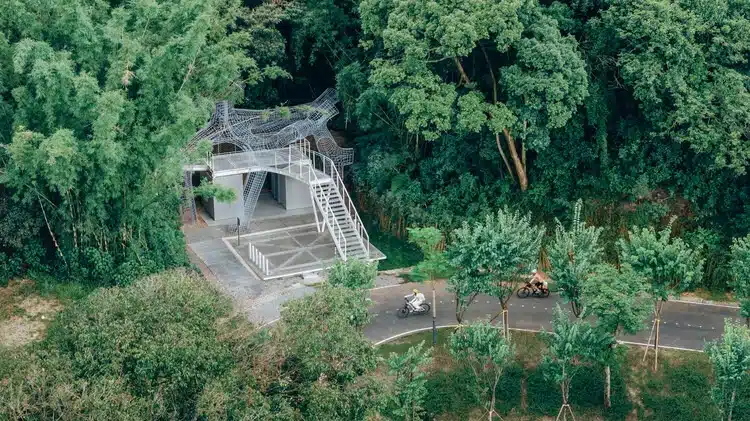
Within China’s Sinpo Amusement Parks, a new architectural trend is emerging, challenging conventional notions of modular construction. The Treepod – Forest Nests project, designed by the Doarchiwow team, exemplifies this transformation, turning prefab structures into artistic forms that harmonize seamlessly with their surroundings.
Design in Harmony with Nature
Unlike the traditional treehouses we knew in our childhood, each dwelling rises from the ground as a meticulously sculpted entity. The steel framework of the buildings is wrapped in layers of timber cladding and weather-resistant steel, complemented by aluminum and glass.
The real ingenuity lies in how these materials interact, producing structures that feel less industrial and more attuned to nature. You might envision them as massive suspended cocoons or intricately woven nests, but they are certainly not conventional modular buildings, the project’s primary objective.
Project Development Journey
Doarchiwow, a subsidiary of DO Architects specializing in high-quality prefabricated systems, began working on this concept in 2021. After four years of research and development, the project was completed in 2025, spanning two sites in Rizhou, Shandong Province, and Wuhan, Hubei Province, covering a total area of 441.92 square meters.


A Unique Interior Experience
Once a visitor enters the dwelling, the experience of the space changes noticeably. Smart home systems and digital networks handle the technical aspects, while floor-to-ceiling windows offer panoramic views of the treetops, enhancing the sense of immersion in nature. The interior curves harmonize with the organic lines found outside, creating a visual continuity that flows seamlessly from indoors to outdoors.
Space and Flexibility
Despite the unit’s small footprint, the interior surprises with its spaciousness and flexibility. The design team focused on addressing a fundamental challenge: how to produce units collectively while maintaining the feeling that each is custom-designed for its occupant. The modular envelope enables efficient construction, while the interior spaces feel tailored to individual needs. In this way, each unit functions as an independent tranquil spot, yet remains part of a larger integrated network.
Environmental Sustainability
The project’s philosophy goes beyond merely adopting visible green building practices. Led by Tang Jiajia, Wang Wenrui, and Jiang Hong, the design team implemented a three-dimensional environmental strategy, including:
- Passive design to reduce energy consumption.
- Active environmental technologies to enhance efficiency.
- Construction methods that respond precisely to local climatic conditions.
This approach helps minimize ground impact, reduce material waste, and limit the need for intensive on-site labor. Moreover, each unit operates as an independent ecosystem capable of adapting to environmental conditions and varying weather patterns, thereby promoting the long-term sustainability of the project.


Flexibility and Environmental Adaptation
Adaptability plays a crucial role in this architectural model, as it can theoretically be applied in any environment: from urban green spaces to protected natural areas, coastlines, and even mountain forests. The fluid shapes of the units prevent them from appearing out of place, a rarity in conventional prefabricated buildings. While most modular structures tend to announce themselves loudly, these units settle quietly, reflecting their harmony with the surrounding nature.
Prefab Construction: Balancing Efficiency and Beauty
The Treepod – Forest Nests project demonstrates that prefabricated construction does not require compromising design or environmental commitment. The Doarchiwow team successfully combines efficiency with aesthetics, allowing these structures to be erected quickly without disturbing the site or creating an unattractive appearance.
A Forward-Looking Trend for Sustainable Resorts
Designers focus on boutique resorts, luxury camps, and rural tourism markets, reflecting their ambition to rethink both vacation space design and traditional construction methods simultaneously. The project proves that sustainability can coexist with visual appeal, offering a compelling model for developing sustainable resorts. The question remains how widely this model will spread in the future, but it undoubtedly represents a significant step toward redefining prefabricated construction in an environmentally flexible way.


✦ ArchUp Editorial Insight
The Treepod – Forest Nests project can be viewed as an attempt to rethink the relationship between prefabricated construction and the surrounding natural environment. On the positive side, the project offers a flexible model for residential units, enabling a diverse living experience that responds to its environment while incorporating sustainability and ecological adaptability, reflecting an awareness of modern building practices.
However, several reservations remain when evaluating the project from a practical architectural perspective. Despite the fluidity and visual appeal of the units, reliance on the modular envelope may pose challenges in terms of functional integration on a larger scale, particularly when applied across multiple sites or locations with complex geography. The focus on organic form and interior experience may also overshadow economic considerations and the ability to maintain efficient mass production. Furthermore, the project raises questions about long-term scalability and maintenance, especially given the variety of materials used and the need to align with differing climatic standards.
Nevertheless, practitioners in the architectural field can benefit from this model as a reference for developing projects that prioritize environmental adaptation and design flexibility, while learning from the practical challenges encountered to apply it more sustainably and efficiently in diverse settings. The project thus provides a platform for architectural experimentation, with the potential to enhance the integration of form, function, and sustainability when adopted in larger or more complex developments.
Prepared by the ArchUp Editorial Team
Don’t miss the chance to explore more from Architecture in fields like Buildings and Design on the ArchUp website.




ArchUp Editorial Management
The article provides a comprehensive analysis of the environmental and design dimensions in the “Forest Nests” project, with a distinguished focus on the relationship between modular construction and sustainability. To enhance its archival value, we would like to add the following technical and structural data:
We would like to add that:
· Structural Data: 8 mm thick modular steel frame with thermal anti-corrosion coating and 120 mm CLT panels, with wind resistance up to 150 km/h
· Advanced Materials: Thermally treated carbon wood cladding resistant to insects and mold, with smart switchable glass achieving 0.4 W/m²·K U-value
· Environmental Systems: Hybrid energy system (solar + wind) with 15 kW/unit capacity, 95% greywater treatment, and smart climate control maintaining 18-25°C
· Manufacturing & Assembly: 6-week manufacturing time per unit, 48-hour on-site installation, with 92% unit disassembly and reassembly capability
Related Link:
Please review for a comparison of advanced modular construction techniques:
[Modular Architecture: From Manufacturing to Environmental Integration]
https://archup.net/piracaia-eco-village-sustainable-construction/