
A Guangzhou Project Redefining the Relationship Between Urban Agriculture and Architecture

Rethinking Our Relationship with Space
Have you ever had an experience that made you reconsider your perception of a certain place?
This is exactly what can happen when you contemplate an unconventional architectural project in Guangzhou, China. Here, the firms Office for Roundtable and JXY Studio broke away from the ordinary to create a concept that defies easy categorization, and this is precisely the secret of its appeal.
Project Concept: Intertwining Functions and Integrating Spaces
The project is titled “Your Greenhouse is Your Kitchen is Your Living Room”, a direct title that reflects the essence of the idea.
Rather than treating the greenhouse merely as a space for growing plants, or the kitchen solely as a place for preparing food, this design transforms into a versatile modular pavilion that merges gardening, cooking, and social interaction into a single harmonious space.
A Collective Experience in One Design
Over time, the pavilion’s form and function evolve to accommodate the needs of its users.
In the morning, it might serve as a vegetable-planted greenhouse, while in the evening, it transforms into an open space for community gatherings or shared cooking workshops.
It is a project that integrates functionality, sustainability, and human interaction into one cohesive experience.

Transformable Architecture
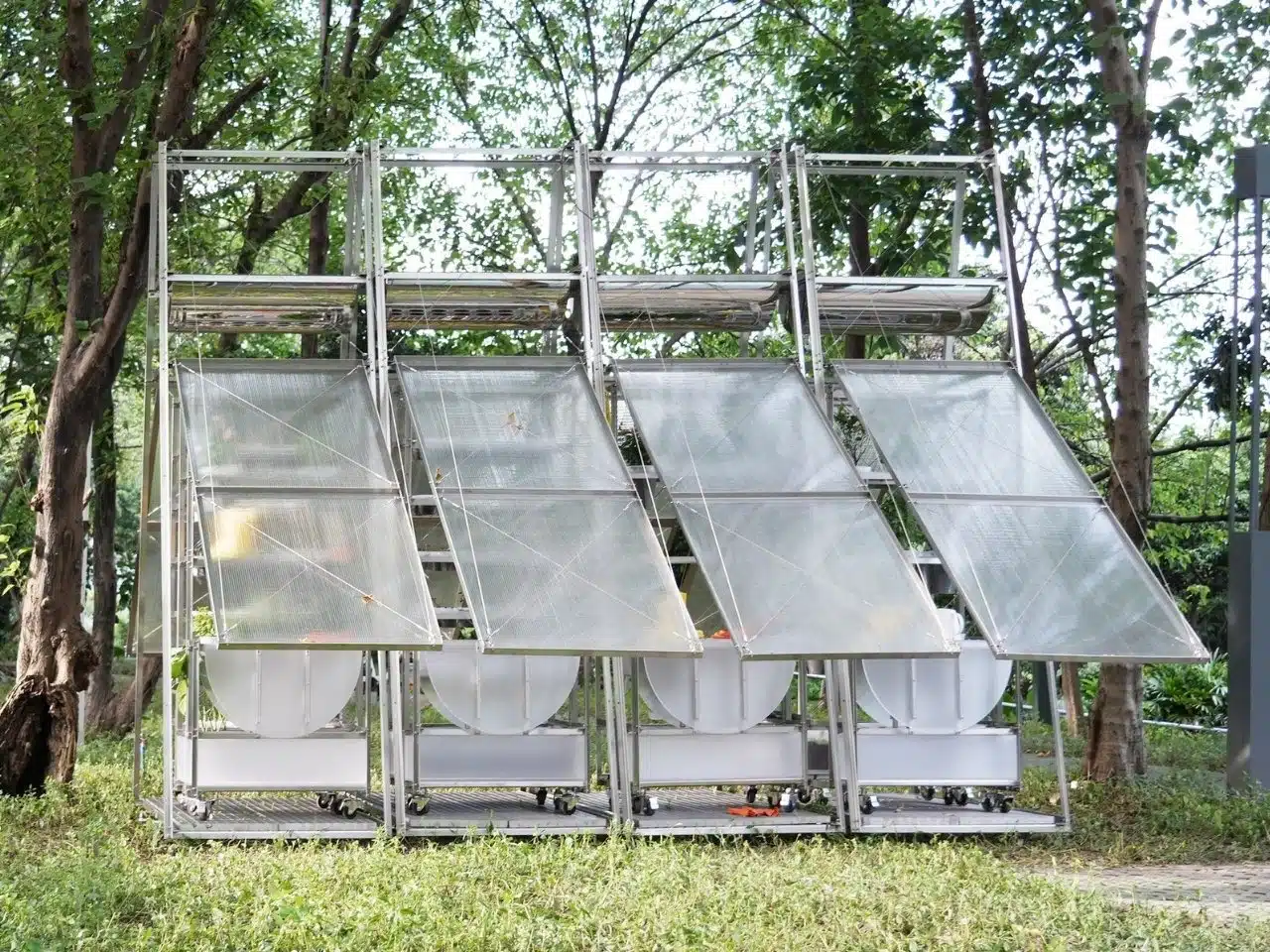
Imagine an A-shaped steel structure, clad in transparent polycarbonate panels, easily controlled via tension cables suspended from the top of the frame. This structure is not merely an aesthetic design, it is an intelligent system that allows the space to breathe and transform according to need.
A Miniature Environment for Plant Life
When the sides are closed, the structure transforms into a mini climate perfect for cultivation.
Inside, plants such as potatoes, green peppers, lettuce, and bok choy thrive, alongside a variety of fresh herbs that add vibrancy and flavor.
In this way, the space becomes a small urban laboratory for agricultural sustainability.
From Greenhouse to Social Space
But once the cables are pulled and the walls raised, the entire scene changes.
Its role shifts from a closed agricultural environment to an open, versatile pavilion ready to host dinner parties or community workshops.
It is a clear example of how architecture can integrate nature and social interaction within a single, ever-evolving space.

The Birth of an Idea in an Extraordinary Time
What sets this design apart is that it did not emerge from a vacuum; rather, it sprang from a highly specific moment in time.
Designer Li Yuan Li received a grant from the Hong Kong Design Trust to research small-scale community farming projects that began to emerge during the COVID-19 pandemic.
Returning to the Roots Amid Isolation
During that period, the world changed rapidly.
While many rediscovered the joy of home baking or cultivated small gardens on balconies and rooftops, deeper questions arose regarding food security and reliance on global supply chains.
Amid this collective concern, attention began to shift toward finding local and community-based solutions that reconnect people directly with what they eat.
From Crisis to Inspiration
Building on this shared human experience, Li Yuan Li sought to transform this new awareness into an architectural space embodying the principles of self-sufficiency and communal sharing.
The result was a project that blends agriculture, creativity, and social interaction into a tangible, living form, reminding us that crises can sometimes open unexpected doors to innovation.

From Documentation to Experimentation
Rather than merely recording a fleeting cultural moment, Li Yuan Li and his teams at Office for Roundtable and JXY Studio chose to go further.
They decided to transform observation into a tangible, actionable experiment that challenges the conventional ways we think about producing and consuming food.
The Pavilion as a Platform for Dialogue
The pavilion was installed at the Fei Arts Museum in Guangzhou, serving as an open platform for discussions about our relationship with food, society, and the environment.
The goal was not simply to showcase an innovative design, but to expand the conversation about architecture’s role in reconnecting people with the source of their food.
Challenging the Centralized Food System
The project raises a fundamental question:
What if we could break the monopoly of the centralized food system?
From this question emerged the idea of creating urban spaces that simplify the processes of farming, cooking, and community sharing, restoring the lost communal spirit of these activities.
In this sense, the pavilion transforms into a miniature model of a possible future, where food becomes a tool for social connection rather than merely a productive commodity.

Intelligent Design That Breathes with the Environment
The technical details in this project are not mere decorative additions; they are an essential part of its environmental concept.
The polycarbonate panels covering the structure were not installed randomly; they were designed with carefully calculated gaps between each panel to allow natural airflow.
These gaps create a natural ventilation system crucial for Guangzhou’s subtropical climate, making the interior environment comfortable and usable throughout the day.
A Balance Between Beauty and Function
Inside, metal shelves are arranged systematically to house vegetables and fresh herbs, forming a practical yet elegant cultivation system.
Here, aesthetic appeal seamlessly blends with functionality, serving as a clear example of how design can benefit people without compromising the beauty of the space.
Lightweight, Flexible, and Reconfigurable
The structure itself is lightweight and fully modular, meaning it can be dismantled, moved, or reconfigured easily to meet different needs.
With this flexibility, the project becomes an open platform for community experimentation, rather than a rigid building confined to a single location or function.

Flexibility as an Architectural Value
Flexibility appears to be the true essence of this project.
Rather than imposing a single use for the space, the designers chose to leave the field open for users to decide for themselves how they want to interact with it.
In this simple approach, the design becomes an invitation to explore and participate, rather than a rigid structure with a predetermined purpose.
Endless Possibilities
One day, the pavilion might serve as a small greenhouse where neighbors learn urban farming techniques.
The next day, it could become an open kitchen where everyone gathers to cook what they have grown with their own hands.
In the following week, it might transform into a community living room to discuss issues such as food systems and sustainability.
Design That Adapts to Change
This diversity of uses not only reflects the beauty of the concept but also embodies a modern architectural approach that places people at the heart of design.
Here, the space is not an end in itself but a means to foster relationships and interaction, a flexible environment that evolves with the community it serves.

More Than Just a Multi-Functional Design
Office for Roundtable describes this work as:
“An architectural device combining the functions of a greenhouse, an outdoor kitchen, and a living room.”
Yet the essence of the project goes beyond multifunctionality or formal innovation.
It is an attempt to rethink the relationship that connects us with food, the land, and each other, especially within urban environments that often separate humans from their natural roots.
Towards a New Relationship with Daily Life
This concept aims to break down the boundaries between the natural and the urban, restoring a sense of intimacy and communal spirit to public spaces.
Instead of treating farming as a rural activity, cooking as a domestic event, and conversation as a separate social act, all these elements are blended into a single space that revives the idea of shared living in the modern city.

Returning to the Roots Through Design
Modern humans have become increasingly disconnected from the source of their food, surrounded by massive production systems that distance them from even the simplest sensory experiences with the earth.
In response to this reality, the project offers a tangible and human-centered alternative, through which the designers propose new forms of what they call “domestic and collective sustainability”, an idea that revitalizes the relationship between growing food, preparing it, and sharing it within a single open space.
What Makes the Design Memorable
It is not the luxury of materials or the complexity of engineering that makes this project remarkable, but its ability to meet real human needs and its boldness in rethinking the way we live and interact.
It serves as a reminder that architecture can be a tool for nurturing human connections, not just for building walls that separate us from one another.

✦ ArchUp Editorial Insight
The project represents a clear step toward integrating agriculture and social life within an urban space, offering great flexibility in its various uses and providing users with a diverse experience.
On the other hand, the challenge of applying this concept on a larger scale within the city remains, particularly regarding costs, maintenance, and adaptation to different climatic and social conditions.
Moreover, the need for continuous user engagement may limit the project’s sustainability without careful management.
In this way, the project presents a thought-provoking model, yet it remains better suited as a limited-scale experimental initiative rather than a comprehensive, city-wide architectural solution.
Prepared by the ArchUp Editorial Team
Don’t miss the chance to explore more from Architectural News in fields like Architecture and Projects on the ArchUp website.


📐 A truly excellent article! However, I agree that the project raises questions about its architectural value. The designer didn’t elaborate on the materials, and the (steel/aluminum) structure appears conventional. The article seems to have succeeded in accurately describing the work, even though the source of the content is primarily aimed at public relations rather than documenting architectural innovation.