Wael Shawky: Reimagining History in Contemporary Art Between East and West

Wael Shawky and Reimagining History from the Heart of Edinburgh
An Artistic Contribution at the Heart of the Event
Talbot Rice Gallery, located in the heart of the Scottish capital Edinburgh, witnesses a massive influx of visitors during August, as the Edinburgh International Festival attracts nearly half a million attendees annually. This year, the gallery participates for the first time in the festival’s programming with a solo exhibition by artist Wael Shawky, who was recently appointed as the Artistic Director of the inaugural edition of Art Basel Qatar, scheduled for 2026.
“Drama 1882”: History Through Art
The exhibition features Shawky’s monumental opera Drama 1882 (2024), a multimedia work that blends film, music, painting, puppet theatre, and live performance. Rather than merely presenting a historical moment, the piece delves deep into the events of the Urabi Revolution (1879–1882) in Egypt, spotlighting a pivotal moment in the resistance against British colonialism.
Through these diverse media, Shawky does not simply retell events—he reconstructs the collective memory and explores the political complexities of the era, opening the door to new reflections on history and identity.
“Cabaret Crusades”: An Alternative Arab Perspective
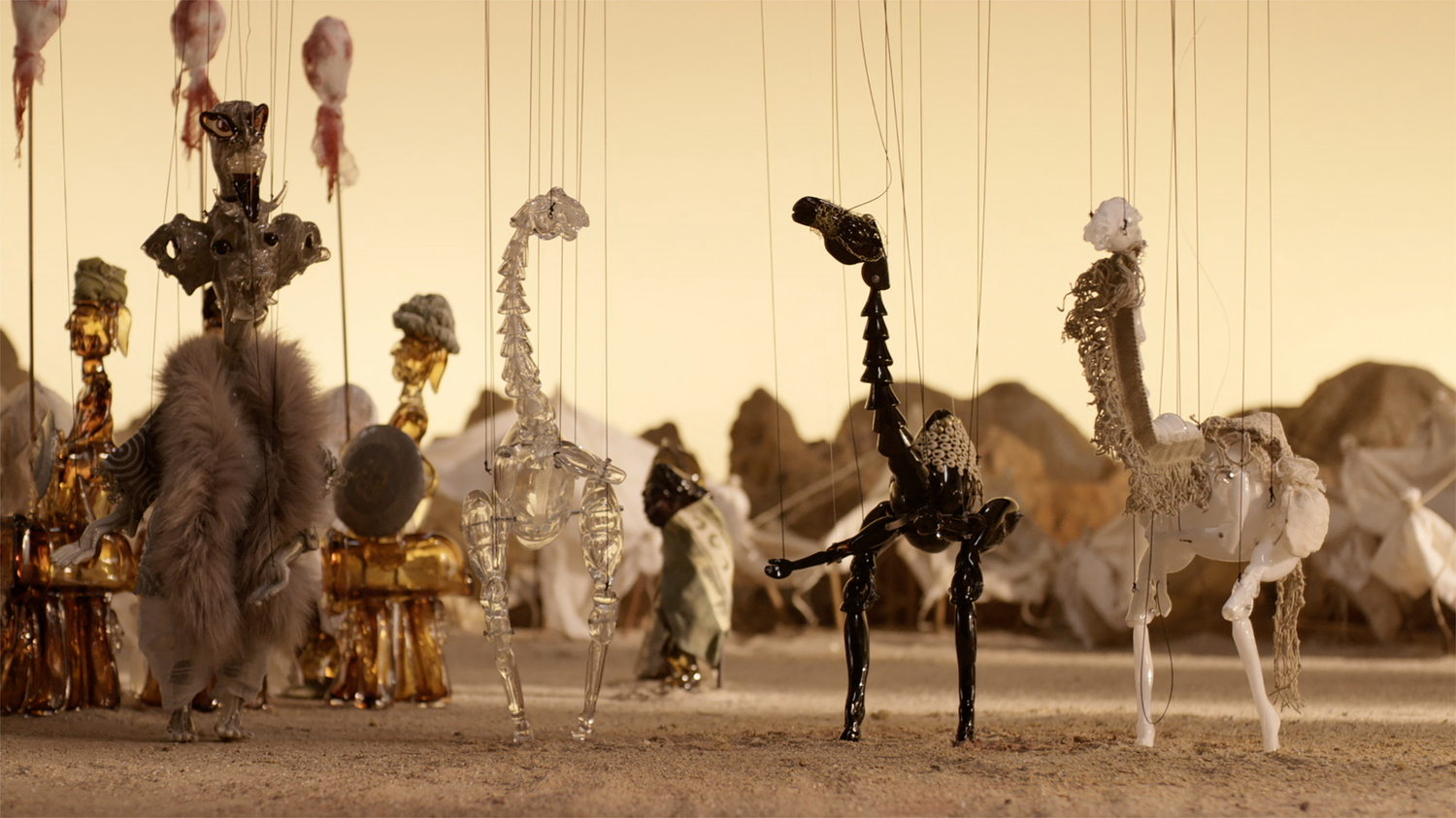
Prior to this work, Shawky gained recognition for his artistic trilogy Cabaret Crusades, which offered a distinctive Arab perspective on the Crusades in the Middle East. The series is notable for its use of singing and speaking glass marionettes to embody historical characters, lending the events a theatrical and satirical dimension.
- The first part covers the period from 1096–1099
- The second part focuses on 1099–1149
This unique artistic approach goes beyond mere historical narration—it seeks to reexamine the past and raise profound questions about the relationship between past and present, especially the intertwined histories of the West, Egypt, and the broader Middle East.
An Alternative Reading of History
Through his work, Shawky offers more than artistic content—he presents a critical re-reading of history from the viewpoint of the marginalized. At a time when patterns of conflict and domination seem to repeat themselves, such approaches feel essential to gaining deeper insight into our present, based on what unfolded centuries ago.
The Dialectic of Time and Power in the Works of Wael Shawky
From Secrets of Karbala to Drama 1882
At Talbot Rice Gallery, the exhibition of Wael Shawky’s works continues until 28 September 2025, showcasing two of his most prominent pieces in parallel:
- The third film in the Cabaret Crusades trilogy, titled Secrets of Karbala (2015)
- His new operatic work Drama 1882
Although the historical events depicted in these two works are separated by nearly 700 years, their pairing in a single exhibition is far from a temporal coincidence. It is a deliberate curatorial decision that reveals the enduring patterns of violence, authority, and the manipulation of consciousness across centuries.
Theatre of History: When the Past Becomes a Staged Performance
Commenting on this parallel, Shawky notes:
“Both films depict a transformation occurring in the Middle East and in Egypt. They each portray a theatrical moment in history and ask: how can we approach history as if it were a staged scene? The point is not conspiracy as much as the potential for us to be manipulated. There is always the possibility of prearrangement.”
Here, the artist proposes a philosophical approach to history—one that does not center on mere facts, but rather on how these facts are narrated and instrumentalized. In Shawky’s vision, history is not a fixed sequence of events but a malleable narrative that can be reshaped according to political and social contexts.
Deception as a Driving Force of Events
What links the two works goes beyond historical subject matter; it is the underlying sense that deception—or ignorance—has played a central role in propelling events forward.
In the context of today’s rapidly shifting media landscape, where trust in sources and information continues to erode, Shawky’s vision resonates powerfully with the present.
Every historical moment, according to him, could very well be an elaborate illusion—or the result of unseen manipulation—urging us to rethink dominant narratives. Through this lens, many issues we consider “settled” are, in fact, still open and unresolved.

Between Man and Marionette: The Hidden Power Behind History
The Puppet as a Metaphor for Humanity
Wael Shawky states:
“I learned a lot from my experience with marionette puppets — humans, puppets, all of them are hypnotized, all are moved by something.”
This comparison is more than a theatrical metaphor. It is a profound reflection on the loss of agency—the ability to make decisions—when individuals are faced with dominant forces, whether political, social, or mediated.
As Shawky presents it, the human being often moves within a network of invisible strings, much like a puppet on stage.
Rethinking History: From Narrative to Questioning
Shawky further explains:
“The potential to be deceived — and a different mode of analysis, since history is a human-made construct — [leads us to ask] what do we really know about history? And how can we transform it […] into a new, comprehensible format?”
Here, the artist is not seeking definitive answers. Instead, he invites reflection and a reconsideration of history as an open-ended, interpretable text—not a fixed and closed narrative.
History, then, is not merely what happened—but how what happened is told, and by whom, and for what purpose.
The Aesthetic of Deception: When Puppets Enchant Us
In Secrets of Karbala, an epic two-hour film, Shawky uses exaggerated, caricature-like glass puppets, painted in soft, muted colors that infuse the work with visual charm.
Yet behind this beauty lies a violent narrative: the film explores the events that led to the 1204 sack of Constantinople by the Venetians, driven by greed for power and wealth.
This contrast between aesthetic allure and brutal content presents the viewer with a dilemma: are we being deceived by what we see? And are we, in turn, passive spectators—hypnotized like the puppets themselves?
Between Music and History: Transmitting Time Through Sound
Both Secrets of Karbala and Drama 1882 are deeply infused with musicality.
While their melodic and visual aspects are compelling, their historical depth remains central.
In Drama 1882, the experience shifts. Shawky works with live adult performers instead of puppets—yet the feeling of submission to a hidden system remains ever present.
As the artist puts it:
“The third element is the connection between the two films, then the temporal link, and also my personal development. When I work with adults, I always recall what I learned from the marionette experience—whether human or puppet, both are guided by something, both are influenced by forces.”
The Past in the Present
Shawky’s work is not about repeating history in the conventional sense, but about the continuity of its impact:
“History repeats itself, but it takes its current form today because of something that happened a thousand years ago—and that will never disappear.”
From this perspective, the relationship between past and present is one of ongoing influence, not superficial resemblance—as if time is not a straight line, but a layered and interwoven fabric.
Material Memory: Puppets and Drawings
In the Edinburgh exhibition, the film is accompanied by the original glass puppets used in Secrets of Karbala.
Each puppet is suspended with its strings, fully costumed, handcrafted on the island of Murano, Italy—the very place represented in the story as one of the conflict’s central players.
Displayed alongside them are drawings and mixed-media artworks representing a lesser-known but equally significant facet of Shawky’s creative universe.
Music as a Medium, Not a Centerpiece
Despite music’s central presence in his works, Shawky insists on viewing it as a conveying tool, not the focal point:
“I compose music only for my films, and for myself. Let’s think of music as a medium; I don’t give it more space than it deserves. I believe anyone can be creative. I completely believe in what Joseph Beuys said: ‘Every human being is an artist.’”
With this statement, Shawky affirms that art—in all its forms—is not the domain of an elite few, but a wide-open space for genuine human expression.
The Evolution of Art in the Contemporary Context
One of the most defining features of Wael Shawky’s work is its ability to adapt and evolve within the shifting frameworks of the present era.
As the Edinburgh Festival approaches—drawing visitors from across the globe—it becomes increasingly important to ask: what role do cultural institutions play today in embracing this kind of artistic practice?
An Arab Reading of the Crusades
Speaking about one of his most renowned artistic projects, Shawky remarks:
“I created three parts of Cabaret Crusades, in which I tell the story from an Arab perspective. The first was produced in Italy, the second in France, and the third in Germany.”
What’s remarkable here is that the three countries that hosted the project are the same powers historically central to the Crusades. Shawky sees this as a positive gesture—Europe’s willingness to reflect critically on its own past, even when it is violent or filled with contradictions, marks a mature cultural consciousness.
History Does Not Repeat—It Persists in New Forms
Shawky adds:
“It’s also very positive that we, as human beings, are able to speak about everything.
What matters is understanding that history does not repeat itself in the literal sense, but what we are experiencing today is a continuation of events that took place a thousand years ago—traces of which still resonate in our present.”
✦ ArchUp Editorial Insight
Wael Shawky’s works can be seen not as a means to condemn or glorify history, but rather as an invitation to engage in critical thinking about how we narrate historical events.
His decision to adopt an Arab point of view in a work presented within Western institutions is not necessarily meant to provoke, but to open a multi-voiced dialogue about who has the right to narrate history—and who is excluded from that right.
Moreover, raising questions about the cultural institution hosting the work reflects the artist’s awareness of the infrastructure of contemporary art and its relationship with power, history, and the public.
Explore the Latest Architecture Exhibitions & Conferences
ArchUp offers daily updates on top global exhibitions, conferences, and professional art and design forums.
Follow key competitions, check results, and stay informed through the latest news worldwide.
ArchUp is your encyclopedic hub for discovering events and design-driven opportunities across the globe.