Wisteria & Light: A Timber Extension Breathes New Life into a 1920s Brussels Home

Introduction
On the peaceful outskirts of Brussels, Belgian studio Hé! has redefined what a contemporary home extension can be—with sensitivity to light, nature, and adaptability. At the heart of this renovation is a mature wisteria vine, carefully preserved and now thriving around a compact timber addition that doubles as both structure and pergola. The house, known as Kasteel after its location on Kasteelstraat, was originally built in the 1920s and is now home to a family of four.
Tasked with creating more flexible living space while allowing natural light to reach the core of the home, Hé! removed a dated rear annexe and replaced it with a minimal, demountable timber structure. The result is a bright, layered extension that breathes new life into the home—both literally and metaphorically.
With the kitchen relocated to the center of the house and a split-level configuration connecting key living zones, the design succeeds in making small moves with big spatial impact. The project not only creates a harmonious dialogue between new and old but also redefines how architecture can support living things—both plant and human.

Contextual and Compact: A Family-Oriented Upgrade
Minimally Invasive, Maximally Effective
Hé!’s extension is just two stories high, yet it dramatically reshapes the spatial experience of the house. Its compact footprint is counterbalanced by its openness—glass walls, double-height voids, and exposed pine interiors flood the formerly dark spaces with light and air.
A Home for a Growing Family
The clients, Frederik and Els, wanted a functional space for themselves and their two daughters. The new addition provides room for dining, storage, and play while keeping the home flexible enough for future change. Demountable bolted joints mean the extension can be altered or even removed if necessary—an uncommon but thoughtful detail in residential architecture.
Three Levels, One Flow
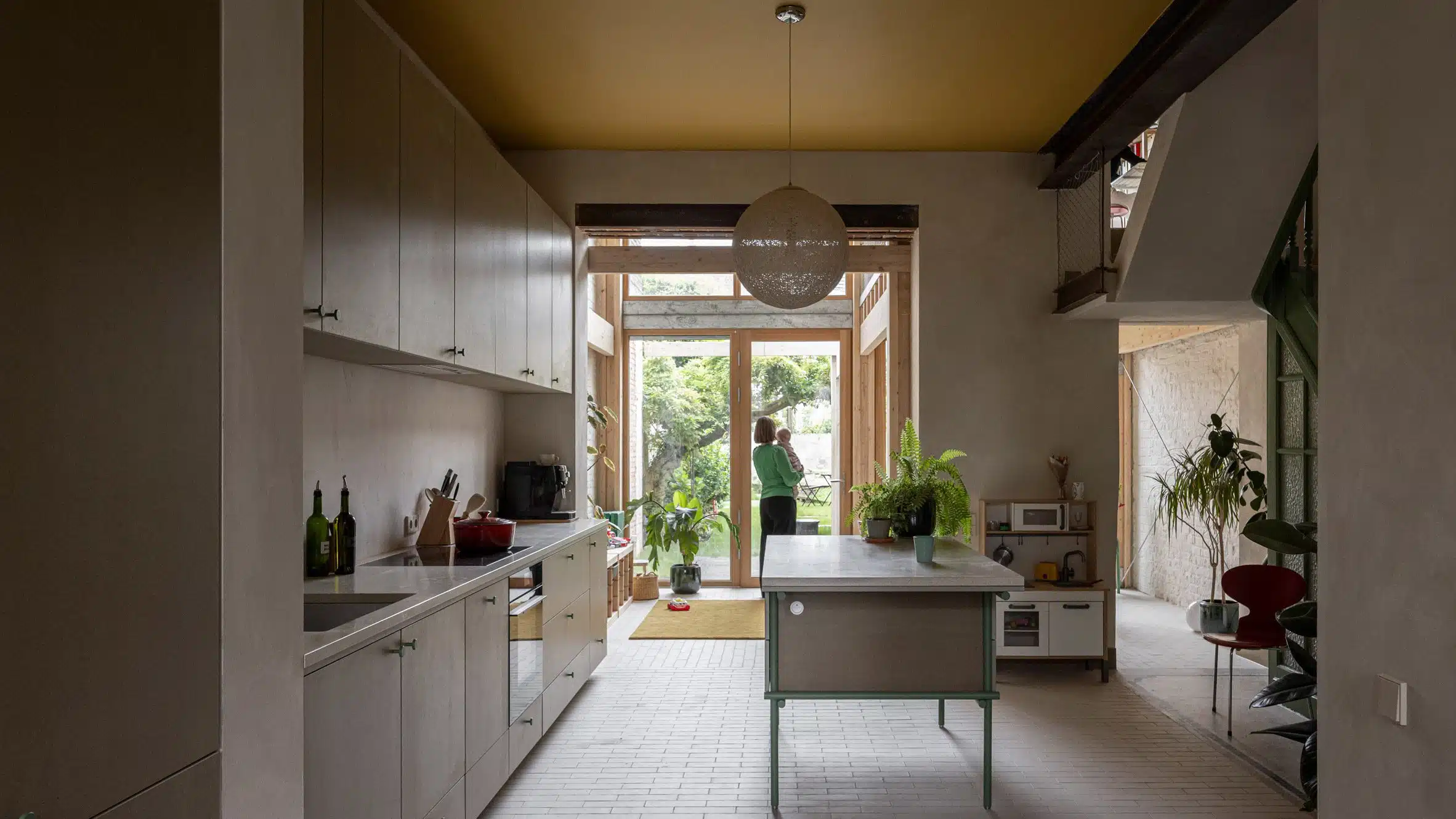
Instead of compartmentalizing the house, the architects embraced a split-level layout: the kitchen sits centrally on the ground floor, with the dining area in the extension and the living room one level above. These spaces are visually and spatially linked via a full-height void, fostering a sense of openness across all areas.

Table: Project Overview
| Feature | Description |
|---|---|
| Project Name | Kasteel House |
| Location | Ganshoren, Brussels, Belgium |
| Design Studio | Hé! (Hanne Eckelmans & Renée Verhulst) |
| Type | Renovation + Rear Timber Extension |
| Completion Year | Not specified |
| Building Era | Original house from the 1920s |
| Clients | Frederik, Els, and their two daughters |
Table: Spatial Functions of Extension
| Level | Program |
|---|---|
| Ground Floor | Dining area, double-height space, bike storage |
| Split-Level | Central kitchen connecting to both floors |
| Upper Floor | Living room overlooking the extension |
Table: Material and Finish Details
| Material | Application |
|---|---|
| Exposed Pine | Structure and interior finishes |
| Painted White Brick | Existing house walls |
| Olive Green MDF | Custom cabinetry and fixed furniture |
| Cream Tile Strips | Used as flooring in kitchen and bathrooms |
| Glass Wall | Double-height façade for light and views |
Architectural Analysis
The design logic behind the Kasteel House extension lies in its dual commitment to adaptability and sensitivity. Using a timber frame with bolted, demountable joints, the architects embraced reversibility—a concept rarely prioritized in domestic architecture. This technical flexibility mirrors the spatial fluidity of the project, which introduces split levels, voids, and inter-visibility between different zones.
Material-wise, the contrast between warm pine wood and crisp white brick generates a clear visual dialogue between old and new. The visual centerpiece—a large glass wall—serves not just to invite in light, but to connect the indoors with the back garden and the preserved wisteria, which is now supported by the extension’s frame like a built-in pergola.
The context—both geographic and botanical—played an essential role in shaping the project. Ganshoren’s residential quietude is echoed in the calm interior palette and unobtrusive architecture. Meanwhile, the decision to design around the wisteria plant signals an intentional blurring of built and natural environments, allowing architecture to serve life in more ways than one.

Project Importance
This project offers valuable insight into how architectural interventions in heritage homes can be lightweight, reversible, and rooted in ecology. The Kasteel House extension doesn’t impose itself on the existing structure; rather, it engages it in dialogue—highlighting rather than hiding the differences between the original brickwork and new timber framing.
By preserving a significant natural element (the wisteria), the architects have also contributed to an emerging typology of eco-sensitive renovation. In a climate where sustainability is often reduced to energy metrics, this project reminds designers that respecting nature on site is just as crucial.
Moreover, the use of demountable joints and non-permanent systems opens up a broader conversation about circularity in residential design. It encourages future architects to consider not just how buildings are made, but how they might be unmade—and what that means for flexibility, ownership, and urban evolution.

✦ ArchUp Editorial Insight
The Kasteel House extension by Hé! uses light timber, olive-toned MDF, and a vertically open plan to transform a dim, aging house into a bright family space. The visual interplay between the exposed pine and white-painted brick creates a material rhythm that’s both warm and contemporary.
Yet, the project raises the question: could this idea of reversibility become a new norm in renovation, or is it limited to niche applications? The emphasis on removable structure suggests a shift in how permanence is valued in architecture.
Still, the project excels in integrating architectural precision with botanical care, providing a refined example of how homes can embrace change without losing soul.

Conclusion
The timber extension to the Kasteel House in Brussels exemplifies a new kind of domestic renovation—one that is light in footprint, rich in spatial experience, and deeply responsive to its environment. Rather than expanding for size alone, the architects focused on expanding the quality of experience—light, connection, adaptability, and ecology.
By keeping construction minimal yet impactful, the design celebrates not just architecture but also nature—supporting the growth of a beloved wisteria and allowing the family to live more harmoniously with their space. The use of split levels, voids, and material contrasts creates a home that feels open without being overexposed.
In an era of ever-increasing permanence and density, this project offers an important lesson: sometimes the most powerful architectural gesture is restraint. By focusing on adaptability, light, and life, Hé! has delivered a modest yet deeply meaningful intervention—one that sets a quiet new standard for renovations of the future.

Explore the Latest Architecture Exhibitions & Conferences
ArchUp offers daily updates on top global architectural exhibitions, design conferences, and professional art and design forums.
Follow key architecture competitions, check official results, and stay informed through the latest architectural news worldwide.
ArchUp is your encyclopedic hub for discovering events and design-driven opportunities across the globe.