Yidan Center in Shenzhen An Architectural Valley of Knowledge and Continuous Learning

Introduction
In the heart of Shenzhen, the Yidan Center emerges as a cultural landmark that redefines the intersection of architecture, nature, and learning. Conceived as an open space that connects thinkers, researchers, and creators, the center embodies the idea that knowledge is not only an intellectual process but also a spatial experience. Here, architecture becomes a tool for learning and exchange an environment that stimulates dialogue and collective growth while reflecting how design can serve as a catalyst for the evolution of human thought.

Design Concept: A Valley Shaped by Light
The architectural concept of the Yidan Center draws inspiration from the natural formations of valleys carved by time. Just as rivers shape the terrain to create pathways for life, the building acts as a flowing corridor for ideas.
The structure rises organically from the ground, with layered terraces converging around an inner courtyard a valley that functions as the heart of the project. This central space is not a void but a vibrant social arena where encounters and interactions take place naturally.
The building feels sculpted rather than constructed, blending with its surroundings to form a living topography where light and air circulate freely.
Architectural Approach: Dialogue Between Interior and Exterior
The project’s architectural strategy emphasizes fluid continuity between interior and exterior spaces. There are no rigid separations; instead, a seamless transition invites visitors to move through terraces, bridges, and courtyards that dissolve spatial boundaries.
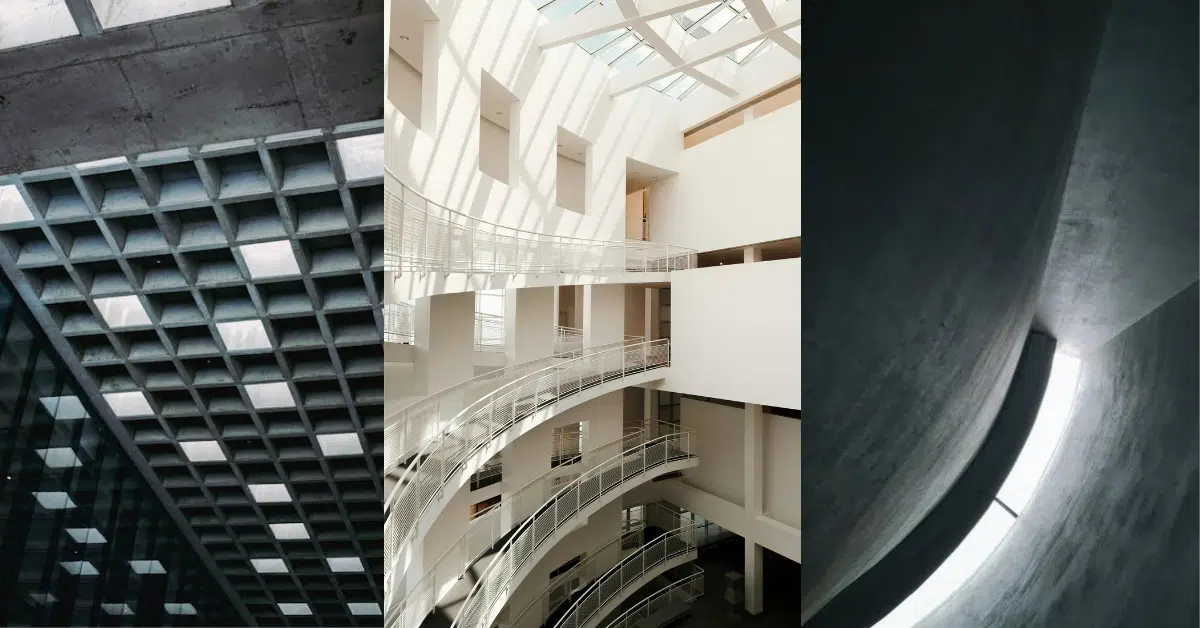
Natural light filters through large openings from above, creating a calm balance between openness and enclosure. The play of shadow and transparency generates a visual rhythm that encourages exploration.
Every spatial gesture conveys a philosophical progression from isolation to connection, from silence to dialogue, from individuality to collaboration mirroring the intellectual journey that the center seeks to inspire.

Philosophical Layer of the Design
Beyond its physical form, the project reflects a conceptual philosophy of lifelong learning. Just as geological layers evolve through time, the center was designed to adapt to the continuous transformations of human knowledge.
Its fluid geometry expresses movement and change a metaphor for learning as a perpetual process rather than a fixed state. Curves, transitions, and open spaces replace rigid boundaries, creating an architectural narrative where ideas can flow freely and evolve.
This approach transforms the building into more than a container for activities; it becomes a living organism that embodies the intellectual and emotional dynamics of discovery.
Sustainability as an Architectural Ethic
Sustainability in the Yidan Center is not limited to technical solutions it is an ethical framework guiding the entire design.
The façade integrates adjustable shading elements that optimize daylight while reducing heat gain. Solar energy and rainwater collection systems operate through a self sufficient environmental loop.
These strategies align with the project’s central theme of balance: balance between people and nature, between light and shadow, between innovation and preservation. The architecture does not impose itself on the environment but grows from it, maintaining a symbiotic relationship with its context.

Human Experience Within the Center
The Yidan Center functions as an open educational community where space itself acts as a teacher.
Public areas encourage interaction, reflection, and experimentation. Movement through the building becomes a sensory and intellectual experience each level, passage, and garden offering a new perspective.
The architecture invites users to participate rather than observe, positioning learning as a spatial event that unfolds through light, texture, and rhythm. This immersive environment allows the individual to feel part of something larger than architecture a shared ecosystem of thought and creativity.
Conclusion
The Yidan Center in Shenzhen stands as more than a cultural complex; it is an architectural manifesto of learning as an ongoing journey. The project unites natural beauty with human curiosity, presenting a model for how built environments can nurture collective intelligence.
In a rapidly changing world, the Yidan Center reaffirms the idea that architecture’s true power lies not in its form but in its ability to inspire, connect, and sustain the search for meaning.

Summary Table
| Element | Description |
|---|---|
| Project Name | Yidan Center Shenzhen |
| Location | Shenzhen, China |
| Primary Function | Educational and cultural innovation center |
| Design Concept | Valley inspired form symbolizing learning and exchange |
| Architectural Features | Layered terraces, inner courtyard, natural lighting |
| Materials | Concrete, double glazing, adaptive shading elements |
| Sustainability | Solar energy, rainwater recycling, natural ventilation |
| Philosophical Message | Lifelong learning as a spatial and social experience |
✦ ArchUp Editorial Insight
The Yidan Center in Shenzhen offers an architectural experience that transcends form to embody thought itself. The structure unfolds as a living organism breathing light and air, its organic lines balancing openness with introspection. The design approach reflects a profound understanding of the relationship between space and knowledge, transforming circulation areas into zones of intellectual exchange. This architectural language elevates the project beyond a conventional building it becomes an open laboratory for ideas, celebrating learning and creativity as essential elements of the human experience.
ArchUp provides an updated reference featuring key global architectural exhibitions and design forums, along with a dedicated space for competitions and results in a daily analytical context.