
A Global Architectural Competition for the Design of the Museum of the Baptism of Christ in Jordan: Visions Inspired by History and Nature

Introduction: A Heritage Site Prepares for a New Architectural Masterpiece
In an ambitious cultural move, August 2024 saw the announcement of a shortlist of seven global architectural firms to design a new museum at the site of Jesus Christ’s baptism in Bethany, Jordan. This project represents a focal point in the development plan for the 340-acre Baptismal Site Development Zone (BDZ), aiming to enhance the spiritual and cultural experience for visitors and pilgrims. The project, under the royal patronage of His Majesty King Abdullah II bin Al-Hussein and partially funded by donors from The Church of Jesus Christ of Latter-day Saints, seeks to create a distinguished building that respects the site’s sanctity and responds to its environmental uniqueness.

The Architectural Proposals: Seven Creative Solutions for a Unique Design Challenge
Malcolm Reading Consultants recently unveiled the design proposals from the seven firms, showing remarkable creative diversity in dealing with the sensitive site, which is classified as a UNESCO World Heritage Site. Despite this diversity, common themes can be discerned in many of the designs, most notably the use of low-slung, barrel-vaulted forms, the application of local building materials, and the integration of water channels as a key design element reflecting the symbolism of the place.
- AAU Anastas: Architecture as a Vessel for Memory and Environmental Transformation
In collaboration with landscape designer Florent Claer and lighting consultants Studio Gelatic, AAU Anastas presented a vision for a museum that blends into the surrounding terrain. The proposal, constructed from local basalt, responds to the challenges of extreme heat and low oxygen in the Great Rift Valley. The design features an undulating roof reminiscent of SANAA’s ‘Grace Farms,’ leading to shaded subterranean spaces that serve as a refuge from the sun. Visitors walk along a winding path beside water channels, attempting to narrate the story of environmental transformations and humanity’s relationship with water and time.

- Heneghan Peng Architects: Inspired by Layers of Geology and History
Following their experience in creating the ‘Palestine Museum’ in the West Bank, the Irish firm returns with a design inspired by the site’s geological and cultural layers. In partnership with Agence Ter for landscape design, the proposal features a dramatic entrance through a series of pergolas that guide visitors on an exploratory journey towards the main building. Exhibition spaces are crowned by gently curved barrel vaults, with exposed structural details, in a nod to the structural poetry famously employed by Louis Kahn at the Kimbell Art Museum.
- Níall McLaughlin Architects: Geometric Symbols and a Dialogue with Nature
The British firm collaborates with Kim Wilkie for landscape design and Nissen Richards Studio for exhibitions to present a design based on earth and stone. The proposal is distinguished by two opposing main entrances, one triangular and one circular, symbolically referencing “life in Christ as the Alpha and the Omega.” Large canopy columns point towards the entrance, while elevated clerestories provide serene panoramic views of the Jordan River and the historic pilgrimage route, creating a specific dialogue between the architecture and the natural landscape.
- Studio Anne Holtrop: A Single Roof Plane Dialoguing with Sky and Earth
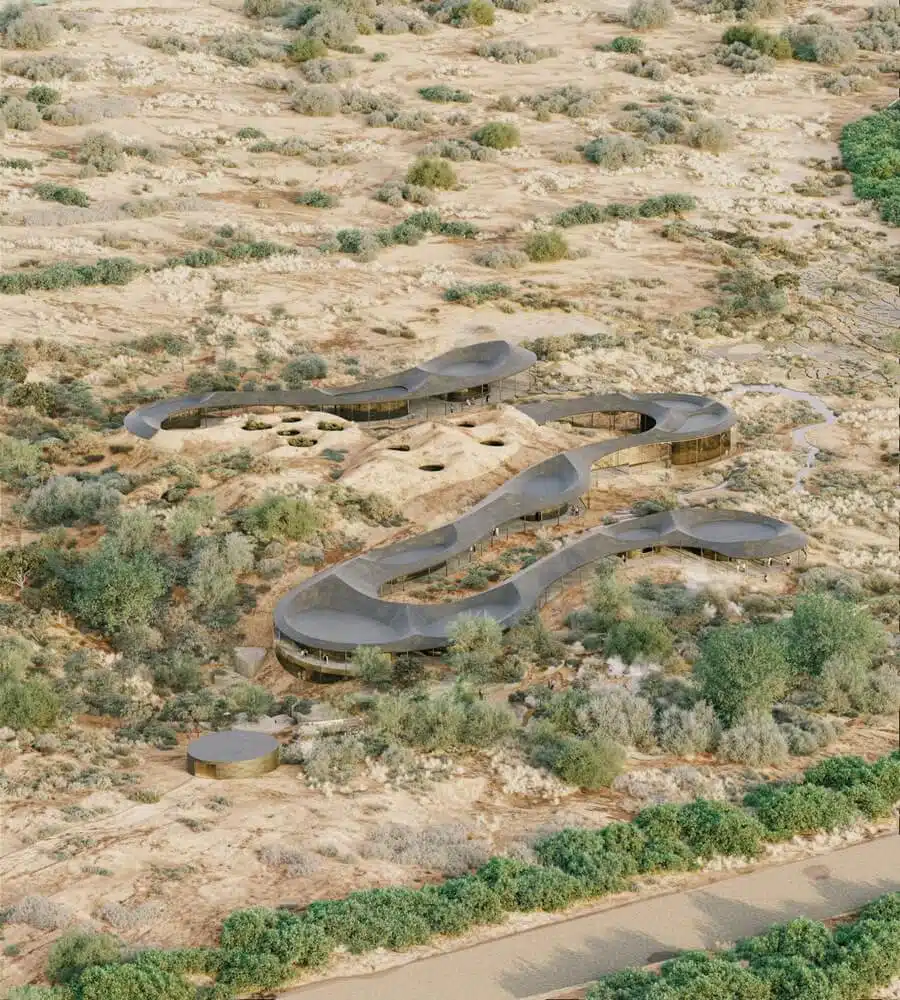
Studio Anne Holtrop presents a bold vision embodied in a single, expansive roof plane that meticulously follows the site’s natural topography. This roof is punctured by regular geometric openings that allow sunlight to filter through, evoking the play of light and shadow seen at the ‘Pearling Path’ Museum in Bahrain. The design extends beyond the museum to include an arboretum supporting research on local plants, making it an integrated cultural and environmental project.
- Tatiana Bilbao ESTUDIO: Embodying the Act of Immersion in Space and Water
The Mexican firm’s proposal is rooted in the fundamental concept of baptism: immersion. The design envisions a low-level platform supported by a system of columns, with its spaces organized by an orthogonal grid broken by conical forms and light wells. In collaboration with Bureau Bas Smets for landscaping, a water channel flows through the site, not only as an aesthetic element but also as an effective means of natural cooling, creating a full sensory experience for the visitor.
- Toshiko Mori Architect: Dispersed Vaults and an Exploration of Knowledge
Architect Toshiko Mori proposes a unique museum experience through a modest series of barrel vaults that radiate from a single central point across the site. Unlike the traditional linear model, this design encourages visitors to explore various pavilions and gardens covering diverse themes including botany, geology, archaeology, and anthropology. Clerestories in the vaults ensure the provision of diffused natural light, while the roof forms echo the contours of the surrounding valley.
- Trahan Architects: Submerged Architecture and a Spiritual Ascent
Trahan Architects offers a humble design submerged underground, using locally sourced rammed earth. This approach enhances the site’s natural watershed system while transforming the building’s roof into productive gardens. The visitor’s path is designed to reflect the journey of baptism itself, initially descending downwards before gradually ascending towards the light and the holy site, in a powerful symbolism of transformation and rebirth.

Conclusion: Awaiting the Announcement of the Winning Masterpiece
These seven proposals represent diverse global perspectives on how to build a future heritage in a sensitive historical location. Each design provides a unique answer to the question of balancing historical respect, architectural innovation, and environmental sustainability. The winning design is expected to be announced in the coming months, marking the start of the implementation of a project that will become a landmark on the map of cultural architecture in the region and the world.


✦ Archup Editorial Insight
The article presents seven competing architectural proposals for a museum at the site of Christ’s Baptism, all focusing on integration with the natural environment and the use of local materials. From an architectural reading, it is notable that some designs rely on creating underground or submerged spaces as a solution to climatic conditions, which raises a question about the relationship between the architectural experience and the connection to the historical site through the sensation of light and direct visual connection to the sky and the river. Furthermore, the repetition of the barrel-vault motif in multiple designs may present a challenge to achieving a distinct visual and functional identity for each project. On a positive note, the collective focus on local resources and passive cooling strategies represents a practical and conscious response to the region’s environmental and sustainability conditions.
Brought to you by the ArchUp Editorial Team
Inspiration starts here. Dive deeper into Architecture, Interior Design, Research, Cities, Design, and cutting-edge Projectson ArchUp.




The seven proposals for the Baptism Site Museum represent a model of contextual modernity, utilizing local basalt and rammed earth in a sensitive, UNESCO-protected historical site. While many of the designs adopt low-rise or submerged architecture with repeated barrel arches to address the thermal performance of the rugged gorge, this collective approach raises critical questions about achieving the desired spatial dynamism. Although successful in environmental sustainability, the designs risk undermining the core of the visitor’s cultural and spiritual experience, as excessive submersion could impede vital visual connection to the Jordan River and the sky, thus limiting the architectural ambition necessary for such a global landmark. Nevertheless, the unified focus on passive cooling strategies and the integration of local resources sets a crucial precedent for cultural development in arid regions.