A House That Melts into the Garden Redefines Domestic Boundaries in Madrid

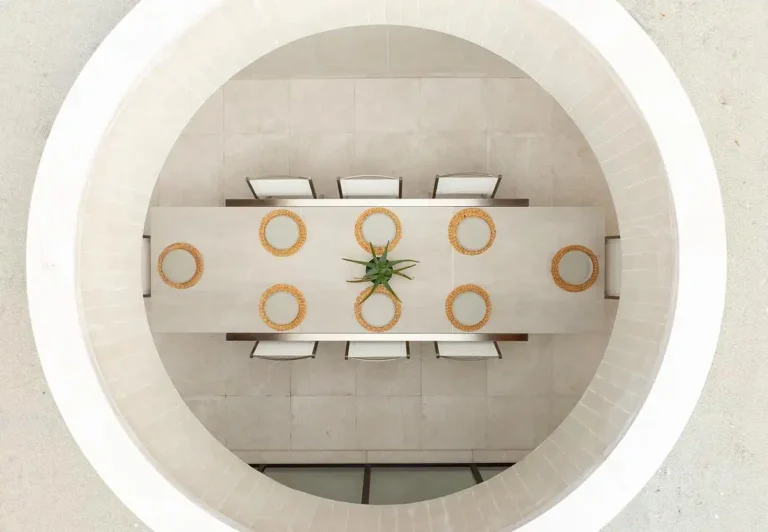
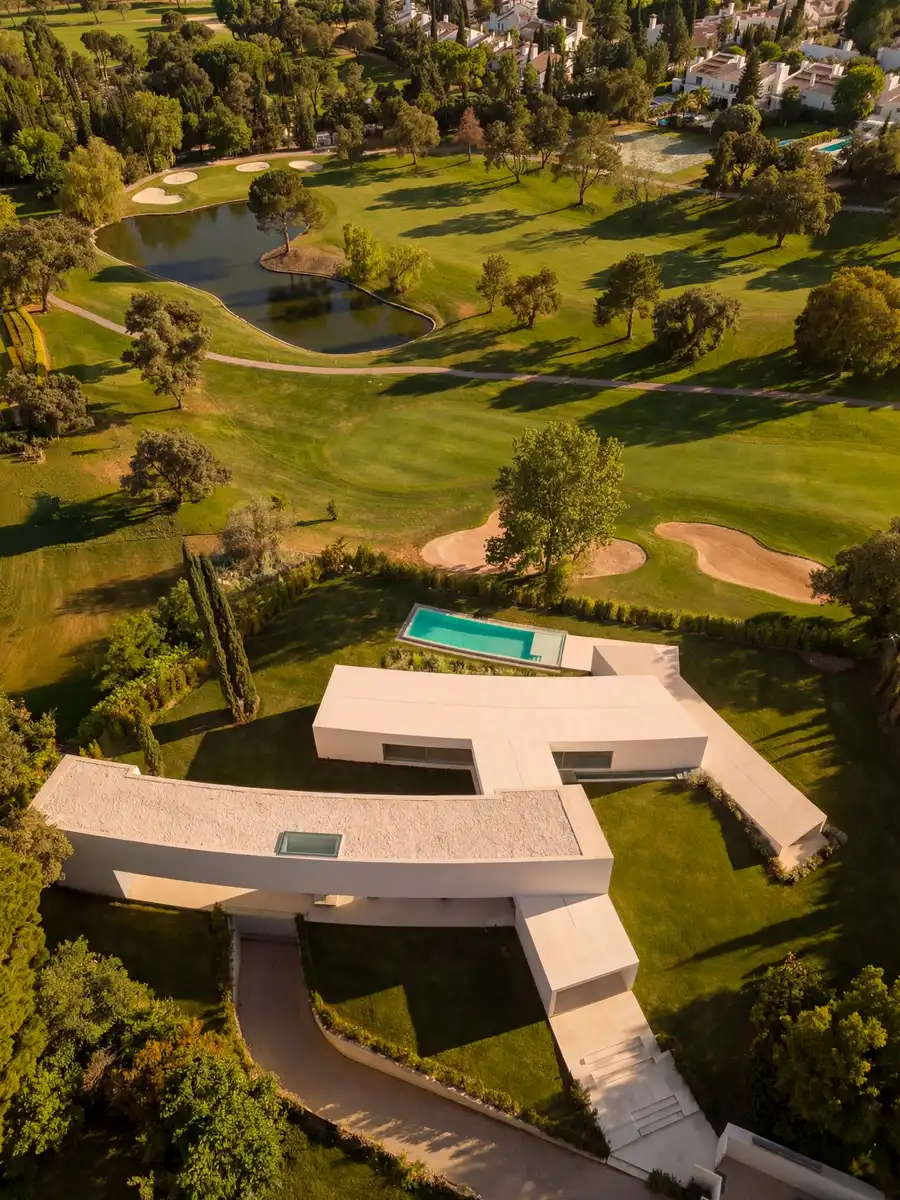
A house that melts into the garden emerges in La Moraleja, Madrid, not as a statement but as a spatial negotiation between dwelling and landscape. This house that melts into the garden dissolves conventional thresholds through longitudinal volumes and curated voids. The result is a residence where the garden is not adjacent but integral a house that melts into the garden structurally, perceptually, and temporally.
Design Concept: Architecture as Landscape Continuation
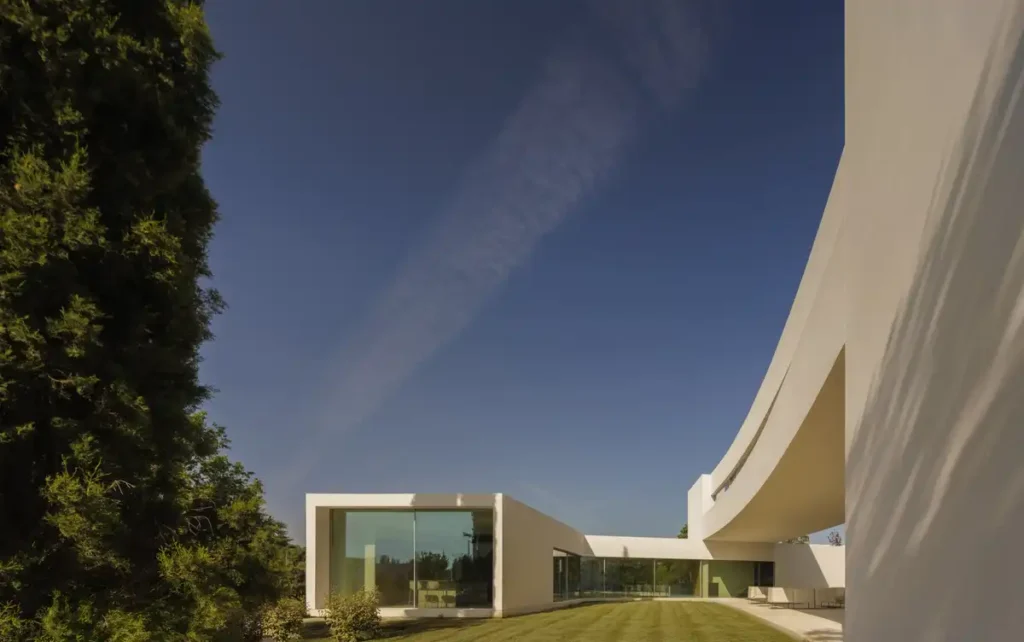
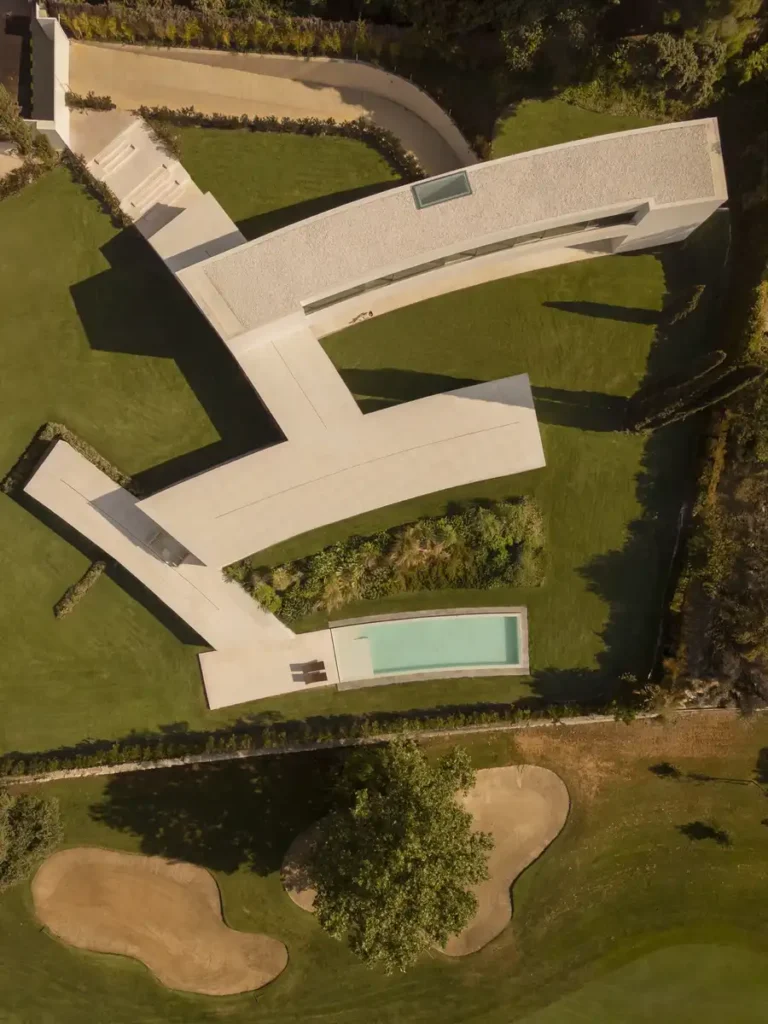
The project rejects monolithic massing in favor of two gently ascending ribbons that follow the natural slope of the site. Each ribbon measures 28 meters in length and 4.2 meters in width, calibrated to balance privacy and outward views. Between them, five open air interstices form distinct garden zones, each designed to accommodate future growth of large canopy trees like holm oak and olive. The layout draws from ancestral typologies the pavilion and the courtyard but reinterprets them as fluid, interconnected domains rather than static enclosures. This approach aligns with broader explorations in architectural design that prioritize experiential continuity over formal autonomy.
Vertical circulation centers on a concrete core that links three levels without corridors. The lower level houses guest rooms and a swimming pool that visually extends into the front lawn. The intermediate floor contains day spaces oriented toward a nearby lake, while the uppermost volume configured as a bridging element contains private quarters and casts shade over an outdoor terrace below. Movement through the house mimics a slow ascent through terrain, reinforcing the idea that architecture can function as topography.
Materials & Construction: Honesty Over Ornament
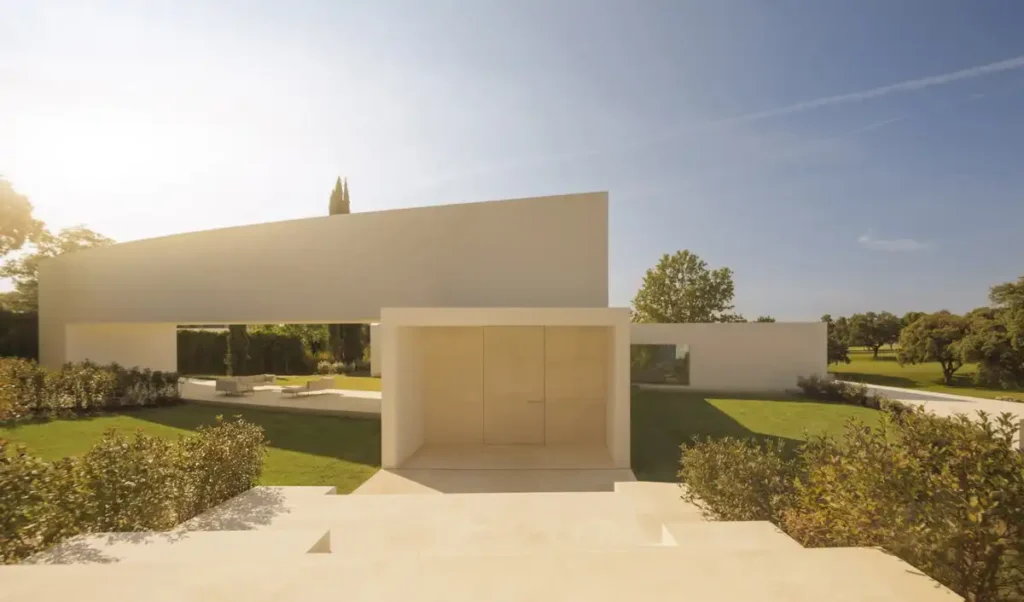
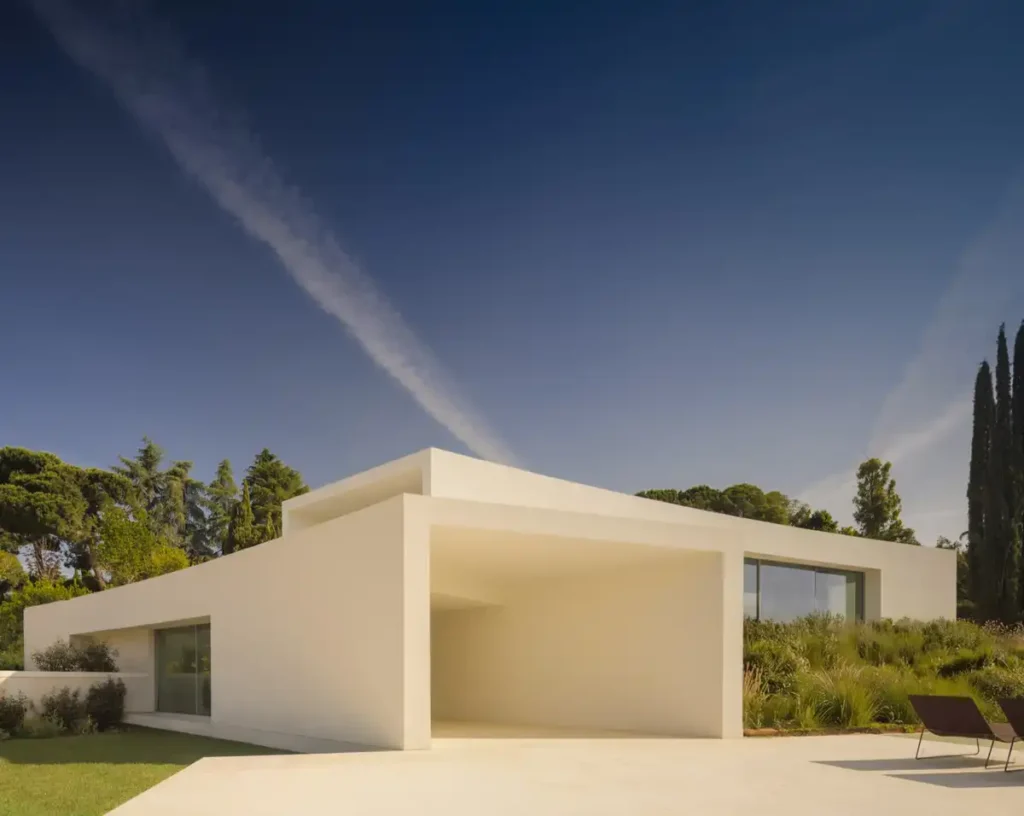
The structure relies on exposed, site poured concrete with a smooth finish, left untreated to weather naturally. Walls are 30 cm thick, providing passive thermal mass that reduces reliance on mechanical systems. Glazing consists of triple-layer insulated units (6–12–6 mm configuration), selected for low reflectivity and high visual transparency. Interior surfaces use European oak treated with natural oils, avoiding synthetic sealants.
These choices reflect a material philosophy documented in building materials studies, where longevity and environmental responsiveness outweigh aesthetic novelty. No decorative cladding or applied finishes appear; instead, the building reveals its assembly logic. Even drainage channels in outdoor stone paving are integrated into the structural grid, demonstrating how construction details can serve both function and form.
Sustainability: Growth as a Design Parameter
Sustainability here is not performance certified but embedded in the design’s temporal logic. Each garden void includes soil beds at least 1.2 meters deep, allowing mature trees to root without artificial containment. Passive cross-ventilation achieved through gaps between ribbons reduces cooling demand by an estimated 40% during spring and autumn. The absence of artificial turf, potted plants, or irrigation-dependent landscaping further minimizes resource consumption.
This strategy resonates with principles outlined in sustainability frameworks that prioritize ecological succession over instant visual completion. The house does not present a finished image but a scaffold for future ecological integration. In this sense, the project functions less as a building and more as a substrate a stance increasingly visible in global news on climate-responsive housing.
Urban Impact: Suburban Reconsidered
Located in La Moraleja a low density enclave north of Madrid the villa challenges conventional suburban models that isolate structures within manicured lawns. Instead, it proposes density through layering: overlapping programs, stacked sightlines, and interleaved green spaces. While the site remains private, its design logic questions whether suburban residences must default to enclosure.
This raises broader questions about cities and peripheral development. Can single family homes contribute to landscape continuity rather than fragment it? The project offers a quiet counterpoint to Madrid’s expanding periphery, where speculative housing often ignores topography and microclimate. It also joins a growing international discourse visible in the archive of unbuilt and built propositions that reimagine domesticity beyond the parcel boundary.
The residence does not announce itself on the street. Its presence is discovered through movement and seasonal change. As such, it avoids the promotional tone common in contemporary housing and instead aligns with documentary approaches found in critical editorial practices. No future expansions are planned; the design assumes its final form only after decades of botanical growth.
Could this model of gradual integration offer an alternative for other Mediterranean suburbs facing ecological stress and sprawl?
Architectural Snapshot: A 28 meter long concrete ribbon house in Madrid unfolds across a sloped site, generating five future gardens through spatial voids and passive environmental strategies.
ArchUp Editorial Insight
Villa Lago in La Moraleja presents itself as an organic extension of landscape through fragmented pavilions and curated voids. The design abandons monolithic massing in favor of meandering ribbons that generate five interstitial gardens yet this very strategy risks aestheticizing isolation under the guise of ecological sensitivity. While the precise 4.2 meter width modulates light and privacy with archival discipline, the project’s hermetic calm sidesteps Madrid’s suburban sprawl rather than engaging it. Credit goes to its material restraint: raw concrete and triple glazed transparency avoid decorative pretense. Still, by scripting nature as a backdrop rather than a participant, the villa may age not as a living document but as a beautifully sealed capsule elegant, inert, and increasingly out of sync with urgent urban ecologies.