Wood and Mountain Cabin: Timber, Privacy and an Open Terrace

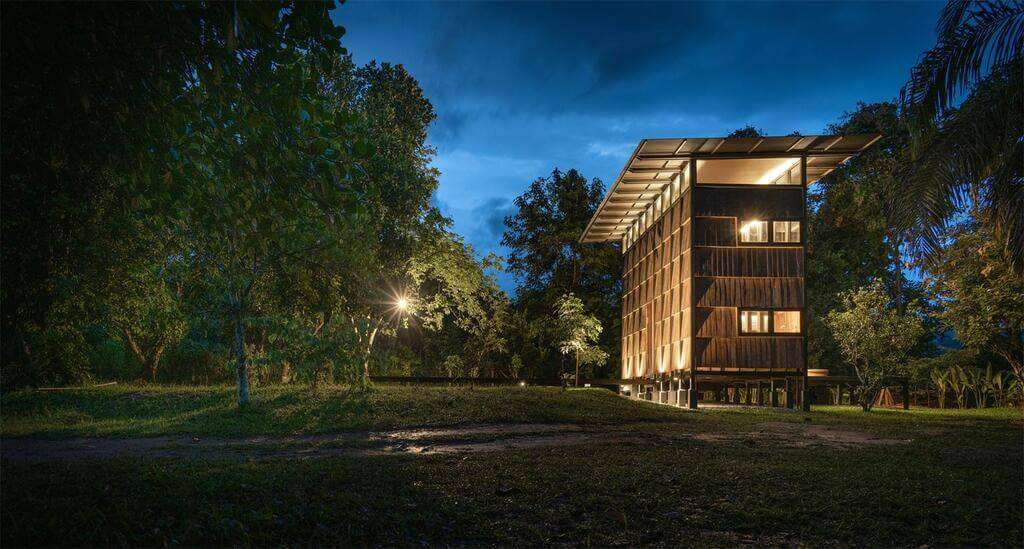
At Wood and Mountain Cabin in Mae Rim, Chiang Mai, the relationship with the landscape is selective. Sher Maker’s 2021 retreat places a largely enclosed timber envelope around a living space that opens toward a terrace. Its architectural interest lies in that change of exposure: the same small building offers a sheltered approach and a broad outlook.
A narrow approach, then an open edge
The paired exterior photograph shows a raised walkway meeting a doorway in a wall of timber panels. Dark structural members divide the surface into a legible grid. Rather than announcing the interior through a large glazed entrance, this side keeps the opening small within the wall. Crossing the threshold therefore changes the degree of visual connection with the surroundings.
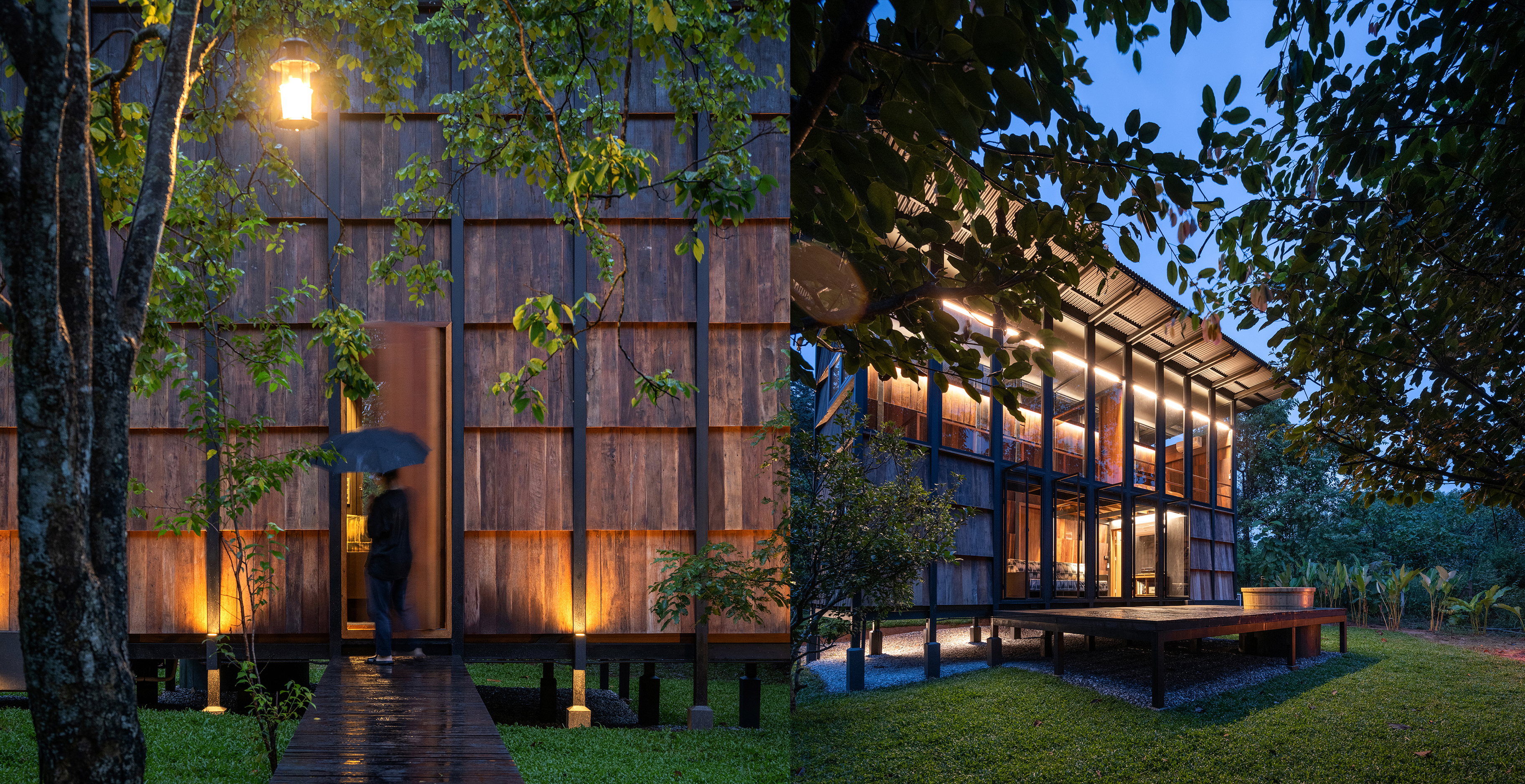
On the opposite side, tall glazed openings connect the rooms to the deck. The terrace projects beyond the enclosed volume, giving occupants somewhere to step outside without immediately descending to the ground. This intermediate surface matters: the landscape becomes a place to occupy at the edge of the room, as well as something to look at.
The frame sets a rhythm; the wood varies within it
In the wider exterior view, the roof extends beyond the wall line, with its underside and supporting members exposed. The vertical frame continues across both opaque and glazed parts of the elevation. That continuity holds together surfaces with very different jobs: timber screens views, while glazing opens them.
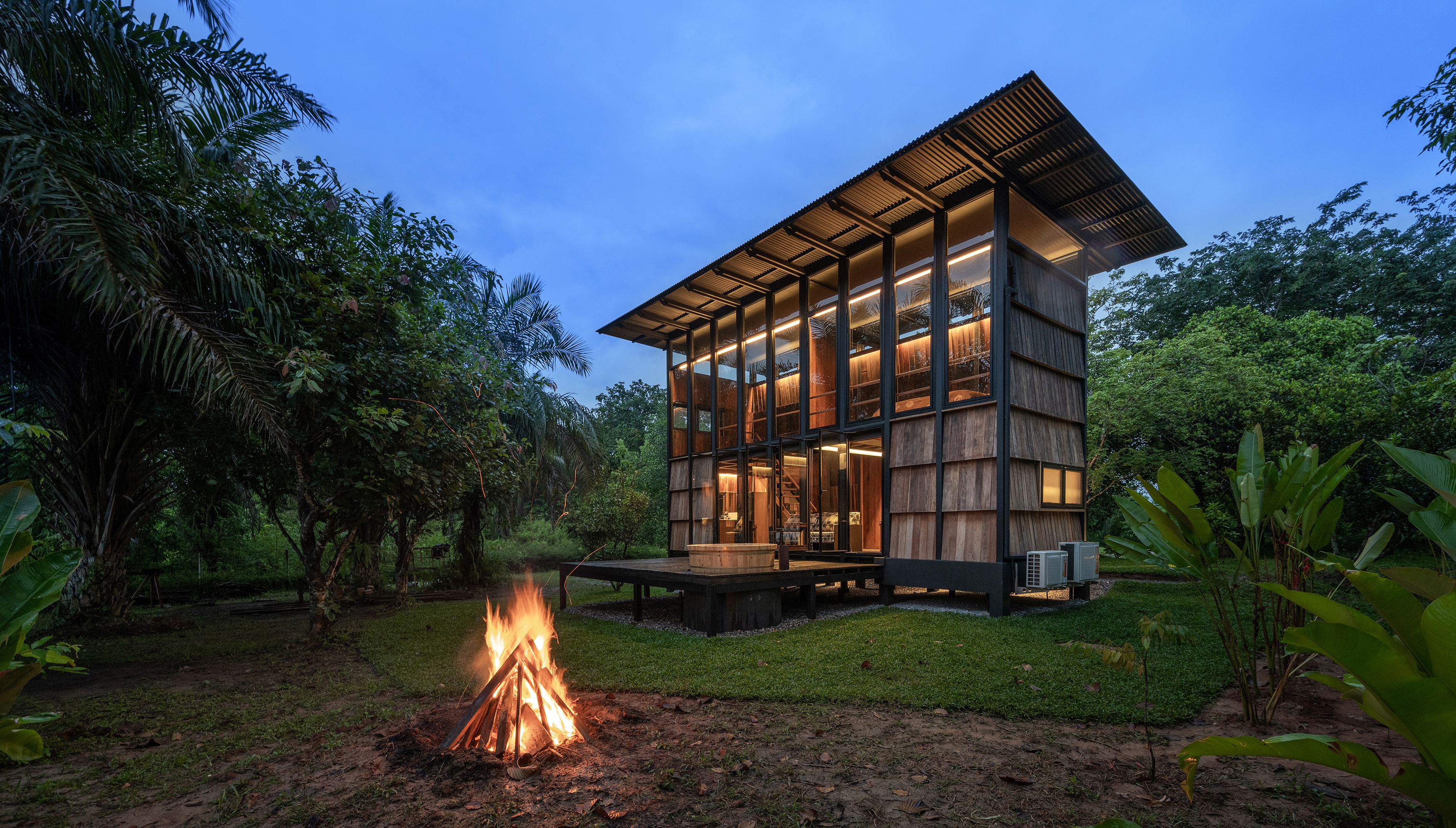
Sher Maker describes sourcing used timber locally, then sorting, sanding and charring the boards before assembling them. The photographs show a range of brown and dark tones rather than one uniform black surface. Within the regular frame, those differences remain visible at the scale of individual boards. Reuse here involves selection and fabrication, not simply substituting an old material for a new one.
The studio tested wall mock-ups in its workshop and adapted a charring process associated with Japanese yakisugi. That documented process supports a reading of the façade as assembled craft. It does not, by itself, establish a maintenance interval or prove the building’s environmental performance.
Living below, sleeping above
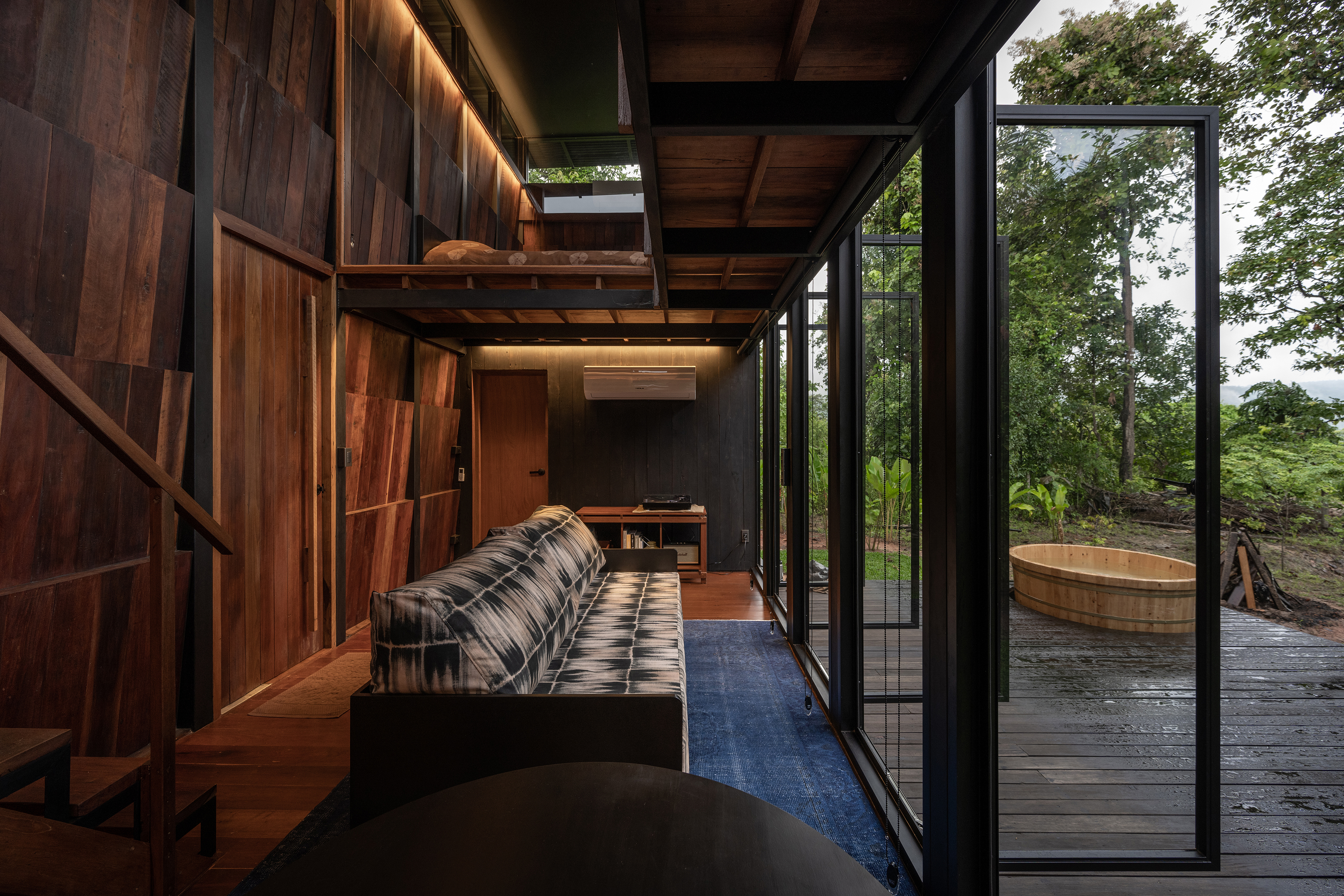
Inside, the sofa runs beside the glazed edge. Open door leaves make the transition to the deck visible from the seating area, while the upper sleeping platform gives part of the room a lower ceiling. This creates different spatial conditions within a compact volume: shelter beneath the platform and a taller zone alongside it.
The timber wall combines boards of differing tones; the darker frame outlines their limits. A blue rug and patterned upholstery stand apart from that background, making the sitting area readable without an enclosing partition. Light along the upper wall catches the timber surface and marks the height of the room. These are visible effects of arrangement and illumination, rather than evidence of measured thermal or acoustic comfort.
✦ ArchUp Editorial Insight
The project brings together two documented requirements: privacy along the enclosure and a view toward the mountains. Its strongest decision is to give these requirements different edges of the building. The entrance remains contained within a timber wall, while the living space opens to a deck. This produces a useful sequence of exposure rather than treating transparency as an automatic virtue. The photographs also suggest why the structural grid matters beyond appearance: it makes a varied collection of boards readable as an ordered envelope, while leaving their differences visible. That is a transferable design lesson for reused material, although it does not remove the work of sorting, testing and fitting it. The upper sleeping level adds another distinction, between the lower space beneath its floor and the taller space beside it. For occupation, the open relationship between these levels raises a practical question about privacy between sleeping and living activities; the photographs cannot establish sound separation. The cabin is most convincing when read through these specific relationships—threshold, deck, frame and platform—rather than through an unqualified promise of simplicity or sustainability.
Project credits: Wood and Mountain Cabin, Mae Rim, Chiang Mai, Thailand, 2021. Architecture: Sher Maker. Photography: Rungkit Charoenwat.