

Ajdan Island in Khobar is a new mixed-use tourism project.

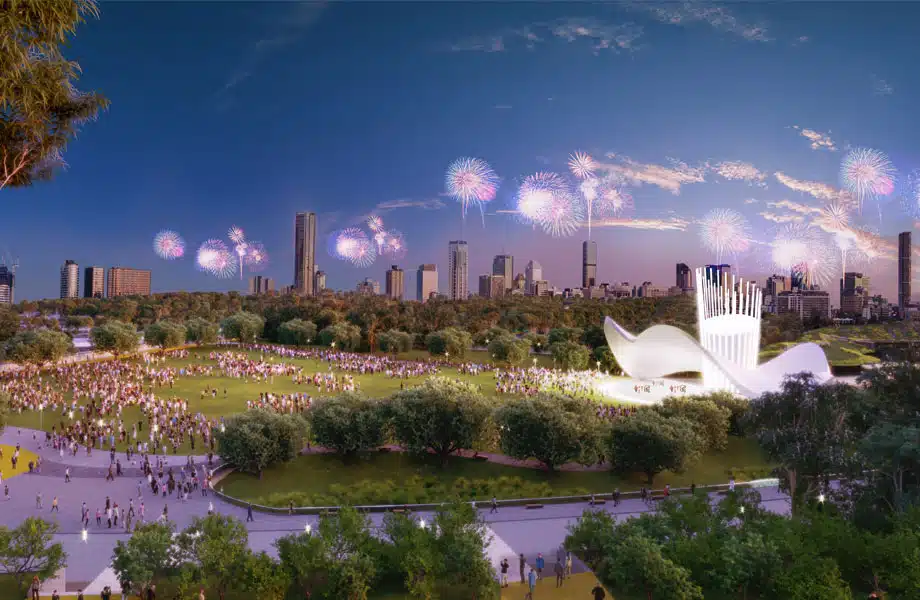
Ajdan Island is advancing as a reclaimed coastal project in Khobar, designed as a mixed use tourism destination featuring sea view cafés, commercial zones, entertainment offerings, and an open air theater. This development reflects a broader regional shift toward experiential leisure infrastructure in Saudi coastal cities. Backed by the Tourism Development Fund and coordinated with the Eastern Province Municipality and Ajdan Company, the project specifically targets underutilized shoreline segments along Khobar’s eastern edge to improve public access to the waterfront.

Design Concept
The island’s masterplan uses a radial configuration to optimize sea views across all functions. Curved pedestrian routes frame vistas of the Arabian Gulf, linking built form with the marine context. Yet the design leans on conventional waterfront motifs such as reflective glass façades and generic walkways without distinctive architectural expression. Similar approaches appear in other Gulf projects archived in the archive, where experiential programming often overshadows formal originality. This raises questions about the project’s contribution to regional architectural design discourse.

Materials and Construction
Marine-grade reinforced concrete and corrosion-resistant steel assemblies are being deployed to ensure durability in the saline coastal environment. Prefabricated modular units for cafés and retail hint at off site construction, a method widely adopted in Saudi Arabia for speed and cost control. Foundations use deep pile techniques to anchor the artificial island against tidal movement and subsidence a standard practice for reclaimed land, as observed in comparable regional buildings. These choices prioritize resilience over material innovation, relying on established building materials suited to harsh climates.

Sustainability
No verifiable data on energy use, water recycling, or ecological impact has been published. Basic climate adaptations like shaded paths and low water landscaping are present, but systems for renewable energy or marine habitat protection are absent. This falls short of international coastal sustainability norms, where regenerative design is increasingly expected. Without transparent benchmarks, the project’s long-term environmental footprint remains uncertain a gap noted in recent research on Gulf tourism developments.

Urban Impact
Ajdan Island aims to ease pressure on Dammam’s crowded waterfront by extending Khobar’s leisure zone eastward. Yet access relies on a single road connection, with minimal alignment to regional cities transit strategies. Should visitor numbers surpass capacity, traffic congestion and coastal degradation may follow. The project’s integration into broader urban infrastructure and its ability to avoid isolated “island” development will be critical. Such challenges are frequently examined in editorial critiques of leisure-driven urbanism in arid coastal zones.
Architectural Snapshot: A radial artificial island in Khobar featuring cafés, retail, and an open air theater, built on reclaimed land with marine-resistant materials but lacking disclosed sustainability benchmarks.
Will Ajdan Island establish a new model for coastal tourism or simply repackage familiar formulas under a new name?
ArchUp Editorial Insight
The coverage of Ajdan Island presents a polished narrative of experiential tourism, aligning with regional ambitions yet echoing familiar Gulf waterfront tropes mirrored façades, radial promenades, and prefabricated leisure pods. The omission of ecological metrics or transit integration reveals a promotional framing disguised as urban news, common in state-backed developments. One credit: its attempt to activate underused shoreline offers a rare spatial intervention in Khobar’s coastal sprawl. Yet without deeper environmental accountability or architectural distinction, such islands risk becoming ephemeral backdrops rather than enduring urban fixtures.




ArchUp: Technical Analysis of the Ajdan Island Project in Al Khobar
This article provides a technical analysis of the Ajdan Island tourism project as a case study in the development of reclaimed waterfronts in the Eastern Region. To enhance its archival value, we present the following key technical and design data:
The project is based on a radial layout centered around a sculptural central tower, designed to maximize sea views towards the Arabian Gulf. The island was created through a land reclamation process, with soil stabilization using deep foundations and waterproof barriers to prevent subsidence and resist tidal forces. Core structures utilize sulfate-resistant high-strength reinforced concrete and corrosion-inhibitor coated steel to protect against the high humidity (up to 75%) and elevated salinity levels of the coastal environment.
The design is characterized by a functional focus on creating open, shaded public spaces. Key components include an open-air theater with a capacity of over 500 people, and café/commercial areas with extensive glazing constituting up to 80% of the waterfront facades to enhance visual connection. Approximately 30% of the island’s area is dedicated to pedestrian pathways and parks, landscaped with local salt-tolerant plants to reduce irrigation water consumption.
In terms of operational challenges, poor integration with existing public transport networks stands out as a key risk. Access relies primarily on a single vehicular entrance, potentially causing traffic congestion during peak visitation exceeding 5,000 visitors per day. Furthermore, the project lacks a clear declaration of sustainability standards, with no published data on renewable energy systems or water recycling, weakening its position compared to global coastal projects adhering to environmental certifications (such as LEED or ESTIDAMA).
Related Link: Please refer to this article for a broader discussion on coastal urban development challenges:
Cultural Shift: Redefining the Relationship Between Civic, Cultural, and Social Functions
https://archup.net/leporte-residence-redefining-australian-architecture-in-a-coastal-embrace/