
Arc ZERO: Eclipse Seoul Recognized at LIT Lighting Design Awards

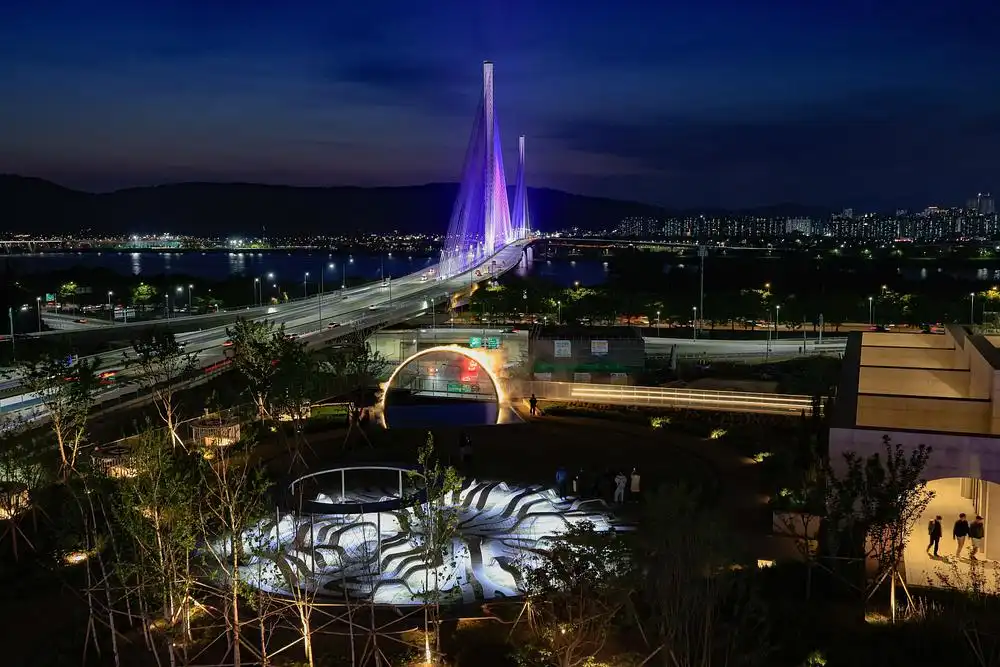
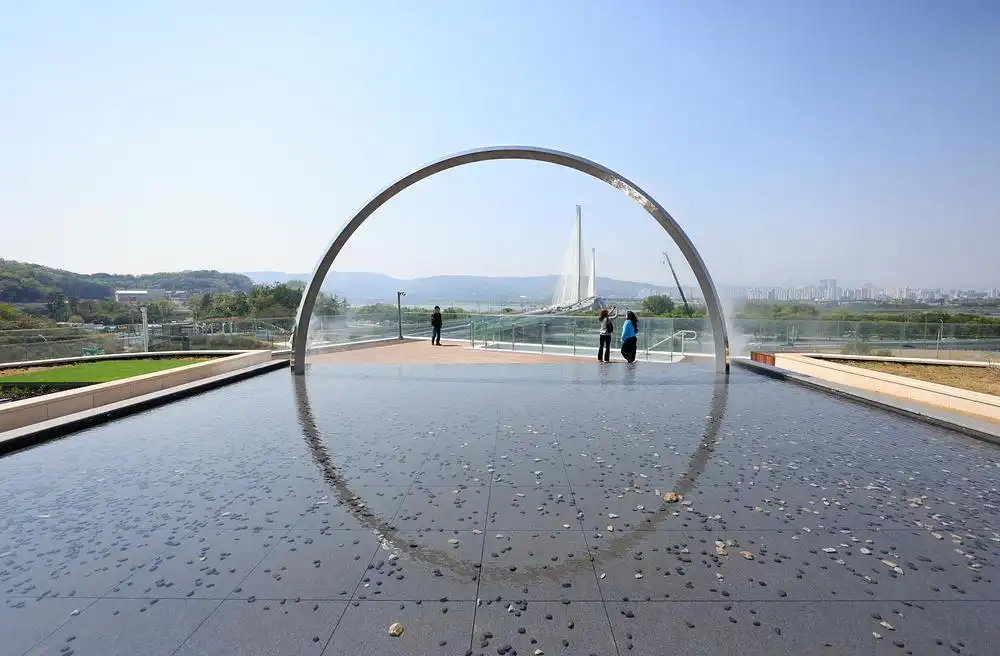
Arc ZERO Eclipse in Seoul is a light and mist installation . It is located on the rooftop of a mixed use building in Godeok, southeast Seoul. The work belongs to the Arc ZERO series, which uses elemental materials instead of digital effects. The installation explores perception through simplicity, frames a bridge through its mirrored half ring, and balances visual clarity from a distance with sensory subtlety.
Design Concept
This version reinterprets the 2017 Arc ZERO Nimbus from Japan. That piece wrapped around bridges for full immersion. Here, the half ring floats above a custom infinity pool. Its reflection completes the circle. The diamond profile form minimizes self-reflection, preserving visual continuity. Positioned on a rooftop garden, it faces the Han River and a key bridge. Drivers on the nearby freeway can see its luminous mist at night. This aligns with trends in architectural design, where art mediates infrastructure and environment.

Materials & Construction
The ring uses a bespoke diamond-shaped aluminum profile. Fabrication was technically demanding. Mist comes from low temperature vapor generators. Programmable LEDs emit directional light. The reflecting pool was built specifically for the piece. It integrates with the building’s drainage and maintenance systems. These choices reflect current approaches to building materials. Unlike past versions, this one avoids enclosing viewers. It keeps the visual field open to the city. Documentation of earlier iterations appears in the archive.

Urban Impact
Godeok is a fast-growing district in Seoul. The installation adds to the city’s civic art portfolio. It was commissioned by The Ton, Seoul’s public art agency. The corner site was selected for its sightlines. The piece is visible from afar at night. It joins another permanent version in Kaohsiung, Taiwan. No future demolition or relocation plans exist. Its presence contributes to debates about art in cities.

Conclusion
As urban spaces increasingly host experiential art, Arc ZERO Eclipse in Seoul prompts reflection. Can minimal, elemental works maintain intimacy at city scale?
Architectural Snapshot: A half ring of mist and light completes itself in water, silently framing Seoul’s infrastructure through elemental minimalism.
ArchUp Editorial Insight
The article presents Arc ZERO Eclipse in Seoul as a poetic extension of an international series, blending sensory description with technical detail while sidestepping critical inquiry into its role within private development. It frames minimalism as inherently meaningful, without interrogating its instrumentalization. Still, the deliberate elimination of viewer reflection offers a subtle commentary on urban surveillance. Whether such works endure beyond their moment of spectacle remains an unspoken question.





ArchUp: Technical Analysis of the Ark Zero Eclipse Art Installation in Seoul
This article provides a technical analysis of the “Ark Zero Eclipse” installation as a case study in experimental public art that merges formal simplicity with technical complexity. To enhance archival value, we present the following key technical and design data:
The installation features a semi-circular form crafted from specially polished, diamond-shaped aluminum, with a diameter of approximately 8 meters and a weight of nearly 1.5 tons. It is mounted at a calculated height above a purpose-built 15 cm deep reflection pool, designed to create a perfect visual reflection that completes the circle. Low-heat vapor generators produce mist surrounding the structure, while programmable LED fixtures provide focused lighting with an intensity of up to 1500 lumens, with total energy consumption below 3 kW/h.
In terms of visual and perceptual performance, the diamond-shaped cross-section of the metal structure is designed to minimize the reflection of viewers and the surrounding environment on its surface, preserving the purity of its form and enhancing the effect of weightlessness and surrealism. The installation operates in two modes: a daytime mode relying on natural reflection and mist, and a nighttime mode where it becomes a luminous beacon visible from the nearby highway from a distance of 2 kilometers. Its angular rooftop location offers variable visual frames toward the Han River and the Banpo Bridge.
Regarding urban integration and operation, the installation was commissioned by Seoul’s public art agency (The Tone) at an estimated cost of about 500 million Korean won (approximately $375,000). It was integrated with the drainage and maintenance systems of the host mixed-use building in the rapidly developing Godeok district. There are no plans for removal, making it a permanent artwork that contributes to the area’s visual identity as a cultural and social landmark.
Related Link: Please refer to this article for a comparison of other public art projects redefining the relationship between art and urban space:
The Aura Effect: How Media Narratives Shape Taste, Emotion, and Architecture
https://archup.net/miranda-chang-studio-design/