

Artificial Intelligence in Architecture: An Innovative Partner or a Challenge to Human Creativity?

At a Crossroads: AI is Changing the Rules of Architectural Design
Architect Tim Fu took a bold step by leaving Zaha Hadid Architects (ZHA), driven by his ambition to expand the horizons of AI application in architecture. This decision was not merely a career move but a declaration of a new phase in the relationship between design and modern technologies.
A Project at the Heart of Nature: Seven Villas on the Shores of Lake Bled
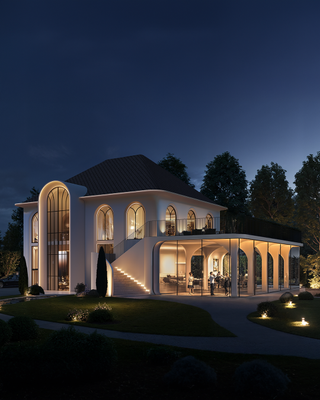
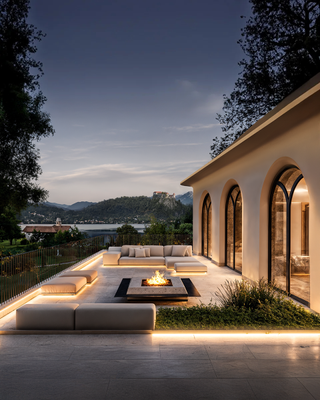
In this context, Fu recently unveiled the design of seven luxury villas in Slovenia, reflecting a conscious integration between human creativity and the technical capabilities of artificial intelligence. The project covers an area of approximately 22,000 square meters and is overseen by a Slovenian philanthropist who preferred to remain anonymous.
The Region’s Past Present in the Design
Despite the futuristic nature of the project, it does not sever its ties with the past. Alongside the construction of six new villas, the historic “Villa Epos” will be restored,one of the most prominent works by Slovenian architect Jože Plečnik, designed in 1909. This interplay between old and new gives the project a unique cultural and aesthetic depth.
Artificial Intelligence as a Design Tool, Not a Replacement
Commenting on the project, Fu believes we are witnessing a radical shift in architectural thinking. He says:
“We stand at a crossroads, in a moment of profound change. AI is igniting a revolution in design, and by harnessing the creative potential of AI, we can realize this groundbreaking project with unprecedented speed and precision.”
His statement reinforces his vision of AI as a tool to enhance human imagination, not to replace it.
AI-Powered Design Tools: From Modeling to Algorithms
Tim Fu’s London-based studio relies on a wide range of intelligent design tools. These include generative models and algorithmic optimization methods, enabling unprecedented possibilities to reimagine traditional architectural elements within a contemporary framework.
Reinterpreting Local Ornamentation with a Contemporary Style
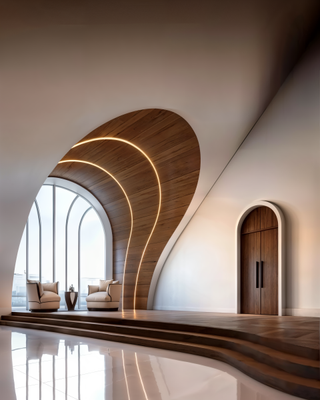
In the Lake Bled development project, the team aims to reimagine traditional Slovenian ornamentation, which is clearly visible in the design of the historic Villa Epos.
One prominent example of this approach is the transformation of a wooden architectural element known as the “risalit”,a prominent part of the building’s facade,into a panoramic lobby overlooking the stunning natural lake views.
In this way, architectural details over a century old become modern design elements that serve a dual role: both as visual inspiration and as a data reference simultaneously.
Accelerating the Creative Process with Advanced Technologies
AI’s role goes beyond improving design accuracy or achieving sustainability; it extends to accelerating the development stages themselves.
Fu explains that one of their key techniques is “diffusion,” used in the early visualization phase, where:
“We can plan architectural programs while AI generates design options in real-time.”
Environmentally and Contextually Responsive Designs
Additionally, the intelligent system allows data-driven improvements such as:
- Natural light analysis.
- Efficient room distribution.
- Integration with the site’s surroundings to ensure contextual harmony.
This integration of local knowledge and modern algorithms opens new horizons for producing designs that respect cultural identity and meet contemporary environmental requirements.
Nature as a Central Element in Architectural Composition
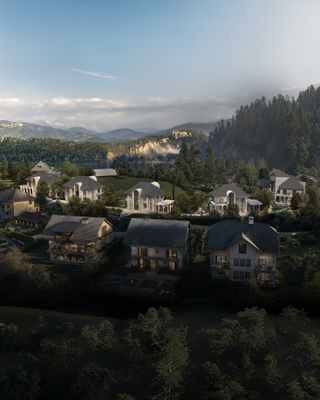
Amidst the breathtaking Julian Alps in Slovenia, nature plays a fundamental role in shaping the villa project. The site was not merely a backdrop but an active part of the design vision. From the outset, the client sought to deepen the connection with the surrounding environment, a goal reflected in every aspect of the project.
Biophilic Design to Enhance Connection with the Surroundings
Biophilic design principles were employed to guide the layout of the villas. This approach was not only aesthetic but also based on functional standards, most notably:
- Abundant use of natural light throughout all spaces.
- Distribution of the villas around a central communal garden, fostering a sense of belonging and encouraging interaction between residents and nature.
A Qualitative Leap in the Role of AI in Design
The project also marks a pivotal stage in the evolving relationship between AI and architecture.
Although the use of AI is not entirely new in the field, its application has often been limited to specific tasks or late project phases.
From a Support Tool to an Integrated Partner
Tim Fu explains this shift:
“We are establishing AI as an integrated partner in all stages of the design process, from creative input, through optimization, to solving complex problems.”
With this concept, AI is no longer just a technical aid but a central element in design decision-making, reflecting a deeper transformation in contemporary architectural methodology.
An Open Question: Should AI Replace Human Creativity?
At its core, this project raises a profound question that goes beyond the technical aspect:
To what extent can , and should , AI be used in architectural design?
And are we heading toward a future where algorithms become the primary source of creativity?
Technology as a Tool… Not a Replacement
Tim Fu’s team firmly responds to this question, emphasizing that:
“Technology must be a tool to enhance human creativity, not to weaken it.”
This vision places humans at the heart of the design process, while granting AI the role of an intelligent supporter rather than an absolute director.
Design as a Conscious and Curated Experience
Fu further clarifies:
“The process of selection and curation is fundamental. We guide the path of AI exploration; we oversee the coordination of the vast creative outputs it generates; and we refine and direct them to align with technical requirements.”
This stance reaffirms that human control is what gives the results meaning and context. AI may generate possibilities, but it lacks architectural sensibility, cultural understanding, and artistic taste , all essential elements in design.
✦ ArchUp Editorial Insight
Integrating artificial intelligence into the field of architecture represents a significant step that reflects a modern trend enhancing the speed and precision of design processes. It opens opportunities to expand creative horizons through new tools such as generative models and algorithmic optimization. From an analytical perspective, these technologies allow designers to focus on higher-level creative aspects, while machines handle complex computational tasks, enabling the production of designs that are more responsive to environmental and cultural contexts, and promoting sustainability through data-driven improvements.
However, from a critical standpoint, there are genuine concerns that require attention. The foremost is that excessive reliance on AI may reduce the designer’s freedom and restrict the human interaction with architecture as an art form. Despite its advancement, AI lacks deep artistic sensibility and the ability to perceive the human and cultural dimensions that enrich design. This could lead to purely technical designs devoid of the spirit and warmth that characterize authentic human creativity.
Moreover, the issues of transparency and accountability remain open. The question arises: who is responsible when AI-driven design decisions result in undesirable outcomes? And to what extent can the architect maintain full control over these complex processes?
Ultimately, AI remains an indispensable powerful tool in the future of architecture, provided it is used with balance and awareness, preserving its supportive rather than dominant role, to truly be a partner that enriches and complements human creativity instead of replacing it.
Prepared by the ArchUp Editorial Team
Don’t miss the chance to explore more from Architecture in fields like Interior Design and Architectural News on the ArchUp website.


