

Atlantis The Royal Maldives An Architectural Design Balancing Luxury and Sustainability

Introduction
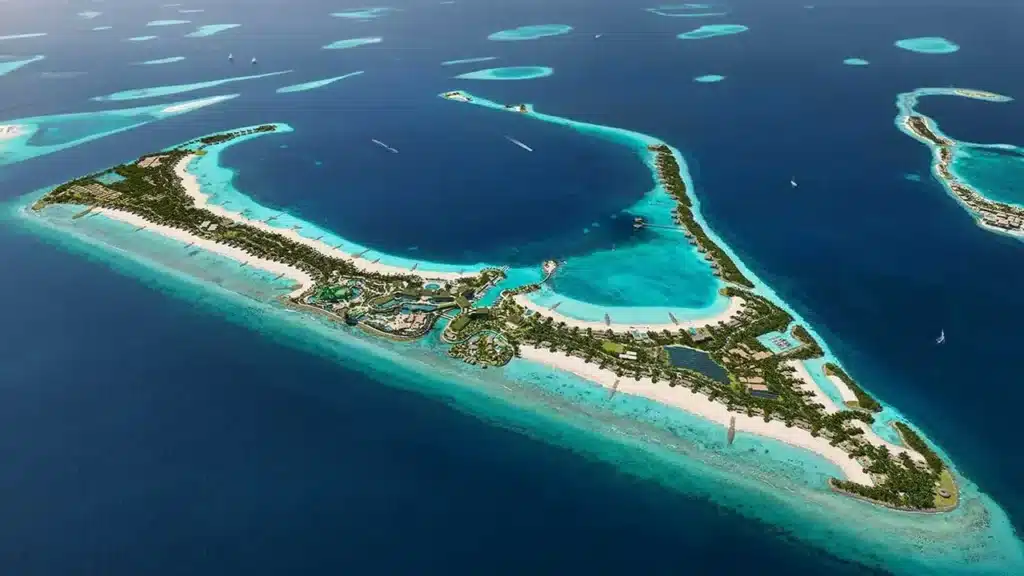
The Atlantis The Royal resort, located on a small island in the South Male Atoll, represents a unique example of luxury resort architecture in a marine environment. Its design blends luxury, interaction with nature, and environmental sustainability, with a strong focus on user experience and circulation through open spaces.This article highlights the keyphrase Atlantis The Royal Maldives as part of the architectural documentation.
Project Location and Spatial Layout
The resort occupies a large island, overlooking more than five kilometers of white sandy beaches. It is divided into two main zones:
- Family Island: dedicated to recreational and educational activities for all ages.
- Luxury Island: provides private, high-end accommodations for guests seeking exclusivity.
The designers arranged the accommodation units to maximize sea views, distributing rooms and villas evenly to enhance privacy and reduce the visual impact on the island.

Architectural Concept and Design Approach
The design emphasizes harmony with the marine and natural environment, maintaining open sightlines toward the sea and beaches. The towers act as central visual anchors, guiding movement throughout the resort and connecting the recreational and accommodation areas seamlessly.
The arrangement of towers and façades creates a multi-layered architectural experience, ranging from open public spaces by the sea to private villas with terraces and landscaped views.

Materials and Technologies
The designers focused on integrating modern technologies and premium materials suitable for the marine climate. The structural system is based on flexible foundations resistant to wind, capable of withstanding speeds up to 250 km/h, with carbon fiber-reinforced concrete in the towers. 12mm thick heat-reflective, salt-resistant glass panels cover 60% of the tower façades to reduce energy consumption. Treated and sustainable wood is used for floors and interior surfaces, accounting for 35% of the final materials.
The energy system includes 1,200 floating solar panels with a capacity of 450 kW, supported by tidal turbines, providing approximately 20–25% of the resort’s electricity consumption. Water management is achieved through a desalination plant with a capacity of 2 million liters per day, combined with recycling 90–100% of greywater and internal wastewater for reuse in gardens and facilities. Smart lighting with motion sensors further reduces energy consumption by an additional 15%.
This combination achieves a balance between luxury, sustainability, and functional efficiency, while maintaining a fully integrated visual experience for guests.

Interior and Exterior Experience
Recreational Spaces
The resort offers a variety of recreational areas, including children’s play zones, sports academies, and educational facilities. Water attractions are seamlessly integrated into the architectural landscape, complemented by local marine life displays within aquariums.
Wellness and Fitness
Wellness areas include a world class spa, yoga and breathwork platforms, beauty salon, and an indoor outdoor fitness center, ensuring a comprehensive guest experience connected to the surrounding natural environment.

Environmental Integration
The resort is designed to maintain harmony between the built environment and nature, enhancing sea views while minimizing ecological impact. Pathways and circulation routes guide guests naturally between public and private spaces, reflecting a sustainable and contemporary architectural philosophy.
Architectural Analysis
Atlantis The Royal Maldives exemplifies a modern luxury resort that emphasizes privacy, recreation, and interaction with the marine environment. The towers and facilities create a balance between different functions, offering a multi-layered experience combining luxury, sustainability, and integrated visual design.
Conclusion
The Atlantis The Royal Maldives resort stands as a unique model of sustainable luxury, combining opulence, innovative design, and interaction with the marine environment. The project demonstrates how contemporary architecture can integrate nature, diverse functions, and guest experience within a cohesive environment, setting a new benchmark for marine resort design worldwide.
Architecture professionals can follow ArchUp’s events section for verified updates on exhibitions, conferences, competitions, and results.
Resort Summary Table
| Aspect | Details |
|---|---|
| Location | Island in South Male Atoll, Maldives |
| Area | 1.3 million m² |
| Beaches | Over 5.8 km of white sandy beaches |
| Island Layout | Family Island / Luxury Island |
| Accommodation Units | 493 units (270 hotel rooms + 223 villas/palaces) |
| Facilities | 20 restaurants/beach venues, 2 beach clubs, 70,000 m² waterpark |
| Materials | Heat-reflective glass, concrete resistant to salinity, sustainable wood |
| Technologies | Solar energy systems, advanced water treatment, smart lighting |
| Design | Gradation between public and private spaces, harmony with marine environment, emphasis on sea views |
| Activities | Sports academies, recreational areas, marine life aquariums, spa and yoga platforms |
✦ ArchUp Editorial Insight
The Atlantis The Royal Maldives resort stands out for its striking visual architecture, where soaring towers create a rhythm of horizontal and vertical lines harmonizing with the surrounding beaches and turquoise waters. Open pathways and private terraces enhance the guest’s visual experience, highlighting the balance between public and private facilities. Critically, the design approach demonstrates strong attention to sustainability and integration with the marine environment, although some interior spaces could benefit from more flexible natural lighting and circulation. Nevertheless, the project offers significant value as a luxurious, sustainable architectural example, combining aesthetics with functional performance and reflecting a sophisticated vision for marine resorts.


ArchUp Editorial Management
The article provides a comprehensive analysis of the resort’s design vision, with a distinguished focus on integrating luxury with environmental sustainability. To enhance its archival value, we would like to add the following technical and structural data:
We would like to add that:
· Structural System: Wind-resistant flexible foundations capable of withstanding speeds up to 250 km/h, with concrete structure reinforced by carbon fibers
· Water Management: Desalination plant with 2 million liters daily capacity, recycling 90% of greywater
· Materials: 12 mm salinity-resistant glass panels, with special marine concrete formulation resisting corrosion
· Energy System: 1,200 floating solar panels with 450 kW capacity, supplemented by tidal turbines providing 25% of energy needs
Related Link:
Please review for a comparison of sustainable resort projects:
[Designing Tourism Complexes Harmonious with Sensitive Marine Ecosystems]
https://archup.net/the-opening-of-the-luxury-ritz-carlton-resort-in-the-red-sea-a-leading-tourist-destination-in-the-middle-east/