
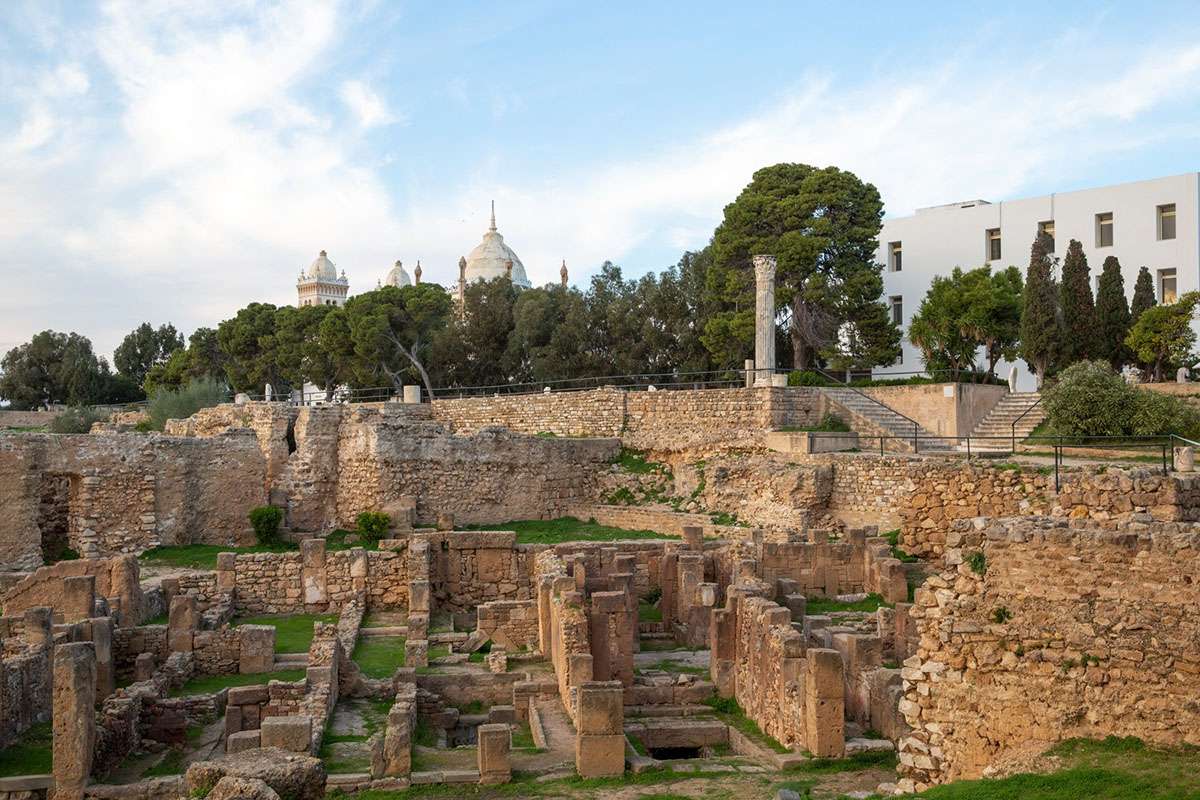
Carthage National Museum in Tunisia
Carthage National Museum in Tunisia
Expertise France, in collaboration with the Tunisian Ministry of Culture and with the support of the European Union, announces the launch of the international one-stage design competition for the Requalification of Byrsa Acropolis and Rehabilitation of the Carthage National Museum in Tunisia.
The International Union of Architects (UIA) endorses this competition as being by UNESCO’s regulations on international architectural and urban design competitions and the UIA’s best practice recommendations.
Objectives
Carthage is an extensive archaeological site, set on a hill overlooking the Gulf of Tunis and the surrounding plain. A metropolis of the Punic civilization in Africa and the capital of the province of Africa during the Roman times, Carthage played a central part in antiquity as a great commercial empire.
Furthermore, the archaeological site of Carthage has been on the UNESCO World Heritage List since 1979. In fact, the main known components of the site of Carthage are the acropolis of Byrsa, the Punic ports, the Punic Tophet, the necropolises, the theatre, the amphitheater, the circus, the villa quarter, the basilicas, the Antonine baths, the Malaga cisterns, and the archaeological reserve.
The competition concerns one of the sites of Carthage, the Acropolis of Byrsa, which includes archaeological excavations, outdoor spaces (square, forum, patio, and gardens), and historic buildings dating as far back as 1852 when the Saint-Louis Archaeological Museum was founded on the site.
The project aims to:
- Find the best enhancement and revitalization concept for this archaeological site, in light of its inclusion on the UNESCO World Heritage List.
- Find the best architectural, landscape, and planning concept for the UNESCO site.
- Expose the archaeological objects in appropriate spaces defining an innovative museography illustrating the history of one of the largest metropolises in the Mediterranean.
- Secure functional communication between a national museum, a scientific and research center, and recreational and cultural facilities.
- Find the best solutions for access to the site and manage the various flows around it.
- Set the project within a sustainable and inclusive development approach in response to the major issues at stake in the ecological, energy, and environmental transitions.
Jury
The international jury is composed of:
- Alberto Veiga, Architect, Veiga Barozzi, Spain (UIA representative, Jury Chair)
- Fathy Kouched, Architect, Ministry of Cultural Affairs, Tunisia
- Lamine Tibet, Architect, representative of the Order of Architects of Tunisia, Tunisia
- Gabriela Carrillo, Architect, Taller de arquitectura, Mexico
- Neil Porter, Landscape architect, Gustavson porter + Bowman, United Kingdom
- Meriem Chabani, Architect and urban planner, New South, France/Algeria
- Momoyo Kaijima, Architect, Atelier Bow Wow, Japan
Alternate jurors
- Grichka Martinetti, Architect, Atelier png, France (UIA representative)
- Ammar Khammash, Architect, Khammash Architects, Jordan
- Nawel Laroui, Landscape architect, Aleaolea, Tunisia/Spain
Prizes
A total of € 200,000 distributed among the authors of the winning projects:
- 1st prize: € 50,000
- 2nd prize: € 45,000
- 3rd prize: € 40,000
- 4th prize: € 35,000
- 5th prize: € 30,000
The jury may, at its discretion, award honorary prizes to projects displaying specific merits.
Language
French is the official language of the competition.
Moreover, the competition documents are provided in English and French, and the information must be identical in both languages. Should a discrepancy be found between the two versions, the French one shall prevail.
Timetable
Launch of competition: 6 September 2022
Online briefing for use of PLACE website: 13 September 2022 & 6 December 2022
Deadline for submitting questions: 7 October 2022
Deadline for responses: 28 October 2022
Moreover, Deadline for submitting electronically registration forms: 2 December 2022 at noon (GMT+1)
Deadline for submission of projects (electronic + paper): 5 January 2023
Deadline for receipt of the paper version of the projects (sent by post no later than 5 January 2023, as evidenced by the postmark): 27 January 2023
Jury session: February 2023
Lastly, announcement of results: March 2023
Eligibility
This competition is open to architects from all countries having diplomatic relations with Tunisia, constituted in a grouping of architects and landscape architects.
Additionally, aligible architects must be authorized for architectural practice in their respective country of residence or origin.
Nota bene: teams including a Tunisian architect (registered with the Order of Architects of Tunisia – OAT) in the project team are recommended.
If the winning project team does not have a Tunisian architect, it must partner with at least one Tunisian architect registered with the Order of Architects of Tunisia.


