

A House in Nicosia Transformed into an Introverted Concrete Sculpture: The Philosophy of the Box within a Box

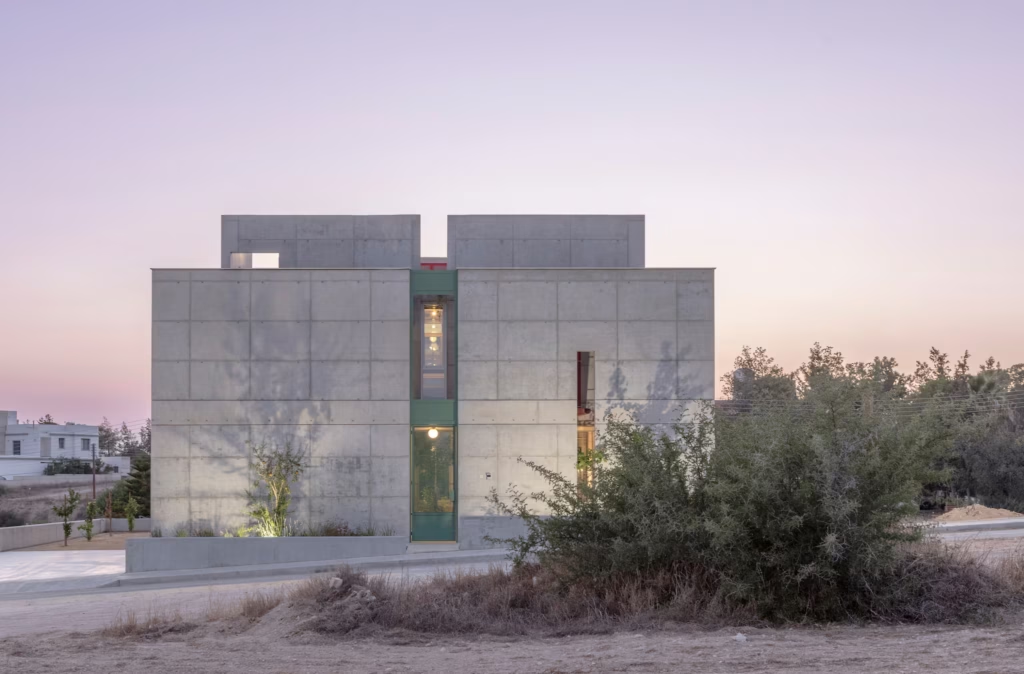
On the outskirts of Nicosia in Cyprus, stands a unique residential building. It sits on the edge of a sparse forest. An architectural vision challenged the conventional open residential concept. The structure presents a model of Carved Concrete. It reflects deliberate isolation and internal protection. From the exterior, the solid mass appears. It resembles a stone sculpture or an impenetrable container. This quality makes the structure an intriguing, enigmatic point in its surroundings.

The Journey Begins with a Vertical Slit in the Wall
The visitor’s experience starts with a dramatic, deliberate transition. The design avoids an obvious, direct entrance. A narrow vertical slit separates the Eastern wall. This slit is not just a regular opening. It is a divider that enhances the sense of crossing a threshold. The visitor passes from the outside world into a private, internal one. They find themselves surrounded by the Carved Concrete. They face the heart of the home: a sky-lit courtyard or atrium. This courtyard functions as the central pivot. Daily life rituals unfold around it. It becomes the dynamic interaction point between the different levels.
The Art of Deconstruction: The Box within a Box
The core concept of the structure clearly embodies the design. The idea centers on the Box within a Box. The outer shell acts as a strong shield. It is a monolithic structure of exposed concrete. This shell measures 14 x 17 meters. Inside, this shell houses a second cube. This second cube contains the living spaces. Intriguingly, the inner cube fractures. It appears eroded into an array of interlocked prismatic forms. This action creates a complex network of voids and volumes. This process manipulates the geometric masses. The manipulation aims to form small courtyards and passages, increasing the spatial complexity.

The Physical Structure: Concrete Tells the Story
The architectural structure narrates its story honestly. The structural system features a three-dimensional grid. This grid consists of beams and columns. They support the outer shell. The design does not hide this grid from view. Instead, it displays it as a fundamental part of the interior design. This approach confirms the seamless connection between material and function. The designers used specific materials and techniques to achieve the massive expression:
- Exposed Reinforced Concrete: The project used this for 85% of the structure and exterior façades.
- Concrete Casting: The process relied on designed molds. These molds create a specific texture. This successfully achieves the characteristic Carved Concrete aesthetic.
- Excised Windows: The façades do not feature extensive glazing. Instead, precise openings exist. These openings frame the exterior views selectively.
- Interior Surfaces: Light, smooth plaster characterizes the interior surfaces. This finish helps reflect the light filtering from the courtyard. Plaster covers 100% of the interior wall surfaces.

Routes and Elevations: Multi Level Dwelling
The distribution spreads life throughout the 190 square meter project space. This distribution occurs across different levels. The central courtyard naturally leads to the common areas on the ground floor. These areas include the kitchen, living room, and dining room. Light bathes these spaces. The light reflects off the pale, tranquil surfaces.
Ascending to the upper floors, one reaches the sleeping quarters. These spaces maintain a consistent atmosphere of serenity and enclosure. The climb to the building’s summit happens via an external staircase. Here, the Carved Concrete journey concludes at a distinctive point. A blue-painted roof merges with the open sky.

The Environment and the Third Shell: The Role of Plants
Despite its current massive appearance, the building carries a forward-looking, environmental dimension. The design prepared the courtyard and passages to host climbing plants. Over time, these plants will grow and envelop the masses. The greenery will embrace parts of the Carved Concrete. This future vegetation will act as the Third Box . This shell will gradually soften the rigidity of the geometric form. It adds an organic layer that moderates the explicit architectural statement.
✦ ArchUp Editorial Perspective
The ‘Domus Aer’ house by Kyriakos Miltiadou in Nicosia imposes an austere, introverted residential model, centered on the idea of a solid concrete box (14x17m) that internally disintegrates into a network of sculpted voids, starkly contrasting with the contextual expectations of marginal urban settings. This explicit adoption of the “concrete sculpture” aesthetic reflects a material boldness worthy of documentation; however, the internal deconstruction may at times appear a formal choice overshadowing functional clarity within the 190 sqm space. The project’s future significance lies in it being an architectural document of the 2025 era, grappling between the urgent need for personal isolation against sprawling growth and the pursuit of self-assertion through tangible structural solidity.





ArchUp: Structural & Material Analysis of the Sculpted Concrete House in Nicosia
This article examines the Domus Aera residence in Nicosia as a case study in sculptural concrete architecture. To enhance its archival value, we present the following key technical and structural data:
The structural system relies on 85% exposed reinforced concrete, designed as a “box within a box.” It features an outer shell measuring 14×17 meters (238 m²) containing a fragmented, prismatic inner volume. The total floor area spans 190 m² across three levels, with a central open courtyard occupying 20% of the footprint.
The material expression is characterized by the use of custom timber formwork to create a defined texture on the concrete surfaces. Punched windows with a depth of 40 cm frame selective views. Interior surfaces are finished with 100% fine plaster to reflect light, while basic thermal insulation is achieved through 30 cm thick concrete walls.
In terms of functional performance, the entrance is dramatically divided by a 1.2-meter-wide vertical fissure. Spaces are distributed as follows: ground floor for common areas, upper level for bedroom suites, and a blue-painted rooftop as a concluding zone. The building is designed to receive the future “third box” through climbing plants that will partially cover the façade.
Related Link: Please refer to this article for a comparison of concrete forming techniques in contemporary architecture:
The Aesthetics of Exposed Concrete: Between Structure and Architectural Expression
https://archup.net/doro-barro-holiday-home-architecture/