
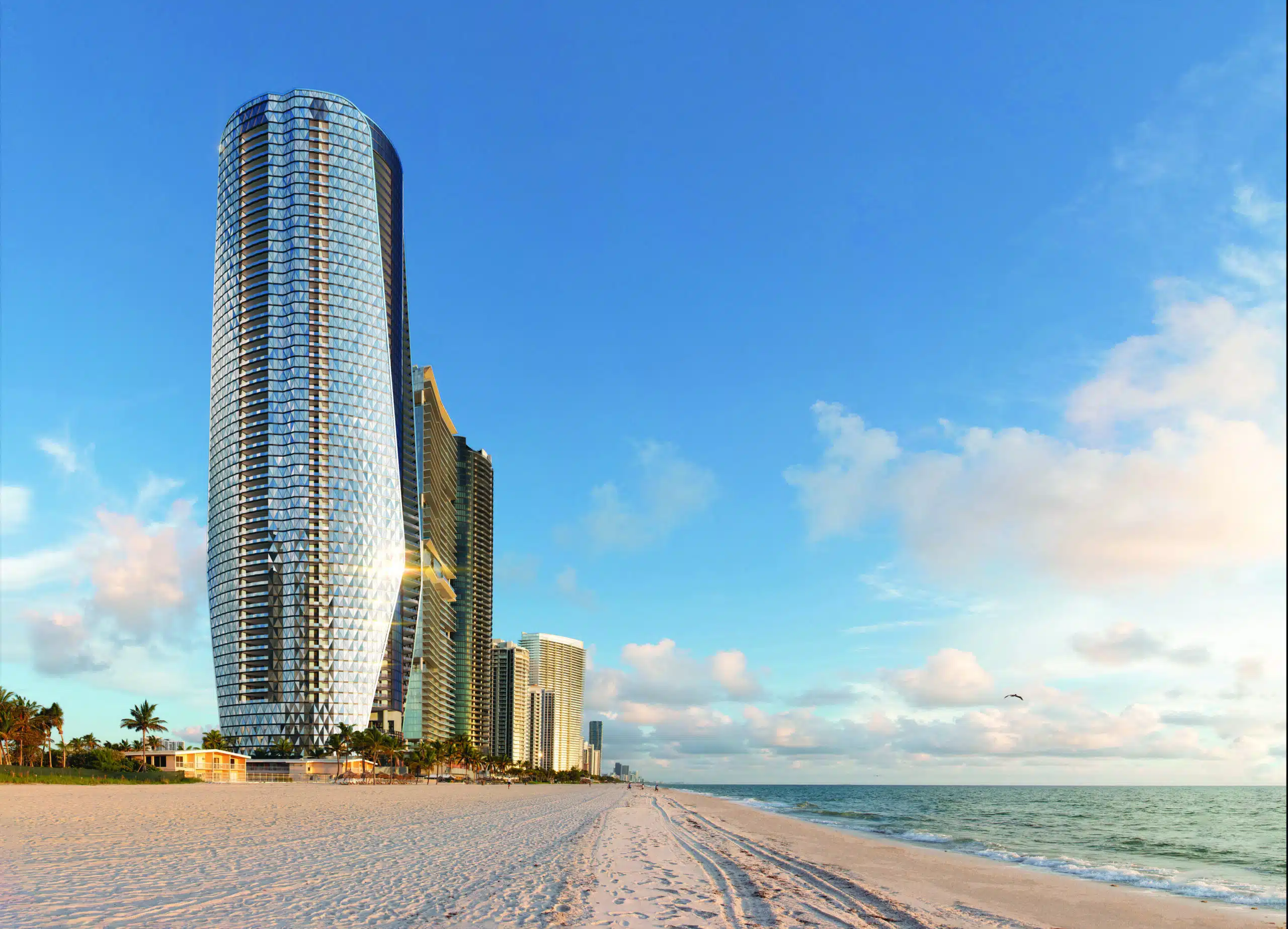
Coastal Foundations in Action: Building a Landmark Tower on Sunny Isles Beach

Preparing the Coast for a New Landmark
Along Sunny Isles Beach, the outlines of a large-scale architectural project are gradually taking shape. The Bentley Residences tower will rise 62 stories, and its foundation is the most critical starting point. The concrete pour was not a routine task but a demonstration of the complexity of Coastal Foundation Engineering in a challenging marine environment requiring precision and coordination.

A Core of Concrete and Steel Anchoring the Structure
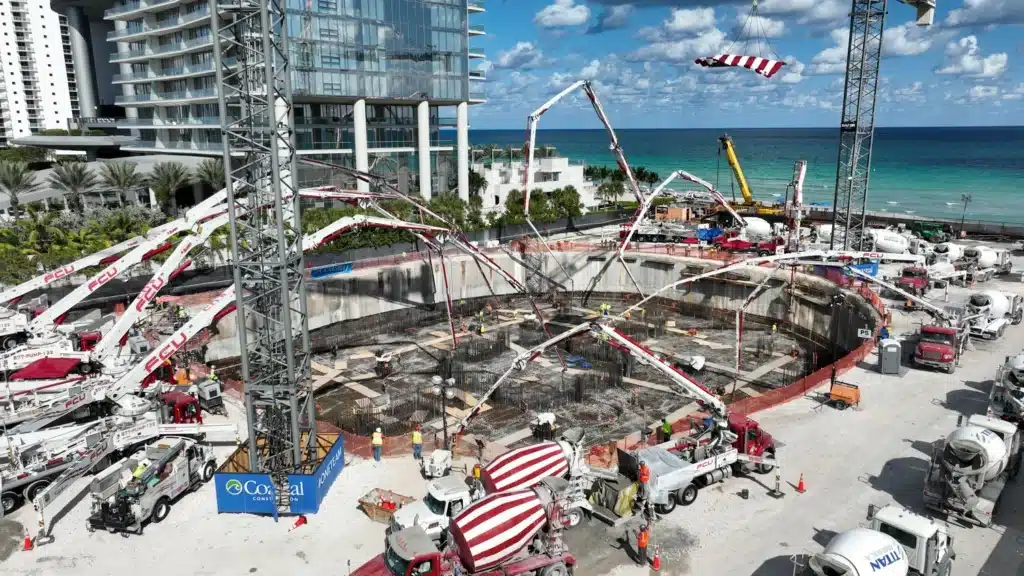
Engineers needed a solid, unified base to secure such a massive tower. The construction team placed a Mat Foundation, a large concrete slab distributing the building’s loads over a wide area. The slab is 15 feet thick and reinforced with massive volumes of steel, ensuring long-term stability of the structure.
Materials and Techniques in Coastal Foundation Engineering
- Volume of concrete used: approximately 20,000 cubic yards
- Reinforcement steel weight: approximately 2,400 tons
- Mat foundation thickness: 15 feet
- Pour type: continuous pour lasting 36 hours
Logistical Precision Under a 36-Hour Timeline
Pouring such a vast amount of concrete continuously posed a major challenge. The operation began in the afternoon and ran nonstop for 36 hours. Project managers coordinated over 2,100 truckloads from ten different concrete plants. Around 250 workers managed the process around the clock, monitoring temperature and flow to ensure the foundation reached the required strength. This operation demonstrates the meticulous planning engineers apply in Coastal Foundation Engineering, especially for high-rise projects.
Movement, Pathways, and Vertical Progress
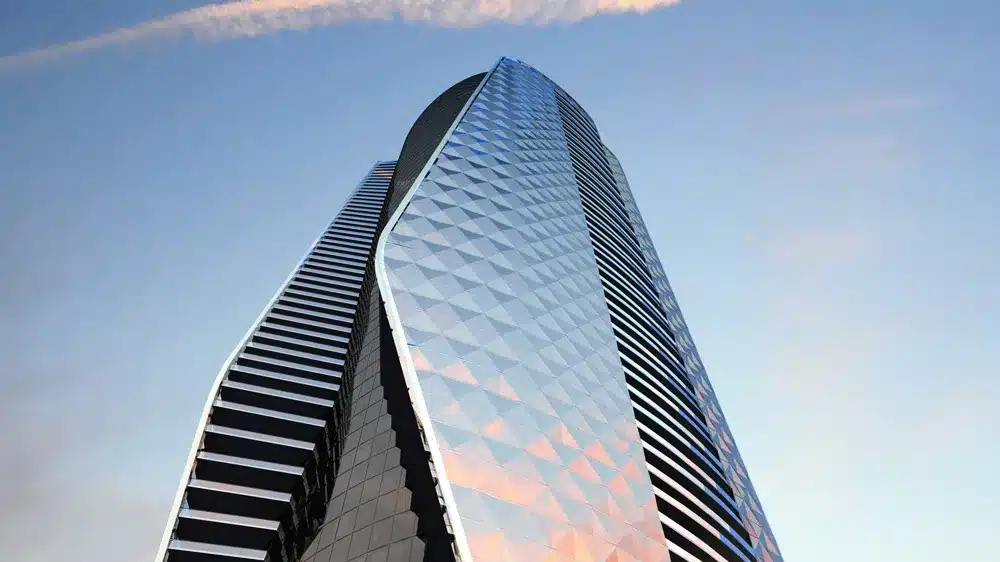
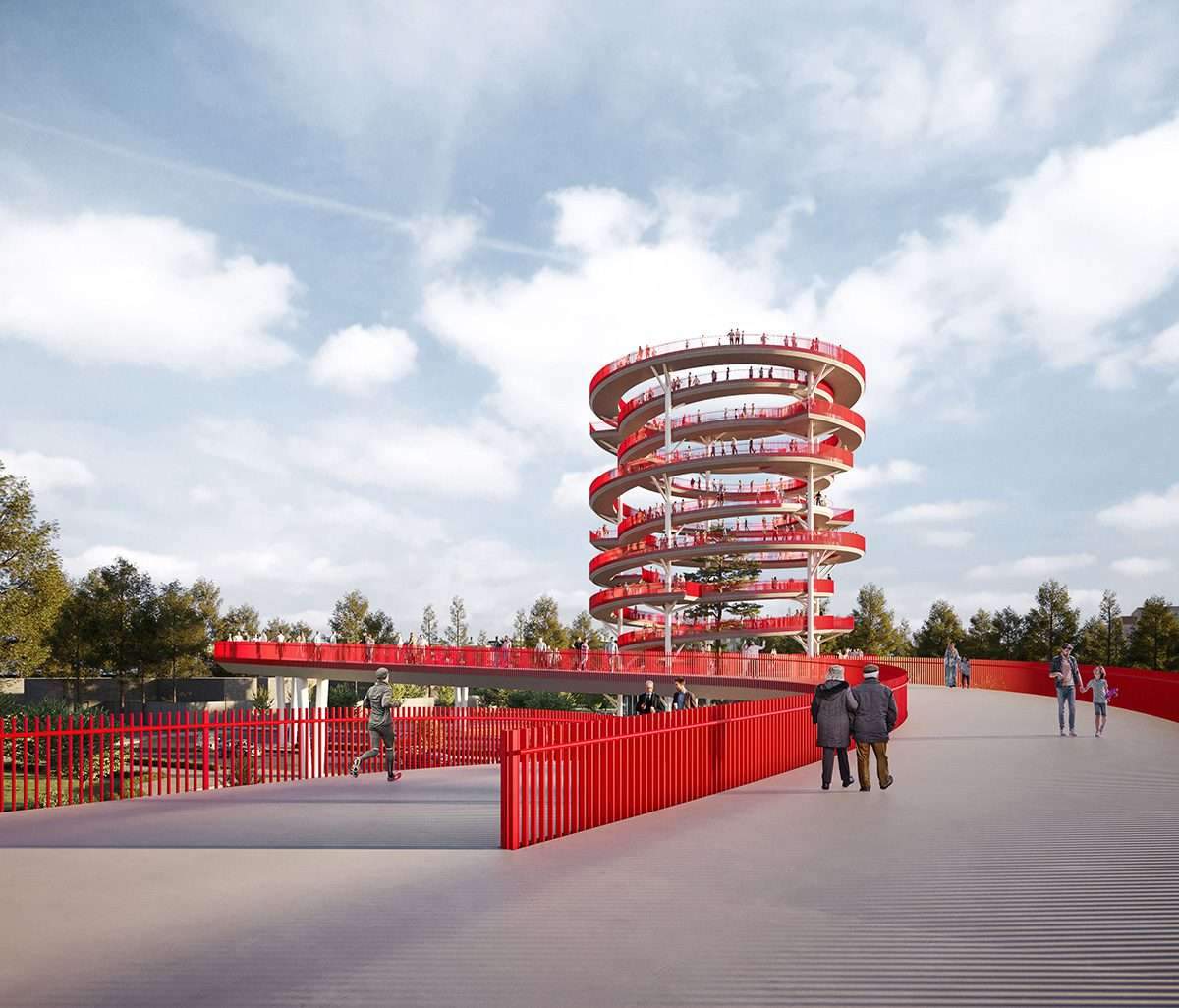
With the foundation complete, attention shifts to vertical construction. The solid base provides a stable platform for the tower’s ascent. Concrete slabs and glass façades will gradually take shape. Internal pathways were designed to allow smooth movement of workers and equipment, while harmonizing with the surrounding coastal environment. This integrated approach ensures safe and efficient site circulation.
Harmony with the Coastal Environment
The project accounts for the marine impact on construction materials, using insulation and protective measures against moisture and salt. Surrounding areas are carefully planned to align with the natural coastline, featuring green spaces, low-lying landscaping, and water elements that reflect movement, enhancing the site experience.

From Base to Summit
The foundation establishes a clear benchmark for Coastal Foundation Engineering in high-rise construction. Each layer of the building will be added following precise structural standards, maintaining balance under various loads. The foundation serves as more than a starting point; it sets a reference framework for future coastal projects.
ArchUp provides an encyclopedic database featuring updates on major events and exhibitions, with regular updates to competitions and official results.
✦ ArchUp Editorial Insight
The Bentley Residences tower presents a clear interplay between massive concrete volumes and transparent glass façades, featuring clean lines and coordinated surfaces that capture natural light. Internal pathways and movement of workers and equipment are carefully planned to harmonize with the coastal environment, integrating green spaces and water elements that soften the concrete mass. Critically, the project relies heavily on the mat foundation and load distribution, highlighting the precision of Coastal Foundation Engineering, though it offers limited variation in public spaces. Nonetheless, the project demonstrates notable value in strengthening coastal infrastructure and setting advanced engineering standards for residential towers.




ArchUp: Technical Analysis of Bentley Residences Tower Coastal Foundations
This article provides a technical analysis of the Bentley Residences tower foundations as a case study in structural engineering for coastal environments. To enhance its archival value, we would like to present the following key technical and structural data:
The structural system utilizes a 4.6-meter (15-foot) thick mat foundation with 50 MPa high-strength concrete, incorporating 2,400 tons of high-strength reinforcement steel. The foundations consumed 20,000 cubic yards of concrete in a continuous 36-hour pour.
The environmental system features 5-mm thick polyurethane waterproofing layers resistant to salinity, with advanced drainage systems capable of handling groundwater levels rising to 2 meters below ground surface. The foundations are designed to withstand wind speeds up to 200 km/h and wave heights of 6 meters.
In terms of structural performance, the tower achieves seismic resistance up to 7.0 on the Richter scale, with soil bearing capacity of 400 kPa. The total foundation depth reaches 25 meters below ground level using advanced soil stabilization techniques.
Related Link: Please review this article for a comparison of foundation techniques in coastal areas:
Foundation Engineering in Coastal Environments: From Challenges to Advanced Solutions
https://archup.net/coastal-infrastructure-and-urban-park-resilience/