

David Adjaye’s Architectural Projects Redefining the Museum as a Space for Thought and Identity

Introduction
The latest architectural projects of David Adjaye mark a mature phase in his career, presenting three designs that transcend form to explore the deeper relationship between architecture, culture, and humanity.
Spanning across America and Africa, these works demonstrate how a building can embody the spirit of its placetransforming from a vessel for art into a living participant in meaning-making.
Each museum is not merely a site for displaying art but a visual narrative that reconnects people with their roots, reminding us that architecture, at its best, is a medium for reflection as much as for habitation.
A Return to the Essence of Material
The Princeton University Art Museum embodies a renewed understanding of materiality as a truthful architectural language.
Light becomes a structural element, while the raw expression of walls and ceilings reveals the honesty of construction.
The building asserts itself confidently an evolution of classical architecture reinterpreted through a contemporary sensibility.
Rather than relying on spectacle, the design achieves poetry through precision and balance, merging geometric rigor with tactile warmth.
Stone becomes memory, and space becomes language, allowing the museum itself to act as a contemplative work of art.

Identity Rooted in the Land
The Museum of West African Art is an architectural gesture toward reconnection with origin.
Constructed from rammed earth, it evokes traditional dwellings that breathe with their environment and rise from the soil itself.
This choice reflects not only cultural respect but a philosophical stance seeing matter as part of collective memory.
The building grows organically from its surroundings rather than imposing upon them, gaining strength from simplicity and silence.
It stands as a mature example of architecture that converses with its environment, emphasizing harmony over dominance.
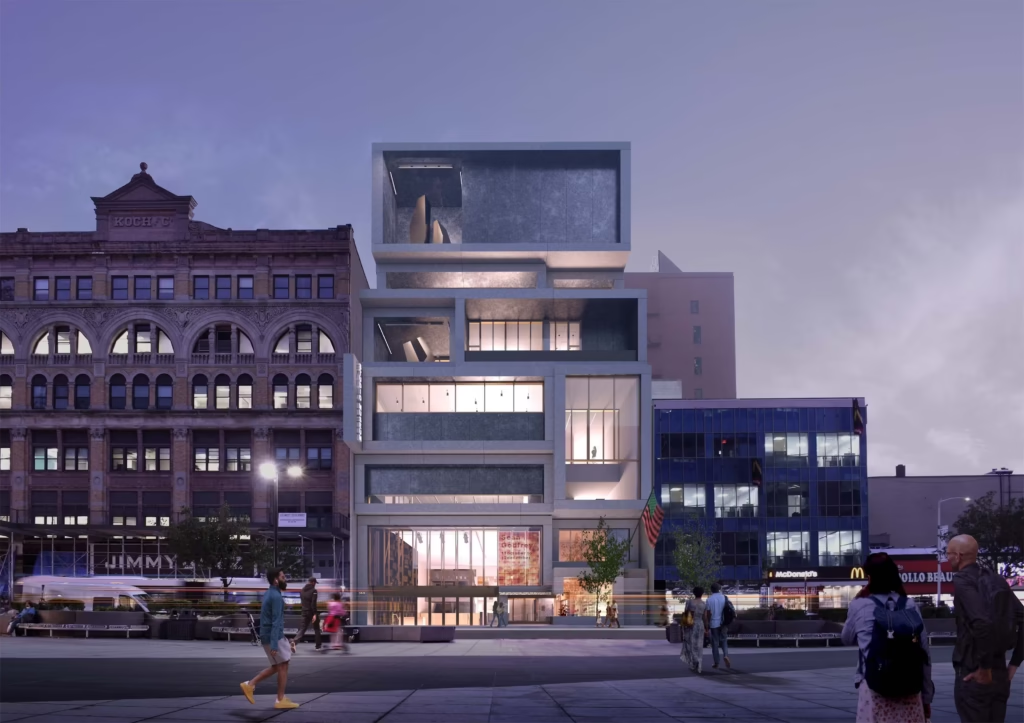
An Intense Urban Experience
In Harlem, the Studio Museum translates Adjaye’s thinking about spatial constraint into opportunity.
The compact urban site is reimagined vertically, producing a layered sequence of public and private spaces that connect the visitor to the neighborhood through carefully framed views.
Its glass and metal façades are not superficial gestures of modernity but visual mediators, reflecting the rhythm of the surrounding streets and engaging the city’s daily life.
Here, architecture takes on a social role transforming the museum into a civic forum that celebrates creativity as community dialogue.
A Philosophy of Unity Between Thought and Place
Across these projects runs a consistent intellectual thread: architecture as a medium for meaning rather than mere form.
Each building questions how humans inhabit space, and how place can embody both personal and collective memory.
Material, light, and shadow serve as cultural signifiers, not decorative effects.
Adjaye’s work, in this sense, becomes a laboratory for rethinking the architect’s role from creator of symbols to curator of collective consciousness.

An Intellectual Legacy Beyond Aesthetics
Setting aside public controversies, David Adjaye’s architectural projects endure as documents of thought.
They are not simply design achievements but meditations on belonging demonstrating how architecture can summon memory without freezing it in form.
His recent work affirms that architecture is inseparable from philosophy; construction becomes a cultural act that asks questions instead of providing answers.
Analytical Summary
In a rapidly shifting world, these three museums redefine the relationship between place, material, and mind.
Adjaye’s architecture seeks not beauty alone, but meaning.
From African soil to American stone, his projects articulate a contemplative journey an inquiry into the essence of human presence and memory.
Summary Table of David Adjaye’s Architectural Projects
| Project | Context | Design Concept | Core Material | Intellectual Dimension |
|---|---|---|---|---|
| Princeton University Art Museum | Academic and classical environment | Redefining materiality and light | Stone and metal | Architecture as a balance of rigor and transparency |
| Museum of West African Art | African cultural landscape | Architecture emerging from the earth | Rammed earth | Linking architecture with memory and community |
| Studio Museum in Harlem | Dense urban fabric | Vertical spatial layering | Glass and metal | Integrating art with daily urban life and social engagement |
✦ ArchUp Editorial Insight
David Adjaye’s architectural approach across these three projects offers a sensory reading of space that moves beyond form into meaning. Each volume becomes a dialogue between light and material, while façades act as symbolic languages evoking the memory of place. His design philosophy achieves a delicate balance between cultural specificity and global openness, turning buildings into living entities that breathe identity without isolation. Despite their sculptural power, the interiors remain expansive and socially engaging, inviting human interaction. These works transcend visual spectacle, redefining the relationship between people and architecture in an era shaped by speed and disconnection.
ArchUp continuously documents leading architecture exhibitions and conferences, offering verified coverage of international competitions and official results within an open-access database.


🟥 **Editor’s Notice:**
This article has been reviewed for editorial integrity. While it highlights Sir David Adjaye’s work, its tone leans toward promotional language and lacks critical depth. Additionally, a technical issue within the text may negatively affect SEO performance. The editorial team will revise it to ensure analytical balance and compliance with ArchUp’s content standards.