

Design Through Finding: Reimagining Three Spaces in MD Anderson Hall at Rice University

The Rice University School of Architecture commissioned Kwong Von Glinow to transform three key spaces within MD Anderson Hall: a Welcome Center, a Student and Community Forum, and a Faculty & Staff Lounge. Located along the building’s central axis, these interventions engage with the architectural legacy of the 1947 original structure by Staub and Rather and the 1981 addition by James Stirling and Michael Wilford.
The Concept of “Finding” Space
The design process began with an exploration of the building’s history, uncovering Philip Johnson’s observation of Stirling’s addition: “I came to see Jim’s building but couldn’t find it.” (Cite Fall 1992-Winter 1993). This idea of “finding”discovering and revealing hidden layers became central to the project. The challenge was to intervene thoughtfully within a structure marked by competing architectural languages while enhancing its existing narrative.
All three new spaces are adjacent to the Farish Gallery, the School of Architecture’s primary public space. The gallery’s trapezoidal form, shaped by a distinctive diagonal wall, features an exposed column and beam from the 1947 building, protruding through Stirling’s 1981 angled wall. This intersection was a deliberate architectural gesture, marking the dialogue between old and new.
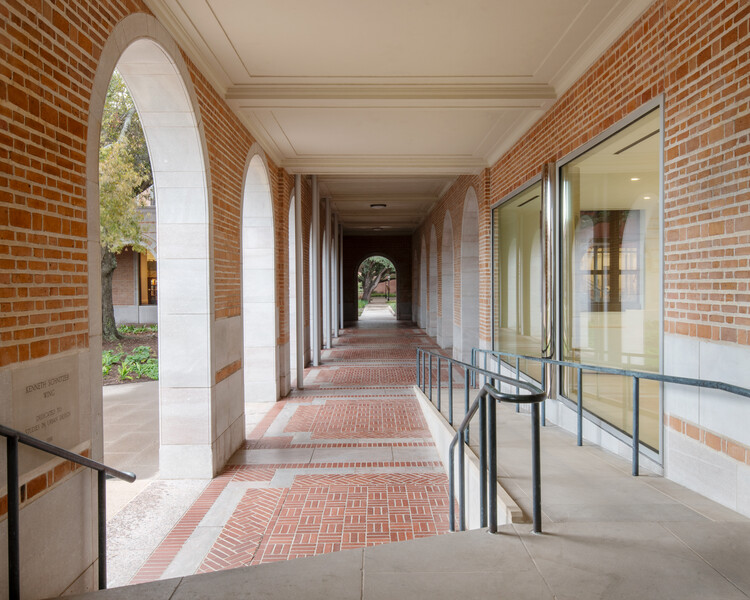
Interventions That Reveal History
1. The Welcome Center: A Transparent Threshold
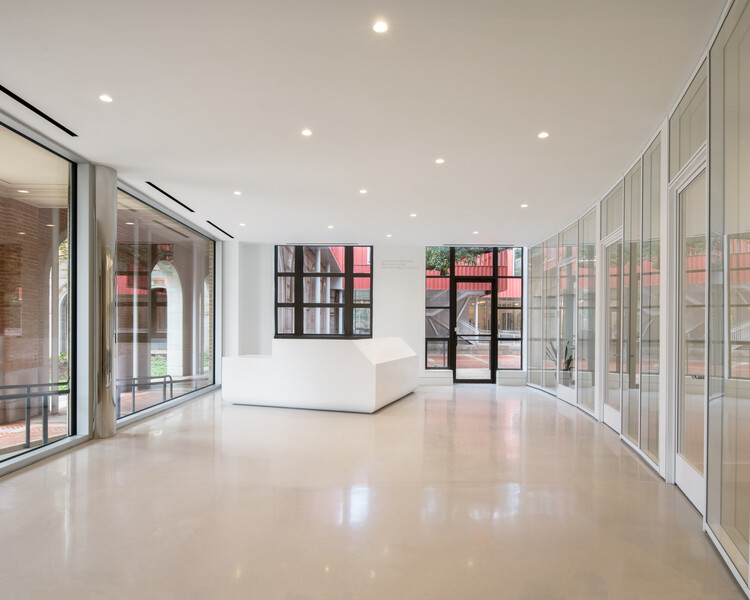
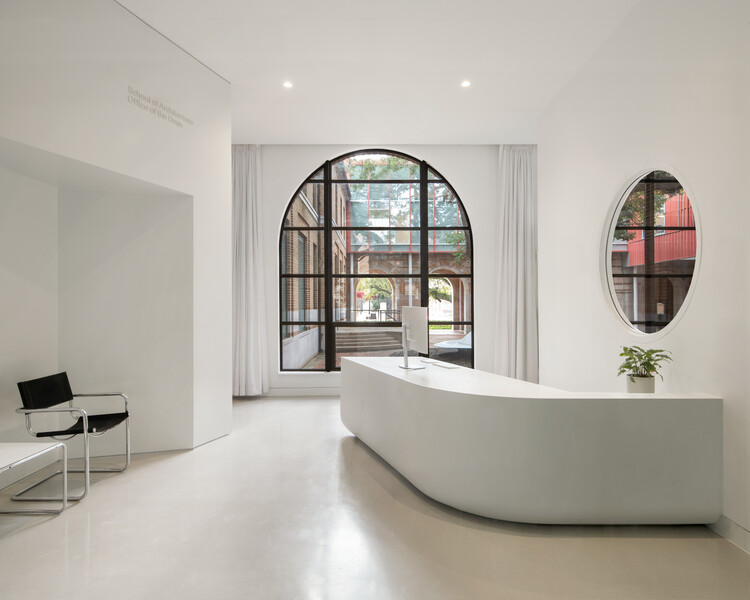
Located at the southeast corner of MD Anderson Hall, the Welcome Center replaces an opaque brick façade with expansive glazing, creating a visual and physical connection to the quad. Four key elements define the space:
- Quad-facing glazing Invites natural light and engagement with the campus.
- Mirror-clad column Reflects the surroundings while nodding to Stirling’s West façade.
- Curvilinear glass walls Form four staff offices, enhancing visibility and accessibility.
- Monolithic welcome desk Anchors the space with a bold, functional presence.
This design dissolves boundaries, encouraging movement and interaction while preserving historical traces.
2. The Student and Community Forum: A Hub for Connection
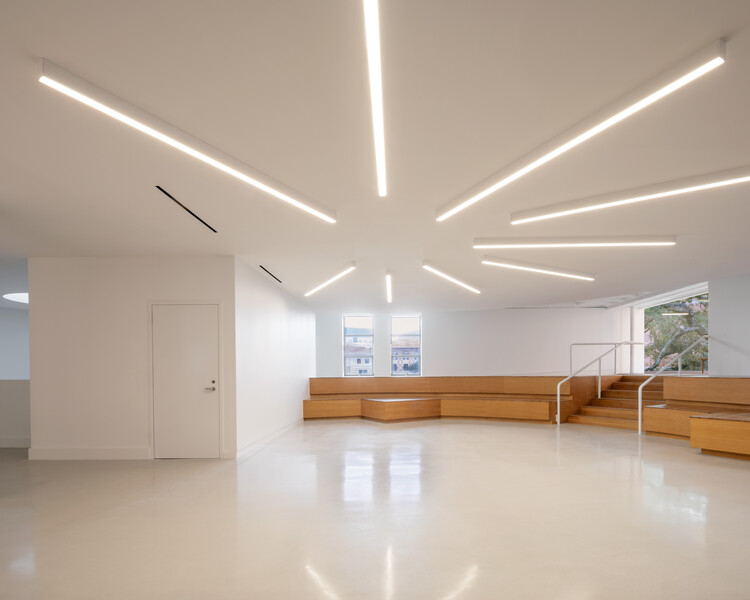
Positioned above the Welcome Center, this space bridges MD Anderson Hall and Cannady Hall via an accessible ramp and stairs. The forum features:
- Tiered circular seating Encourages informal gatherings.
- Jutting piers & wood grain patterns Echo Stirling’s diagonal wall, creating intimate niches.
- Flexible multipurpose use Supports lectures, exhibitions, and student collaboration.
By integrating material and formal references, the design fosters a dynamic, layered environment.
3. The Faculty & Staff Lounge: A Refined Retreat
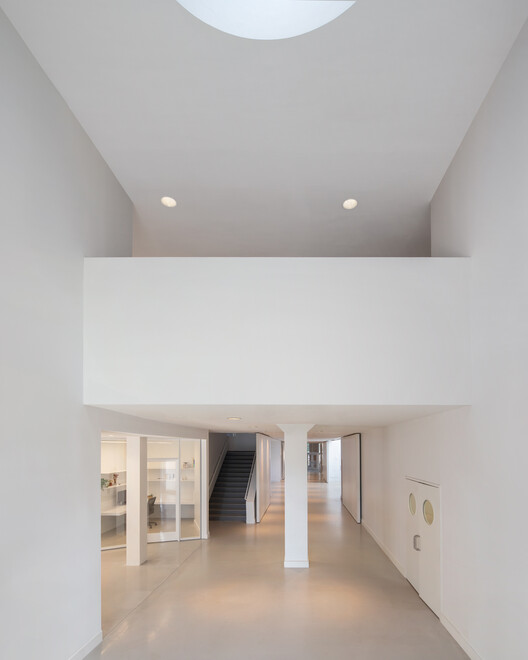
Redefining the former Dean’s Office reception area, this lounge balances privacy and openness through:
- A Corian reception desk Mirroring Stirling’s original design language.
- A “wedge-like” volume Separating public and private zones while directing light into the windowless rear.
- Amenity spaces Including a kitchenette, seating area, and ADA-compliant bathroom.
The lounge reinterprets historical elements while prioritizing functionality and comfort.
Conclusion: A Dialogue Between Past and Present
Rather than imposing new divisions, Kwong Von Glinow’s design works with the building’s history, using form, materiality, and transparency to create distinct yet harmonious spaces. By revealing and enhancing existing architectural narratives, these interventions ensure that MD Anderson Hall remains a living, evolving part of Rice University’s campus.
✦ ArchUp Editorial Insight
Kwong Von Glinow’s renovation of MD Anderson Hall thoughtfully engages with the building’s layered history, using the concept of “finding” to reveal hidden connections between past and present. The design successfully integrates transparency and materiality to foster interaction, though one might question whether the mirrored elements risk prioritizing aesthetics over long-term functionality. Nevertheless, the project excels in creating dynamic, historically rooted spaces that enhance both utility and architectural dialogue, ensuring the building remains a vibrant academic hub.
Explore the Latest Architecture Exhibitions & Conferences
ArchUp offers daily updates on top global architectural exhibitions, design conferences, and professional art and design forums.
Follow key architecture competitions, check official results, and stay informed through the latest architectural newsworldwide.
ArchUp is your encyclopedic hub for discovering events and design-driven


