Experimental Architecture: Designs That Break Traditional Rules and Redefine Space

What if architecture were no longer defined by static boxes, but instead became an evolving artistic language that reshapes how we experience buildings and space? Experimental architecture pushes beyond established norms of form and function to create bold visual and sensory experiences, transforming buildings into unique spatial experiments. This approach challenges traditional relationships between form, function, and user interaction, turning architecture into a medium for artistic vision and technological innovation that continues to influence contemporary design discourse across the global architecture platform.
Heydar Aliyev Center – Baku
Designed by Zaha Hadid, the Heydar Aliyev Center exemplifies experimental architecture through its seamless curves that dissolve boundaries between ground, walls, and roof. The building demonstrates how architecture can become a living artistic experience, challenging traditional structural logic through advanced engineering and redefining spatial perception. Its fluid form rejects rigid geometry, inviting visitors to move through the space as though they are part of a continuous sculptural landscape rather than a conventional building.
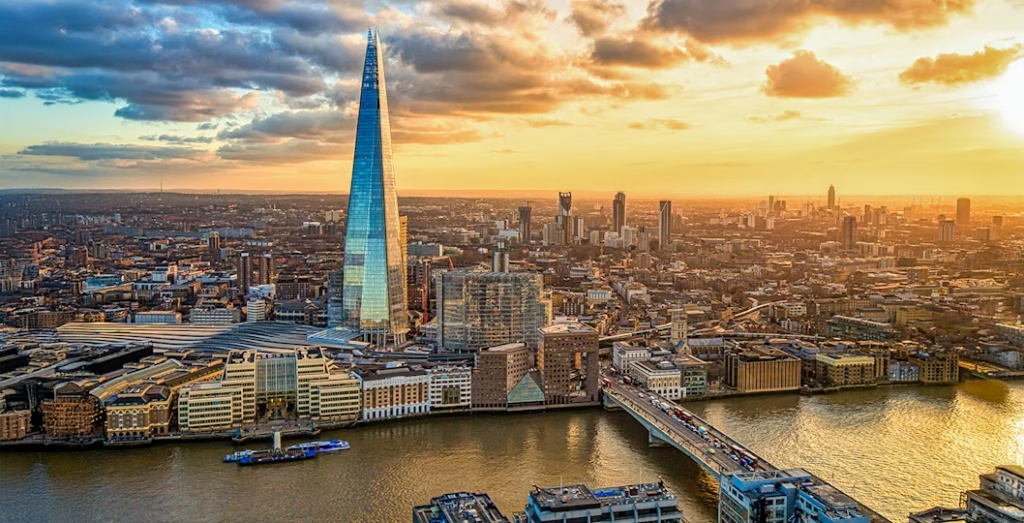
The Shard – London
The Shard represents another form of experimental architecture, where its glass mass pierces London’s skyline in an unconventional manner. The extensive use of glass not only defines its striking appearance but also enhances light, transparency, and environmental performance. The design emphasizes not only aesthetics but also the visual experience of the city, illustrating how experimentation can coexist with functional urban architecture while reshaping how tall structures engage with their surroundings.
(Image © Diliff)
Experimental Architecture in Japan and the UAE
Projects such as Mode Gakuen Spiral Towers in Japan and the Museum of the Future in Dubai represent major leaps in architectural thinking. These iconic forms challenge gravity and conventional geometry, with the Spiral Towers redefining how towers can function as vertical campuses and innovation hubs. Through ongoing architectural research, innovative materials, and advanced technologies, these projects expand the boundaries of architectural possibility and demonstrate how experimentation can drive global design evolution.

(Image © Kakidai)

(Courtesy of Killa Design)
Impact on Human Experience
Experimental architecture transforms the way people engage with buildings and spaces. Unconventional forms, curves, and unfamiliar facades stimulate the senses, provoke curiosity, and create distinctive spatial experiences. Buildings become immersive environments rather than static structures, encouraging exploration and emotional connection. By reimagining circulation, scale, and light, experimental architecture reshapes not only external form but also interior design, influencing how users feel, move, and interact within these spaces.
✦ ArchUp Editorial Insight
Large-scale cultural landmarks emerge after a sequence of non-spatial behaviors stabilizes. Public institutions prioritize symbolic visibility to justify funding cycles tied to political timelines. Financing models favor one-time capital expenditure over long-term operational flexibility. Procurement systems reward certainty, compressing experimentation into controllable technical packages. Risk is redistributed through insurance logic, encouraging formal resolution over programmatic adaptability.
Decision frameworks then narrow. Codes permit exception only when projects are labeled “iconic.” Approval accelerates when international recognition is statistically probable. Advanced modeling software enables precision, reducing tolerance for informal use or future modification. Labor structures favor specialized fabrication over local adaptability.
The architectural outcome appears last: a singular object optimized for representation, media circulation, and controlled access. Spatial behavior becomes predictable. Repetition across unrelated contexts signals not imitation, but shared institutional pressure. The building is not expressive. It is compliant.