Robotically woven fibres wrap university building for textiles


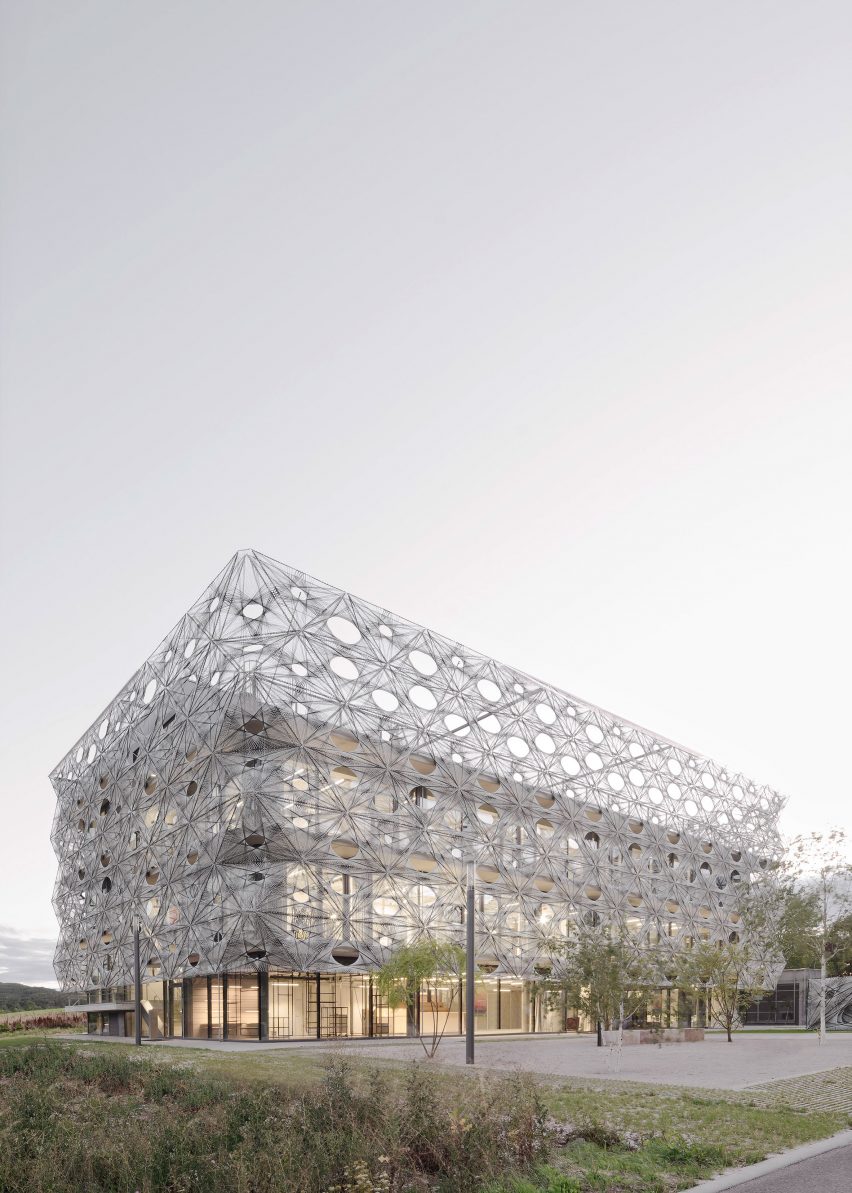
Texoversum is a university building for textiles designed in Germany by the architecture companies Allmannwappner and Menges Scheffler Architekten. It is covered in a web of glass and carbon fibers.
Comprising offices, workshops, a university store, collaboration rooms, and a CNC robot workspace, Texoversum is part of the Reutlingen University of Applied Sciences campus extension. It is also situated in the city of Reutlingen.
Its weaving exterior was created by Allmannwappner and Menges Scheffler Architekten in collaboration with Jan Knippers Ingenieure, an engineering firm, and is inspired by textile construction.
Partner at Menges Scheffler Architekten Achim Menges told Dezeen, “The fiber facade is an integral part of both the architectural expression of the building as a textile research and innovation center and the environmental engineering and related indoor comfort strategy of the project.”
The facade of Texoversum is built up of triangle panels that are roughly four meters wide and 1.5 meters tall. The robotic winding method used to create each panel was created at the University of Stuttgart.
There are five different kinds of panels; they all have the same exterior triangle shape. However, varied somewhat in the corners and in the size of the central apertures.
The web-like panels, which are produced by FibR GmbH, are composed of black carbon fibers that are layered above white glass fibers to provide structural support.
Menges stated that since the manufacture is customized, there was no material off-cuts or production waste.
“Fibrous filaments are freely placed between two rotating winding scaffolds by a robot,” said Menges.
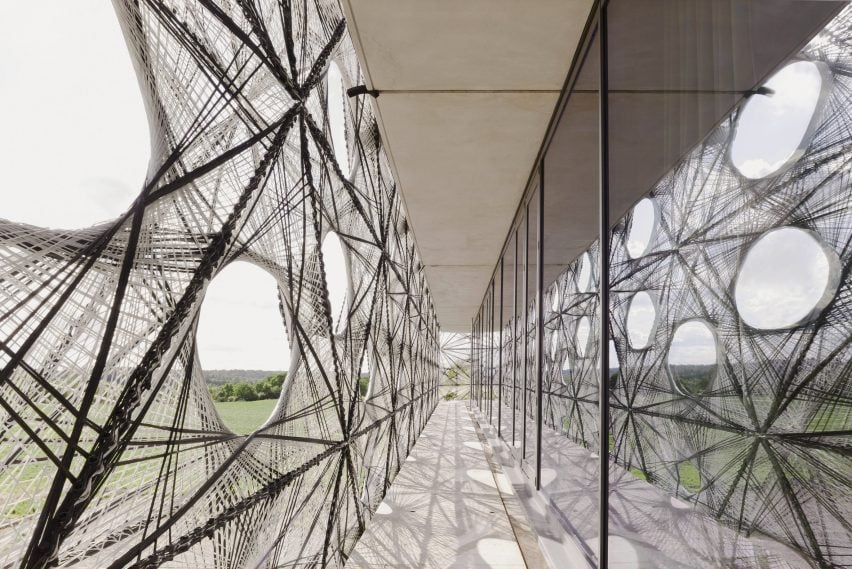
“During manufacturing, a lattice of white glass fibres is generated, onto which the black carbon fibres are placed where they are structurally needed.”
“In this process, the predefined shape of the building component emerges only from the interaction of the filaments. Therefore, eliminating the need for any mould or core,” said Menges.
According to him, each component has a “bespoke form” and a “highly distinct architectural appearance” as a result of this procedure.
The self-supporting facade tiles from Texoversum are arranged in a staggered pattern. Also, This produces a multi-layered look that offers openings with views out of the building and shadows the inside rooms.
“The fibre facade constitutes the external sun protection of the building, which has to fulfil stringent shading requirements in compliance with the German building code,” said
Moreover, Structural engineer Jan Kippers continued, “The black carbon fibers, which supply the required structural capacity, use the white glass fibers as a formwork.”
“It is a pure fibre structure that spans from floor to floor and allows cantilevers of around four metres at the upper edge without a steel frame or similar.”
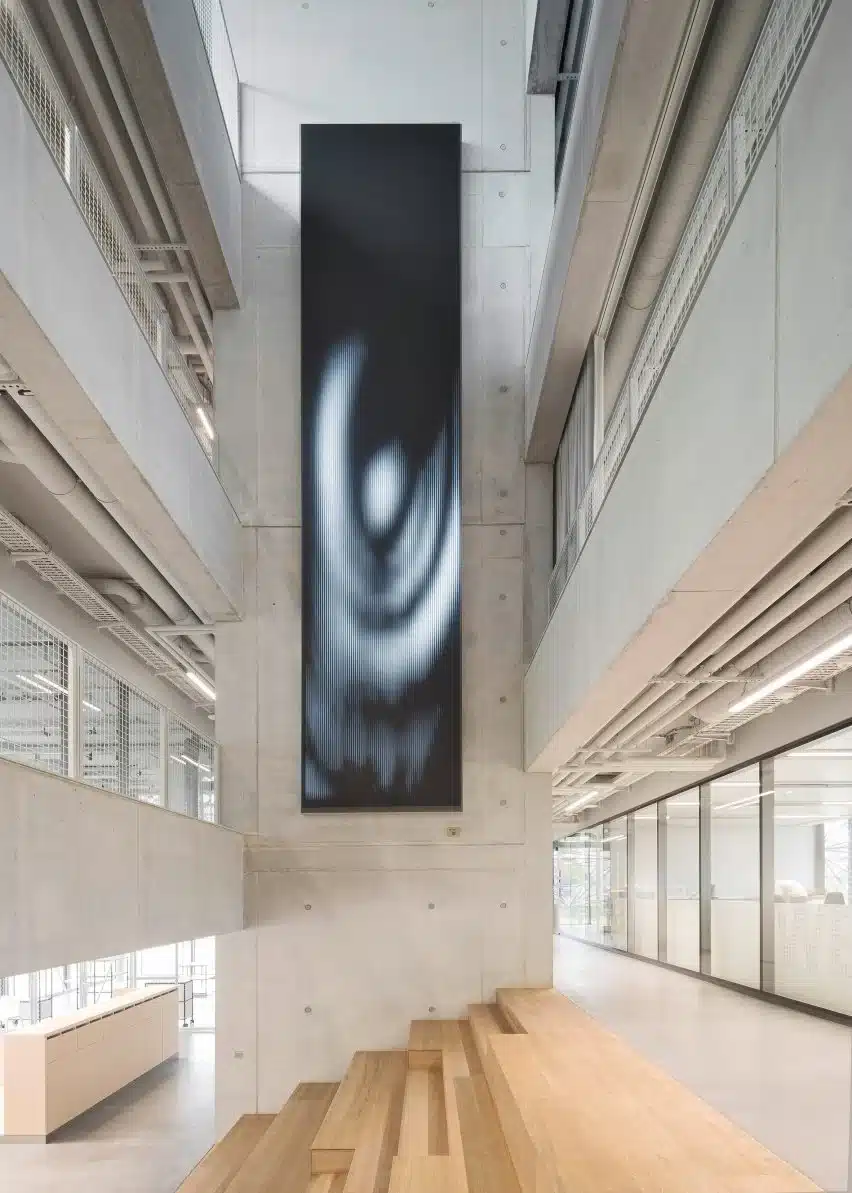
Texoversum features a split-level interior concept. The structure is divided into two parts by a central atrium. Also with a half-floor level separating the height of each side.

With its exposed concrete construction, ceiling ducting, and open-plan design that promotes teamwork, the interior has an industrial feel.
Furthermore, The BUGA Wood Pavilion at the Bundesgartenschau horticultural event in Germany and the Elytra Filament Pavilion at the V&A museum in London were designed using the same robotic winding technology as the facade.
Menges claims that the robotic manufacturing technique was used for the first time in the design of a permanent building at Texoversum.
“While we had successfully built several temporary structures before, Texoversum constitutes the first permanent building using this design and manufacturing approach,” he stated.
“As Texoversum is a permanent building, we had to meet the full requirements of German building authorities,” said Kippers.
“For this, extensive tests had to be carried out to prove the long-term creep behaviour, fire resistance and others.”
Finally, find out more on ArchUp: