
Grand Canal Gateway Bridge: A Design Integrating Cultural Heritage, Modern Engineering, and Sustainability

Grand Canal Gateway Bridge: A Link Between History and Urban Development
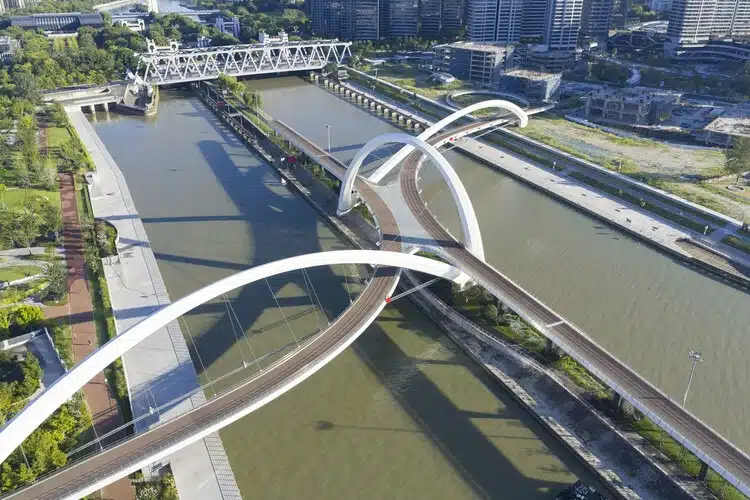
Construction of the Grand Canal Gateway Bridge in Hangzhou was recently completed, with public opening expected later this year. The bridge aims to connect pedestrians to the Seamless City masterplan, spanning 800,000 square meters along the east and west banks of the Grand Canal.
A New Axis for Public Parks
The bridge forms a central part of the new River Middle public park, which covers 14.7 hectares, along with the surrounding riverside promenade. Through this infrastructure, the bridge becomes a meeting point between nature and contemporary urban design.
Integrating Residences and Public Spaces
Through the bridge and the development plan designed by Zaha Hadid Architects (ZHA), the city reconnects with the historic Grand Canal and the Qiantang River by integrating residences, workplaces, and community services with vibrant public spaces. These areas focus on recreation, leisure, and tourism, reflecting a modern model of sustainable urban development that preserves heritage while addressing contemporary needs.


The Grand Canal: A Cultural and Engineering Legacy
The Grand Canal is one of the most prominent UNESCO World Heritage sites, distinguished as the oldest and longest engineered waterway in China.
A Journey Through History
This historic canal dates back to the 5th century BCE, representing an extraordinary engineering achievement of its time. Flowing south from the capital Beijing, it provides a water link between the Yangtze and Yellow Rivers before joining the Qiantang River at its southern gateway in Hangzhou.
The Grand Canal’s Significance Today
The canal plays a pivotal role in connecting China’s northern and southern regions, reflecting the evolution of Chinese hydraulic engineering through the ages. Beyond its historical importance, it offers insights into how ancient infrastructure has influenced modern cities and continues to serve functional purposes today.

The Silver Dragon of the Qiantang River
The Qiantang River in Hangzhou is famous for its unique tidal wave, known as the Silver Dragon, which is the largest tidal bore in the world. This natural phenomenon occurs when the incoming tide from Hangzhou Bay travels upstream, generating massive waves up to 9 meters high and moving at speeds of 40 kilometers per hour.
Balancing Nature with the City
The bridge promenade and plaza have been designed to balance environmental sensitivity with urban ambition, providing visitors with an opportunity to observe this stunning natural event. With multiple viewing points, visitors can safely experience the raw power and breathtaking spectacle of the Silver Dragon.
The Phenomenon and Its Environmental Significance
This tidal wave is more than just a natural show; it reflects complex ecological interactions between tides and the river system. It also offers opportunities to study the impact of tidal waves on the surrounding environment and the river’s ecosystem, making it a subject of interest for scientists and researchers in biology, geology, and hydrology.

The Bridge and Hangzhou’s Cultural Heritage
Building on Hangzhou’s rich heritage as a prominent center of craftsmanship, particularly its renowned silk embroidery, the bridge’s design offers an innovative reinterpretation of traditional embroidery techniques.
Structural System as a Blend of Art and Engineering
The bridge features a wavy structural system that mimics the weaving, interlacing, and knotting patterns used in embroidery. This approach not only adds visual beauty but also provides the necessary structural support for a pedestrian and cycling bridge.
Enhancing Urban Connectivity
The bridge plays a pivotal role in linking new residential, civic, and commercial neighborhoods within the framework of the Seamless City masterplan along the east and west banks of the Grand Canal. Through this design, heritage-inspired aesthetics and modern urban efficiency are seamlessly and harmoniously integrated.

Digital Innovation in Bridge Design
The Grand Canal Gateway Bridge was enhanced using advanced 3D digital modeling, enabling material usage to be minimized without compromising safety or structural performance.
Precasting and Modular Units
The project employed a precast system with modular units, efficiently assembled on-site, which helped reduce waste and improve construction efficiency.
Minimizing Impact on River Traffic
The bridge construction strategy was specifically designed to reduce project duration and minimize disruption to river traffic on the Grand Canal. Currently, the canal accommodates around 100,000 barges annually, transporting approximately 260 million tons of goods sustainably across China, making the smooth flow of navigation a critical priority.

Supporting Local Industries and Sustainability
The bridge project relied on locally sourced materials and low-impact finishes, contributing to the support of regional industries and promoting sustainable construction practices through the collective expertise of local contractors and engineers.
Sustainable Lighting
Additionally, the bridge is equipped with an integrated LED lighting system powered by renewable energy sources. This technology charges battery units throughout the day, enabling environmentally friendly and energy-efficient illumination of the bridge at night.

Bridge Structural Framework
The Grand Canal Gateway Bridge spans 390 meters and relies on a steel system composed of three interconnected arches. Its engineering was carefully designed to withstand weak soil conditions at the confluence of the Grand Canal and the Qiantang River, reflecting a balance between structural strength and flexibility.
Wind Resistance and Preservation of the Historic Site
To minimize the impact of strong river winds on the adjacent historic site, the bridge was designed to reduce secondary bending, ensuring stability and mitigating lateral forces on the foundations.
Efficiency in Fabrication and Assembly
Thanks to steel’s high strength-to-weight ratio, the bridge is much lighter compared to concrete alternatives. This advantage not only reduces material usage but also enables more efficient fabrication and assembly processes while maintaining long-term durability and safety.

Structural Balance of the Bridge
The Grand Canal Gateway Bridge was designed to consolidate all forces acting upon it, including torsional forces generated by the bridge deck, and transfer them evenly to its supports.
Foundations and Smart Design
The bridge rests on a sculpted concrete pier located on the island separating the northern and southern channels of the canal. This intelligent design helps reduce the span lengths required to cross the canal by half, while ensuring structural balance and visual harmony of the bridge.

The Bridge as a Symbol of Sustainability and Modern Engineering
By uniting Hangzhou’s cultural heritage with 21st-century engineering and the use of recyclable materials, the Grand Canal Gateway Bridge stands as both a sculptural and sustainable project. It was designed for long-lasting durability with minimal environmental impact, reflecting a balance between urban beauty and ecological efficiency.

✦ ArchUp Editorial Insight
The Grand Canal Gateway Bridge can be seen as an example of efforts to integrate cultural heritage, modern engineering, and sustainability. The project highlights several clear advantages, such as the use of lightweight steel to reduce material consumption, renewable energy for lighting, and enhanced urban connectivity between the canal’s two banks. Its design also provides viewing points that allow visitors to appreciate the natural phenomenon of the Silver Dragon, reflecting attention to the local environment and urban experience.
However, some aspects may require deeper evaluation in different architectural contexts. The adoption of modular units and precast construction, while efficient in reducing waste, may limit opportunities for innovation during the detailed design phase and pose challenges in adapting to flexible aesthetic standards or future changes in bridge usage. Likewise, the focus on sustainability could make it more difficult to achieve greater integration with surrounding urban frameworks or flexibility in reconfiguring adjacent spaces.
Overall, the project serves as a rich source of architectural and engineering lessons, particularly in the design of sustainable bridges and the integration of natural environments with urban heritage, while leaving room for further development in areas such as local community interaction, urban adaptability, and expanding design innovation.
Prepared by the ArchUp Editorial Team
Don’t miss the chance to explore more from Architecture, Buildings, and Cities on the ArchUp website.


