

The Grand Egyptian Museum: A Design That Integrates Egyptian Heritage with Modern Educational Functions

The Long-Awaited Opening of the Grand Egyptian Museum
The Grand Egyptian Museum, designed by Heneghan Peng Architects, has been completed after years of planning and construction. Located just over a mile from the Giza Pyramids, it stands in close proximity to one of the world’s most iconic heritage sites.
The Museum’s Significance in Showcasing Egyptian Heritage
The museum is set to become a central destination for exhibiting Egyptian civilization, housing more than 5,000 diverse artifacts, including relics from various pharaonic periods. This vast collection makes it the largest museum in the world dedicated to a single civilization.
It is said that the spark that ignited the idea of the Grand Egyptian Museum was not purely a governmental plan, but rather born from a sharp, critical remark. During a ministerial meeting, as discussions were underway, a subtly sarcastic question was directed at Egypt’s then Minister of Culture, Farouk Hosni: “How is that warehouse you have in Tahrir Square doing?”, a jab at the old Egyptian Museum.
That remark struck a nerve. The minister took this negative perception, viewing the museum as nothing more than a storage space unworthy of Egypt’s heritage, to former President Hosni Mubarak. Hosni emphasized that Egypt deserved a grand cultural landmark befitting its history, not just a “warehouse.” From there, a presidential directive was issued, setting in motion extensive studies and consultations that later evolved into an international architectural competition and a major funding partnership with Japan, ultimately laying the foundation stone for this monumental project.
Tutankhamun Wing
Among the museum’s most notable exhibits is the Tutankhamun Wing, scheduled to open to the public on November 1, 2025. This wing offers a unique opportunity for visitors to explore the young pharaoh’s possessions and gain insights into his life and civilization through an educational and contemporary presentation.
Cultural and Educational Vision
Beyond preserving heritage, the museum aims to serve as a cultural and educational hub, connecting Egypt’s rich history with visitors from around the globe, enhancing understanding of Egyptian civilization, and inspiring interest in research and study.

Born from an International Competition
The Grand Egyptian Museum project originated from an international architectural competition held in 2003, which was won by the Dublin-based firm Heneghan Peng. Subsequently, the firm collaborated with Arup and Buro Happold to develop and implement the design.
A Design Linking Past and Present
The museum’s design was conceived as a bridge connecting ancient history with modern innovation. This approach reflects a commitment to preserving Egypt’s rich heritage while offering visitors a contemporary educational and architectural experience.
The Architects’ Vision
Róisín Heneghan, founding partner of Heneghan Peng, explains:
“Designing a museum of this scale, located in close proximity to such a monumental and symbolic site as the Pyramids, is a once-in-a-lifetime opportunity. Our design aims to enhance this connection to history and place, providing a home for artifacts never seen before, situated on the very ground where they were created.”
These statements underscore the commitment to making the museum not merely a repository for artifacts, but a space that tangibly and contemporarily connects visitors with Egypt’s illustrious history.

Geographical Context and Its Influence on the Design
The museum’s geographical location has played a pivotal role in shaping its design. Situated on a desert plateau formed by the Nile, the site adds both historical and natural dimensions to the project.
The building directly faces the Pyramids, aligning its visual axis with the three ancient structures, thereby reinforcing the sense of connection between past and present. Additionally, the radiating lines of the museum’s walls and roof form a fan-like shape that echoes the geometry of the Pyramids, without competing with their height, preserving the monument’s grandeur while presenting a contemporary architectural vision.

A Visitor’s Journey Through Time
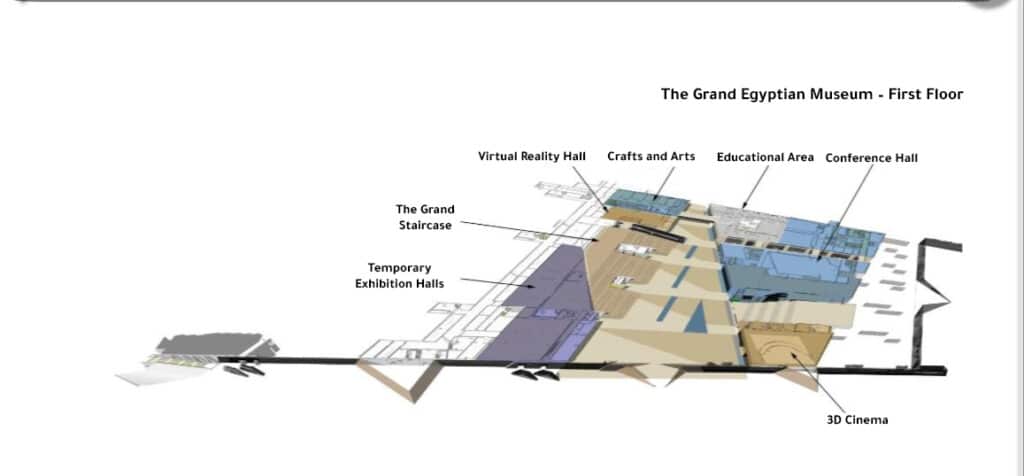
At the heart of the Grand Egyptian Museum lies a six-story staircase flanked by massive artifacts, such as the ten statues of King Senusret I. This staircase guides visitors chronologically through Egypt’s history, from the Predynastic period to the Coptic era.
The journey culminates on the top floor, which houses the permanent exhibitions of the Tutankhamun Wing, before the staircase opens up to a panoramic view of the Pyramids, connecting the educational experience with the sense of place in this historic setting.
Integrating Natural Light and Sustainable Design
Natural light is employed wherever possible, carefully balanced with preservation requirements in areas containing the most delicate artifacts. Reinforced concrete plays a crucial role in regulating internal temperatures, significantly reducing the need for air conditioning and adding a sustainable dimension to the visitor experience.

The Museum as a Cultural and Educational Hub
Beyond serving as a world-class exhibition space, the Grand Egyptian Museum is envisioned as a cultural and educational center reflecting the depth of Egyptian civilization. This role enhances visitors’ understanding of Egypt’s history in an educational and interactive manner.
Gardens and the Nile Valley Inspiration
In collaboration with landscape architects from West 8, the museum’s expansive gardens were designed to evoke the lush beauty of the Nile Valley, creating a sense of harmony between the natural environment and modern architecture.
Conservation and Research Laboratories
The museum houses one of the largest conservation and research facilities in the world, featuring 17 specialized laboratories connected to the main building via an underground tunnel. These laboratories safeguard Egypt’s vast heritage—from delicate papyri and textiles to statues, pottery, and human remains—ensuring the preservation of these treasures for future generations.

A Symbol of Heritage and Global Influence
The completion of the Grand Egyptian Museum marks a milestone in Egypt’s heritage, standing as a living symbol of the country’s enduring influence on world civilization. This achievement reflects Egypt’s ability to merge its ancient past with modern innovation within a comprehensive educational and cultural space.
✦ ArchUp Editorial Insight
From an architectural standpoint, the Grand Egyptian Museum represents a significant step in consolidating Egypt’s heritage in a single, accessible location. Its design integrates modern architectural lines with a visual connection to the Pyramids, offering visitors a comprehensive educational and cultural experience. The gardens, consideration of natural sunlight, and use of sustainable materials provide additional valuable elements that can serve as models for balancing architectural design with the environment.
However, the project raises certain questions regarding the expansion of usable spaces and long-term design flexibility, particularly given the large number of artifacts that may pose challenges for circulation and maintenance. Moreover, the focus on educational and cultural aspects does not necessarily accommodate greater flexibility for hosting temporary events or non-traditional exhibitions. Additionally, visitors’ sensory interaction is limited to a predefined interior arrangement, which may reduce opportunities for free exploration and direct engagement with the architectural experience.
The project offers an important case study on integrating heritage with modern innovation, especially in managing and preserving large collections within a sustainable environment while providing a tiered educational experience through staircases and exhibitions. These insights can guide future projects toward more flexible designs while enhancing visitors’ direct interaction without compromising conservation and heritage considerations.
Prepared by the ArchUp Editorial Team
Don’t miss the chance to explore more from Architecture in fields like Architecture Competitions and Projects on the ArchUp website.


