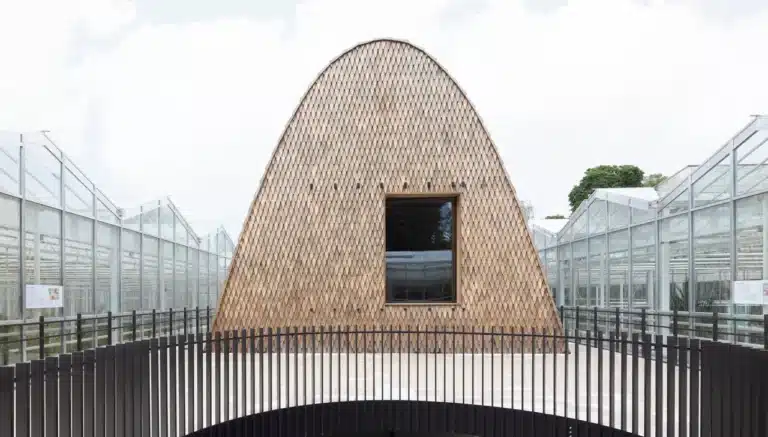
Heartland Whole Health Institute: Curved Forms and Giraffe-Stone Facades in Bentonville

The new headquarters of the Heartland Whole Health Institute in Bentonville, Arkansas, is a compelling example of architecture that integrates natural forms, local materials, and health-oriented spaces. Designed by Arkansas studio Marlon Blackwell Architects, the three-storey building occupies 85,000 square feet within the Crystal Bridges Campus, drawing inspiration from the Ozark forests and karst landscape. Its curvilinear form branches across the site and includes a dogtrot near the entrance, connecting the west lawn and forest beyond. Facades feature a combination of vernacular giraffe-stone cladding and vertical brass fins, responding to both sunlight and the wooded context. The interiors are spacious, airy, and use earthy materials such as travertine, wool carpeting, and plywood with pecan and walnut veneers. Terraces and large glazing provide direct engagement with nature, while interior spaces accommodate offices, social areas, a cafe, event spaces, and art exhibitions. Through its materiality, form, and spatial organization, the building reflects a holistic approach to health, education, and wellness, merging functionality with a strong architectural identity.

Architectural Form and Spatial Organization
The building’s irregular plan and slender, curvilinear form allow for dynamic circulation and visual engagement with the campus landscape. Branching volumes create varied experiences, from the street-facing entrance to terraces and outdoor areas, establishing a connection between indoor and outdoor spaces. The dogtrot near the entrance provides a transitional passage, evoking traditional vernacular architecture, while also serving as a threshold to the flexible lawn and forest environment. Upper levels are organized to accommodate administrative offices for the Heartland Whole Health Institute, the Alice L Walton Foundation, and the Art Bridges Foundation. The ground floor focuses on community interaction, featuring a cafe, exhibition areas, and event spaces.

Materiality and Facade Treatments
The headquarters incorporates two main facade treatments. The lower portion uses giraffe stone, a vernacular cladding developed as a durable and insulated masonry cavity wall. Stones were sourced from Arkansas and Oklahoma quarries and laid to form a patterned surface resembling a giraffe’s hide. The upper portion is clad with pre-weathered vertical brass fins that provide shading while referencing textures of the wooded site. The brass is consistently applied for wall panels, soffits, and trim. Interior finishes complement this material palette, with travertine flooring, wool carpeting, and wood ceilings tying spaces together while enhancing warmth and cohesion.

Integration with Landscape and Nature
Extensive glazing, terraces, and outdoor spaces create a continuous dialogue between the building and its natural surroundings. Curvilinear forms mirror the topography and forested landscape, while the choice of native materials reinforces a sense of place. The building’s openness encourages wellness and engagement with the environment, supporting Heartland Whole Health Institute’s holistic approach to health. Terraces, balconies, and pathways enhance circulation and provide opportunities for contemplation, social interaction, and connection to nature.

Sustainable Strategies
Sustainability is embedded in the project through the use of local materials, durable masonry, shading devices, and a high-performance building envelope. The design leverages passive environmental strategies, integrating orientation, material thermal performance, and natural ventilation to reduce energy demand. The building’s responsiveness to site conditions and context ensures environmental comfort while minimizing resource use.

Table: Project Overview
| Project Name | Heartland Whole Health Institute Headquarters |
|---|---|
| Location | Bentonville, Arkansas, USA |
| Architect | Marlon Blackwell Architects |
| Size | 85,000 sq ft (7,897 sq m) |
| Stories | 3 |
| Main Materials | Giraffe stone, pre-weathered brass, travertine, plywood, wool carpeting |
| Program | Offices, cafe, event spaces, exhibition areas, terraces |
Architectural Analysis
The building relies on curvilinear geometries and branching forms to frame both social and private spaces, emphasizing human experience and connection to landscape. Material selection, including vernacular stone and brass, creates a tactile and visual dialogue with its wooded environment. Dogtrot passages and terraces reinforce traditional regional architectural elements while promoting openness. The design balances sculptural expression with functional use, though the complexity of curving volumes may challenge efficiency in construction and interior planning. Nevertheless, the integration of form, material, and context establishes a cohesive architectural narrative that enriches the campus.

Project Importance
The Heartland Whole Health Institute headquarters demonstrates how architecture can reinforce holistic health principles and community engagement. For architects, it emphasizes the potential of context-sensitive forms, natural materials, and spatial sequencing in shaping functional and experiential environments. The project contributes to architectural discourse by blending vernacular inspiration with contemporary material innovation, highlighting the importance of sustainability, human-centric design, and wellness-focused architecture. Its relevance lies in modeling future institutional architecture that prioritizes both environmental and social considerations.

✦ ArchUp Editorial Insight
The project integrates natural forms, vernacular materials, and curvilinear volumes to create an architecture rooted in context and wellness. The giraffe-stone facade and brass fins enrich visual texture, yet the building’s complex form raises questions about construction and interior efficiency. Despite this, the design succeeds in merging functional health-focused spaces with a cohesive architectural expression, demonstrating how form, materiality, and site can inform contemporary institutional architecture.

Conclusion
Marlon Blackwell Architects’ headquarters for the Heartland Whole Health Institute exemplifies a sophisticated approach to institutional architecture. By merging curvilinear geometries, vernacular stonework, and brass elements, the project establishes a strong visual identity while remaining deeply connected to the landscape. Interior and exterior spaces are carefully sequenced to encourage wellness, social interaction, and engagement with nature. The building’s materiality, openness, and sustainability measures highlight its contribution to both architectural innovation and health-centered design. As the third major addition to the Crystal Bridges Campus, it reinforces the campus’s identity as a hub of culture, art, and education while offering a model for future context-sensitive institutional buildings.
Explore the Latest Architecture Exhibitions & Conferences
ArchUp offers daily updates on top global architectural exhibitions, design conferences, and professional art and design forums.
Follow key architecture competitions, check official results, and stay informed through the latest architectural news worldwide.
ArchUp is your encyclopedic hub for discovering events and design-driven opportunities across the globe.
Brought to you by the ArchUp Editorial Team
Inspiration starts here. Dive deeper into Architecture, Interior Design, Research, Cities, Design, and cutting-edge Projects on ArchUp.