Hennebont Equestrian Hall: Reinterpreting Heritage and Space

Site and Historical Context
The new equestrian performance hall is located within the Cour du Puits, one of the two historic courtyards of the Haras National. The site is characterized by a dense historical atmosphere deeply connected to the heritage of traditional Architecture, placing the project within a quasi-sacred context charged with architectural memory.
Architectural Massing and Height
The Buildings rises to a height of approximately seventeen meters, clearly reshaping the site’s skyline. This elevation exceeds the scale of the surrounding Napoleonic-era stables and significantly alters the perception of visual balance within the historic space.
Formal References and Contextual Approach
The architectural volume expresses a visual continuity with the wide slate roofs of traditional longères. In this context, contemporary formal gestures that would conflict with the historic environment were deliberately avoided. Instead, local classical references were adopted in order to preserve the overall harmony of the composition with its setting, drawing from a rich Archive of design principles.

Historical References and Plurality of Models
The stylistic investigation is grounded in a multiplicity of original architectural typologies, where early wooden stables can be identified as one of the now-extinct forms of permanent arenas. Influences of 17th-century market halls also emerge, extending from Quimper to Bloiscat, within a multi-layered historical reading of these typologies, which is essential for advanced Research in the field.
Influence of Victor Baltard and the Formation of a Reference
However, Victor Baltard remains the decisive reference within this accumulation of influences over time. The Marché Secrétan, as one of his most significant works, was present during the early stages of the Design process before becoming a key driver in shaping the project’s concept and overall development.
Lighting and Architectural Massing
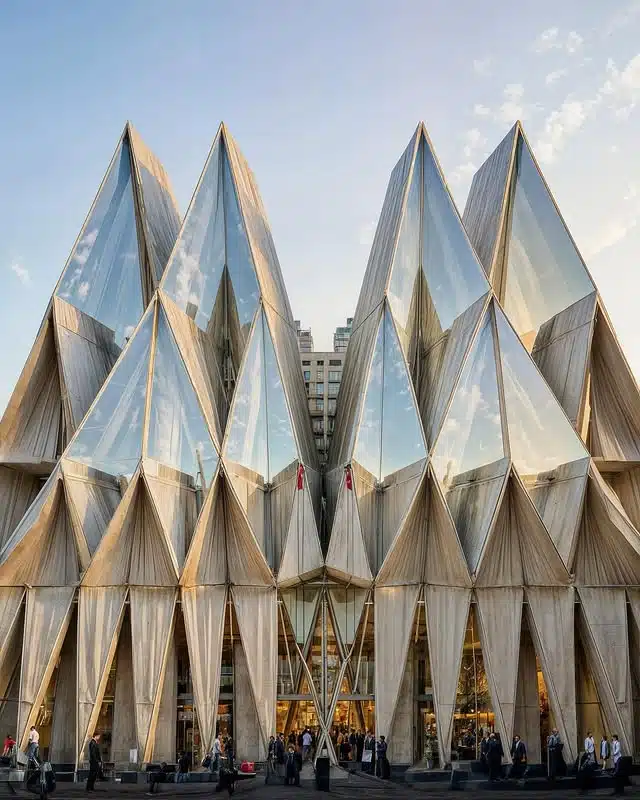
The project reinterprets the system of successive clerestories, historically used to enhance natural lighting and ventilation within large interior spaces. Through this principle, the volumes beneath the arches are extended, and the building’s visual mass is fragmented, resulting in a stepped roofline that reduces its perceived weight within the landscape, utilizing innovative Building Materials.

Architectural Envelope and Formal Transformations
The building envelope engages in a temporal dialogue based on a layered architectural materiality. Roof levels are clad with rectangular strips that evoke remnants of Napoleonic architecture, interwoven with more curved strips that reflect a contemporary reading. As a result, the slopes are transformed into a reinterpretation of culturally hybrid visual elements, reducing the roof’s rigidity and giving it a more evocative, almost imaginative character, which can be explored further through detailed Material Datasheets.
Structural System and Spatial Liberation
The structural strategy is based on the complete liberation of the hall, achieved by eliminating load-bearing points along two of the four façades. This is made possible through an arch system forming a vaulted framework that supports a stepped pyramidal structure above, while the arches gradually rise to carry lattice beams spanning across the façades. This solution enables an open interior void defined by transparency and the absence of intermediate supports, a hallmark of advanced Construction techniques.
Visual Relationship with the Historical Context
When moving from the Cour du Puits toward the Écurie d’Honneur, the visual composition allows the gaze to extend directly through the hall, creating a panoramic view of the historic stables. In this way, the equestrian performance space is integrated within an existing heritage architectural context, preserving the continuity of the landscape between interior and exterior, much like the best examples found in global Cities.

Chiaroscuro Scenography: Shadow and Light
The impact of the site extends beyond its external form to shape the experience of the interior space, where the façade is treated as a subdued structure during the day, while acquiring a more intense presence beneath the vault. This contrast establishes a direct relationship between light and space without relying on additional decorative elements, a concept often discussed in Discussion forums.
Structural Expression and Interior Lighting
Under low scenographic lighting, the curved timber frame emerges as a primary structural element defining the hall’s spatial identity. Secondary elements and technical systems are visually minimized through their treatment in a matte dark finish, allowing attention to be redirected toward the structural framework. In this way, the effect of light contrast enhances the perception of space and its volumetric depth, complementing principles of Interior Design.
Façade Flexibility and Relationship with Context
The project’s adaptability is expressed through a retractable façade that allows the relationship between interior and exterior to be reconfigured. When opened, wall segments slide behind fixed supports, dissolving the boundary between the performance arena and the historic surroundings. As a result, the hall transforms into an open space that reintegrates it with its original context, a strategy celebrated in many award-winning Architecture Competitions.


The Timber Envelope and Its Relationship to Interior Space
The façades surrounding the Cour du Puits are defined by a timber cladding with a regular grid, which functions structurally in shaping the boundaries of the void. This treatment creates a sense of a warm interior mass while maintaining a clear dialogue between inside and outside.
Louver System and Light Organization
The cladding consists of serrated horizontal wooden boards that engage in a visual dialogue with the ventilation louvers embedded within the roof layers. This system regulates the passage of natural light, gradually reducing its intensity toward the center of the courtyard, achieving a balance between illumination and visual protection.
Structural Expression of Light and Framework
This system connects two luminous rings that operate in conjunction with adjustable wooden slats, allowing light to be directed and diffused within the space. During the day, the play of light across the arches reveals the details of the timber trusses, emphasizing the structural framework as a key visual element within the hall, with the entire composition acting as a living Pintercture of light and form.

Environmental Performance and Natural Ventilation
The upper layer performs a functional role that goes beyond its formal expression, acting as a key element in the building’s natural ventilation strategy. Louvers are used to precisely regulate airflow while also contributing to noise reduction by functioning as acoustic baffles (abat-sons), thereby preserving acoustic calm during equestrian performances, a feature often highlighted in Top News coverage of innovative stables.
Thermal Ventilation System
Through their openness toward the sky, these elements reinforce the principle of the “thermal chimney” associated with the work of Victor Baltard. This system enables the natural extraction of warm air, enhancing the efficiency of passive ventilation within the hall, drawing on principles documented in the Archive of historical climate strategies.
Climatic Comfort and Operational Continuity
The integration of these mechanisms results in a more stable indoor climatic environment throughout the year. In this way, the system becomes part of an operational strategy based on natural solutions rather than conventional mechanical systems, a topic of frequent Discussion among sustainable design experts.

Formal and Historical References
The main hall is influenced by noble architectural forms spanning from the 17th to the 19th century, alongside a clear imprint of contemporary environmental awareness. This overlap situates the project within a reading that combines historical references with the requirements of modern sustainability, reflecting core values of Architecture that respects the past while building the future.
Materials and Structural Composition
The hall relies on primary materials of bio-based origin such as timber, and geo-sourced materials such as slate. This choice reflects an approach that favors the use of natural Building Materials within a simple and direct structural system, ensuring both durability and environmental harmony.
Architectural Expression and Functional Identity
The architectural mass appears simultaneously as a solid volume and a light, almost translucent structure. This duality expresses the idea of constructing simple yet robust frameworks, within a responsible functional architecture grounded in heritage references while remaining aligned with contemporary use requirements, a principle often celebrated in Architecture Competitions worldwide.

✦ ArchUp Editorial Insight
The equestrian performance hall in the Cour du Puits within the Haras National emerges as a direct outcome of the intersection between heritage preservation policies and the adaptive reuse of equestrian facilities within a cultural economy driven by tourism and the reactivation of historical architectural assets. Visual protection constraints imposed on historic courtyards, references to Napoleonic stables, and regulatory height limits generate a structural pressure that leads to the elevation of the mass to 17 meters through structural adjustments based on arches and load redistribution, a strategy that redefines how we approach historic Buildings in sensitive contexts.
The selection of timber and slate follows a logic of risk reduction in operation and compliance with low-impact material standards, with detailed specifications available in the Material Datasheets section. The final form becomes a negotiation between ventilation requirements through clerestories, operable façade systems, and the continuity of the visual landscape with the historic stables, while recalling Victor Baltard’s principle of thermal ventilation. Within this framework, the architect’s role recedes behind a regulatory apparatus governed by heritage governance and operational efficiency rather than formal intent, a concept explored in-depth through Research on contemporary adaptive reuse.
This project demonstrates how Construction techniques rooted in bio-based and geo-sourced materials can achieve both climatic comfort and heritage sensitivity. The operable systems and natural ventilation strategies align closely with the best practices found in sustainable Design today, while the overall composition remains a poetic expression of light, shadow, and material authenticity.