

The Xinchang Globular Center: Architectural Engineering Redefining Sustainable Development for Smaller Cities

Can sports arenas become sustainable economic engines instead of just financial burdens? This is the challenge faced by the Integrated Sports Complex in Xinchang. This ambitious project
embodies an integrated (1+N) model. This model addresses the sustainability of sports facilities in smaller cities.
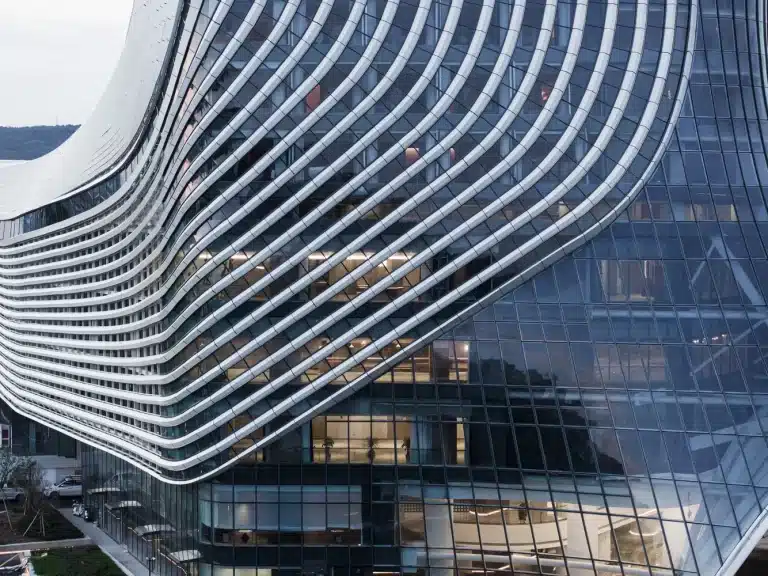
Where the River Meets the Mountain: A Flowing Architectural Interface
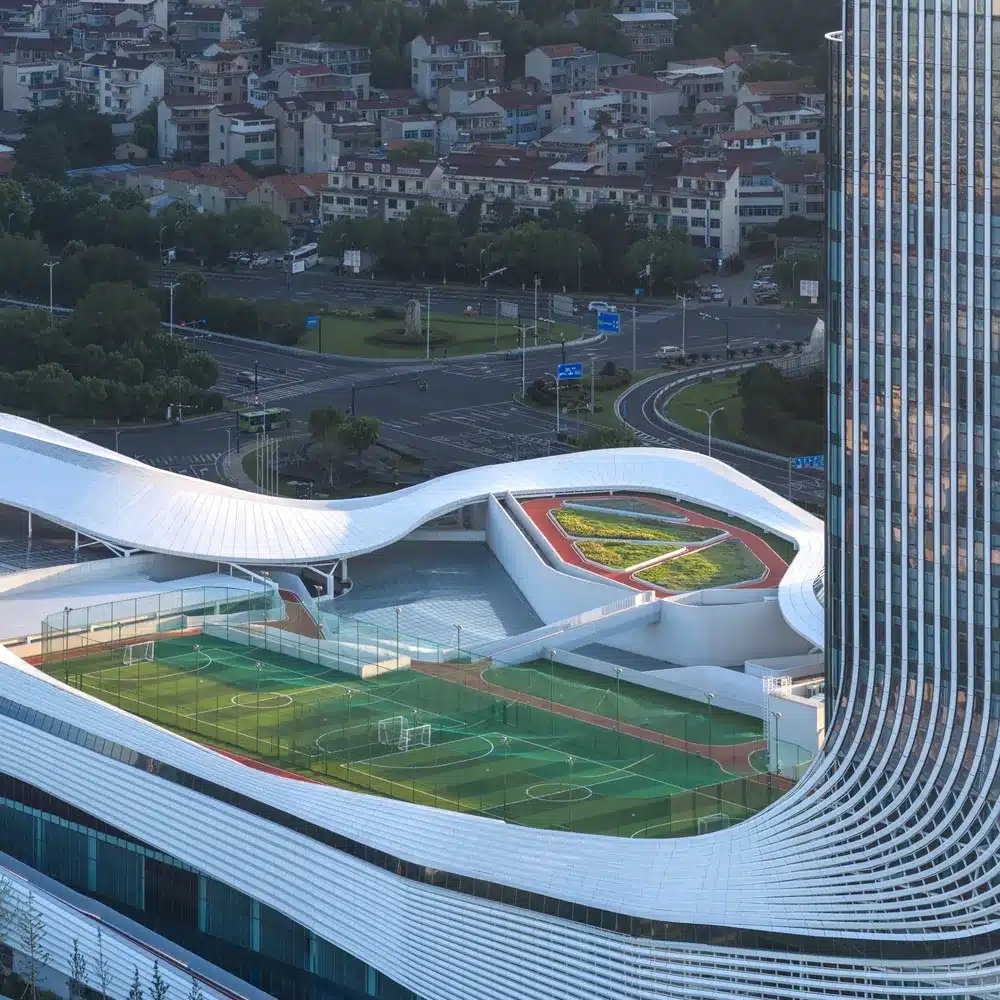
Your experience with the Integrated Sports Complex begins at the entrance.The pivotal junction hosts the building. Major transport axes converge here. This establishes it as the city’s northern gateway. The design draws inspiration from the local landscape. Strong horizontal lines mimic the water’s flow. The extended architectural massing resembles the surrounding mountain topography. This harmony breaks the rigidity of traditional sports structures. It creates a lively and welcoming interface.
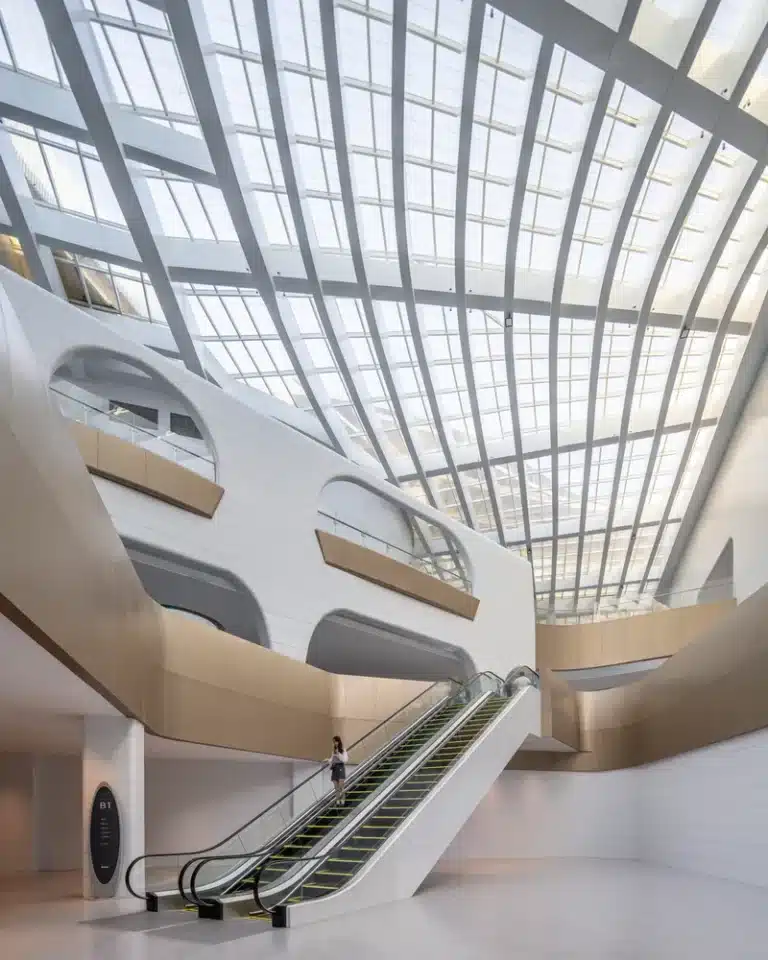
Vital Internal Pathways: The Atrium as an Urban Artery
Upon entering, you find the building is designed for daily life. The central atrium is the heart of the Integrated Sports Complex. This vast space functions as an internal urban street. It serves as the primary distribution system. It smoothly connects the complex’s five functional volumes. Pathways encourage continuous movement. Visitors navigate between retail outlets and restaurants. We integrated these directly with training halls and courts. This ensures the building remains a year-round, active magnet. This guarantees the success of the facility’s economic model. The public asset transforms into a sustainable community hub.
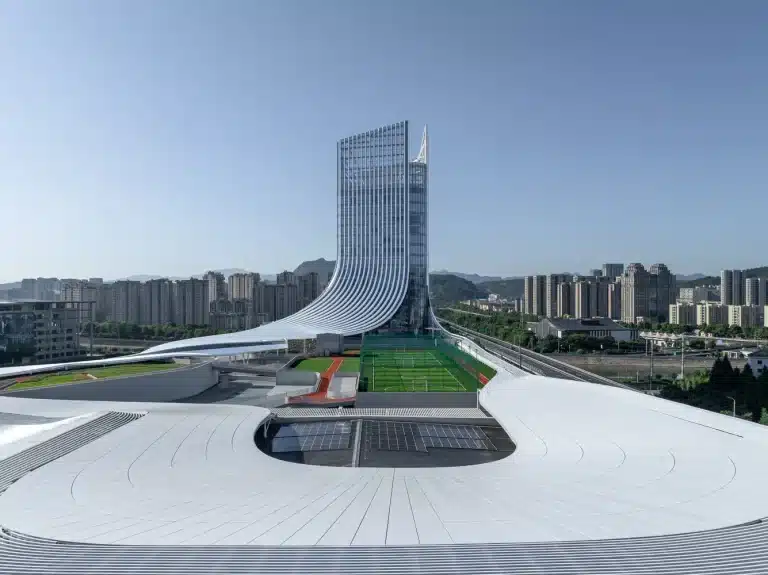
Stacking Efficiency: World-Class Facilities
The architecture of the Integrated Sports Complex demanded exceptional functional density. Sports, commercial, and hospitality facilities were cleverly stacked. This stacking meets international standards. It also provides a seamless visitor experience.
- Main Arena: Seats 5,000 spectators.
- Flexible Training Hall: Measures 7,900 square meters. It can be configured for 24 badminton courts or two tennis courts. The basement includes a gymnasium and a four-lane pool.
- Table Tennis Hall: Measures 6,100 square meters. It features double-height spaces to optimize performance.
The complex also includes a ballroom and exhibition areas. It is completed by a soaring 19-story athlete hotel. This tower provides accommodation and acts as a prominent vertical landmark in the city skyline.
Construction Techniques and Materials: The Foundation of Durability and Sustainability
The construction relied on a mix of materials and techniques. This ensures the vast facility’s durability and functional performance:
- They employed reinforced concrete and steel structures in key sections. This guarantees the stability of the long-span roofs.
- The team applied advanced facade cladding systems. Composite panels cover about 65% of the horizontal surfaces. This achieves the consistent, flowing aesthetic.
- They integrated double glazed insulating glass into commercial and atrium spaces. This accounts for approximately 30% of the enclosure. This maximizes natural light while reducing heat load.
- They blended green and locally sourced materials into the interior design. These materials exceeded 10% of the finishes. This supports sustainability and reduces transport carbon emissions.
This mix solidifies the position of the Integrated Sports Complex. It is a leading model for urban development. It successfully integrates daily life and athletic activity into the urban fabric.
✦ ArchUp Editorial Insight
The Integrated Sports Complex exemplifies functional design within the context of decentralized urban expansion. The extended, low-profile architectural massing, inspired by the surrounding mountains and water, demonstrates an attempt to integrate a vast facility (121,132 m²) into the natural landscape rather than imposing upon it. The central atrium, operating as an internal urban street, provides a critical approach to addressing sustainability challenges, ensuring continuous linkage between commercial and sports functions. However, the repeated use of landscape metaphors can be seen as a familiar design solution. The project’s true value lies in its success in achieving operational sustainability, transforming the Integrated Sports Complex from a seasonal financial burden into a year-round community and economic anchor, setting a new standard for infrastructure in smaller cities.





ArchUp: Structural and Programmatic Analysis of Xinchang Sports Center
This article examines the multi-purpose sports center in Xinchang as a case study in integrated sports infrastructure. To enhance its archival value, we would like to present the following key technical and functional data:
The structural system utilizes a hybrid framework of reinforced concrete and steel for large-span areas, featuring a façade composed of composite panels (65%) and double-insulated glass (30%). Total area spans 121,132 m² distributed across five functional blocks, with a central atrium measuring 40 meters in width and 25 meters in height serving as the primary circulation hub.
The functional performance features multi-level stacking including a main hall with 5,000-seat capacity, a flexible training hall (7,900 m²) convertible into 24 badminton courts, and a table tennis hall (6,100 m²) with double-height space. The complex incorporates a 19-story hotel tower (80 rooms) with fitness center and four-lane swimming pool.
In terms of operational efficiency, the central atrium achieves 40% commercial integration with retail spaces, featuring internal circulation paths designed for continuous movement of 3,000 daily visitors. The model maintains year-round activity through mixed programming that reduces operational costs by 25% compared to traditional facilities.
Related Link: Please review this article for a comparison of integrated sports facility models:
Multi-Purpose Sports Facilities: Design Economics and Operational Sustainability
https://archup.net/the-sport-district-codroipos-athletic-grounds-reimagined-as-social-hubs/