

The Integrated Urban Stadium: An Experience of Belonging in the Heart of St. Louis

A Vision Beyond the Green Pitch
The ambition was to construct an entity. It surpasses the boundaries of a mere football venue. The vision sought to create a dynamic civic destination. It’s capable of generating new energy and reviving pride among the city’s residents. This sports project is managed with pioneering foresight. The project set a deeper objective: transforming the athletic gathering place into a catalyst for community and urban integration. This is the Integrated Urban Stadium. It unites people based on shared understanding. It confirms that the power of sport lies in its ability to inspire.

The Visitor’s Path: Fusing the Stadium with the Civic Fabric
This stadium is not a closed structure, isolated from its surroundings. In fact, the Integrated Urban Stadium represents a new architectural design. It occupies a site that was formerly an off-ramp and a neglected parking lot. To ensure harmony with the neighborhood’s scale, designers placed the pitch and core supporting facilities below street level. This design decision eliminates visual and functional barriers. There are no massive loading docks to isolate the building.
The visitor experience begins at the stadium’s open corners. These function as welcoming portals. They directly connect the surrounding neighborhoods to the inner plaza. You feel invited to enter from any direction. The stadium seems a natural part of your daily journey. From inside the stands, the design ensures the city remains a visible, present part of the spectacle. You feel like you are participating in the match while overlooking the urban skyline.
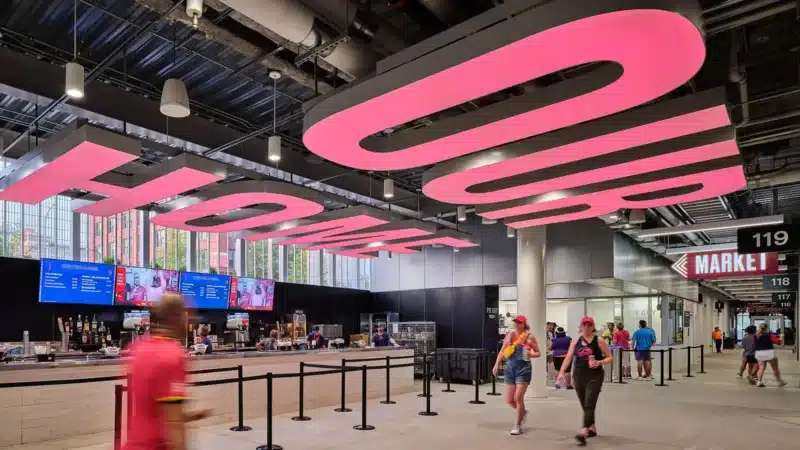
The Spatial Experience: Strategic Location and Honoring Memory
This project occupies the western end of a significant urban place in St. Louis. It completes the visual and spatial composition of this large civic area. The Integrated Urban Stadium does not turn its back on any part of the city. It does not ignore the historically marginalized North Side. On the contrary, designers treated every facade as a vital component for the overall design success.
The experience gains a crucial historical and cultural dimension along the main street. A sculptural artwork stands prominently there. It is dedicated to commemorating memory. This installation honors a thriving African American community. That community once existed on the site, but urban renewal programs removed it. Through this act, the stadium becomes a site for remembrance and acknowledging the past.
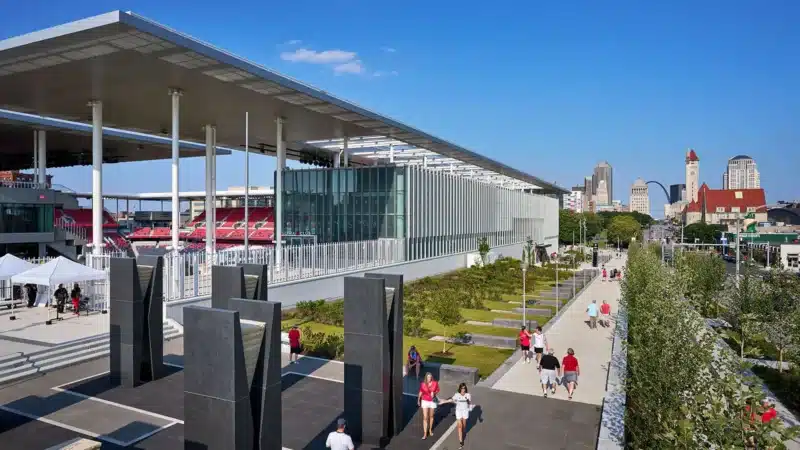
Construction Techniques and Materials: Foundations of Sustainability and Equity
The Integrated Urban Stadium relies on a Structural Steel
frame, forming 90% of the main structural materials. Its unique design
places the pitch and core facilities 15 meters below street level (Sunk) for visual integration with the neighborhood’s scale. The facility holds 22,500 seats and occupies a strategic 31-acre site. The project
emphasizes sustainability
by targeting LEED Gold standards; its solar array generates 15-20% of energy needs, and it utilizes 40% Low Carbon Concrete. Furthermore, a rainwater management system achieves 75% pure water savings through collection and reuse. Spatial integration is achieved through four open stadium corners that connect directly to surrounding neighborhoods, supplemented by new pedestrian paths and a memorial artwork honoring the historical community of the site.
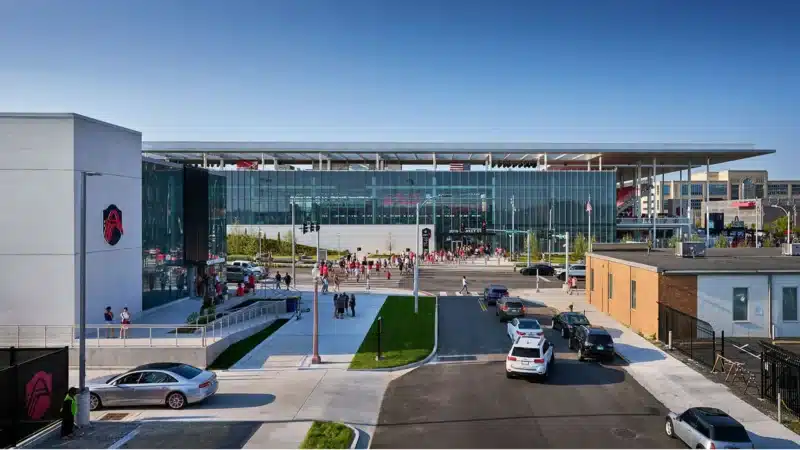
✦ ArchUp Editorial Insight
The Integrated Urban Stadium in St. Louis establishes an architectural design model that transcends its athletic function. The visual approach is evident by placing core facilities below street level, ensuring the structure integrates seamlessly with its urban scale. A constructive critique emphasizes the continuous monitoring of stringent claims, such as the zero waste stadium goal, particularly given the reliance on materials like concrete and steel in its construction. The stadium’s design utilizes “porosity” through open corners, actively promoting inclusive urban planning principles. This is positively underscored by honoring local memory through site-specific artwork. This blend of contextual responsiveness and environmental transparency gives the project significant relevance beyond the scope of football.


ArchUp: Structural and Urban Analysis of the Integrated Urban Stadium in St. Louis
This article examines the integrated urban stadium in St. Louis as a case study in sports infrastructure integrated with urban fabric. To enhance its archival value, we would like to present the following key technical and structural data:
The structural system utilizes structural steel constituting 90% of primary construction materials, featuring a unique design that sinks the playing field and support facilities up to 15 meters below street level for visual integration with neighborhood scale. The stadium capacity reaches 22,500 seats, occupying a strategic 31-acre (125,450 m²) site that reclaims space formerly serving as a highway exit ramp.
The environmental performance implements LEED Gold standards through a solar array on roof and parking structures generating 15-20% of energy needs, with a stormwater management system achieving 75% potable water savings through collection and reuse. The project uses 40% low-carbon concrete and 100% native plants in green spaces.
Regarding urban integration, the stadium’s four open corners (50-meter wide openings) provide direct connectivity to surrounding neighborhoods, with new networks of pedestrian and bicycle pathways. The project incorporates memorial artwork honoring a displaced historic African American community, alongside a multi-use outdoor event plaza.
Related Link: Please review this article for a comparison of sports facility integration strategies in urban contexts:
Urban Stadiums: Between Sports Function and Community Integration
https://archup.net/levis-stadium-2026-innovative-design-and-comprehensive-fan-experience/