
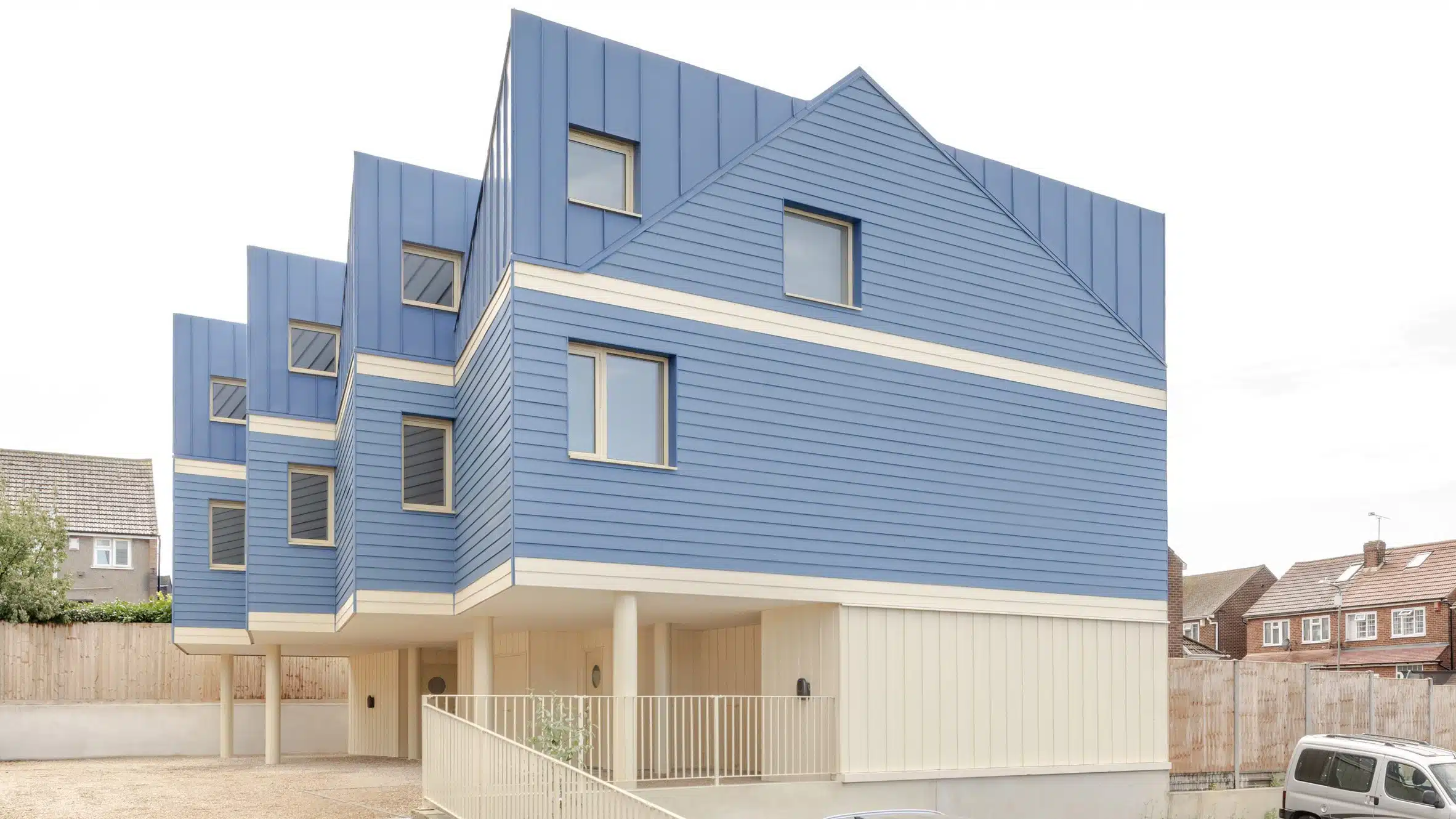
Goldsmith Mews: How Pale Blue and Dickens Charm Challenged the Kent Suburbs?

In the quiet village of Chalk, where every corner tells a story of England’s history, a small residential project emerged, sparking debate about the identity of the contemporary urban scene. This complex provides four new housing units. Developers built it on a completely neglected plot. This design clearly announces a new vision for the evolution of Kent Transitional Architecture.

A Visual Journey to Forgotten Shores
Your journey toward the new complex begins with a calm visual withdrawal. Traditional brick architecture is prevalent in the area. The visitor feels transported to a lost coastal bank. Memory returns to the old cottages with timber cladding that characterized the village in the nineteenth century. The architects specifically drew the complex’s design inspiration from this heritage. It offers a contemporary interpretation that challenges the typical pattern of new suburbs. It emphasizes the importance of Kent Transitional Architecture in redefining urban development.
You access the homes via a carefully designed path. This path runs beneath the first floor. A shaded and open space welcomes you there. Concrete columns created this space, supporting the structure above. It forms a sheltered area for the entrance and storage below.

The Technical Dimensions of Past Cladding
The design utilized modern materials and technologies. The goal was to translate the traditional local texture into sustainable architectural language. The designers chose an exterior cladding to reflect the distinctive pale blue colour of the coast. This decision replaced timber, which requires periodic maintenance. This material composition became essential for achieving the visual separation from the neighbourhood:
- Exterior Cladding: 90% of the facade features Fibre Cement Weatherboarding panels. These panels offer high durability and resistance to moisture. They also retain the texture of traditional timber planks.
- Floors and Foundations: 8% of the concrete foundations and bases support the first floor on pilotis.
- Metal Details: 2% of the metal components make up the roof system and structural details.

The Dialogue of Colors and Forms
The visual composition of the complex relies on a dual color dialogue. Dusty blue covers the upper cladding and metal roofs. This gives the building a distinctive coastal character. In contrast, the ground floor stands out in a warm buttery yellow color. The designers also used this neutral color as a horizontal strip separating the two floors. This contrast works to break visual uniformity. It confirms the building is part of the Kent Transitional Architecture movement. Here, architects do not fear color experimentation in a rural context.
Details inspired by European modernist architecture complete the visual experience. Examples include the front doors equipped with small porthole openings. This blend of historical and contemporary signals enriches the experience of walking through the space.

Harmony with the Site’s Memory
The goal wasn’t merely to erect a new structure. The team intended to rewrite a part of the site’s history. They named the complex after a local figure linked to the village’s ancient past. This connects the new housing to the memory of the land. The building’s form moves away from traditional lines. The first floor features a sawtooth roof form. This shape adds depth and helps provide shade to the entrance below. This approach represents a step towards developing Kent Transitional Architecture. It is an approach that respects the past without being enslaved by it.
✦ Editorial View from ArchUp
Goldsmith Mews is an explicit example of eclectic architecture that seeks to revive a lost contextual memory using a contemporary visual language. The Office S&M project in Kent offers four units on pilotis, relying on the metaphor of blue weatherboarding from the Dickens era to confront what it calls generic suburbs. The real challenge lies in this blend’s ability to transcend being merely a synthesis of historical (heritage) and modernist (Jean Prouvé references) symbols, positioning it in a gray area between documentation and critique. The project is characterized by tangible boldness in the use of colors and massing, making it an important visual document for the trend of small developments attempting to redefine British suburban identity. This necessitates that architects, in the future, articulate more authentic answers to this tension.


