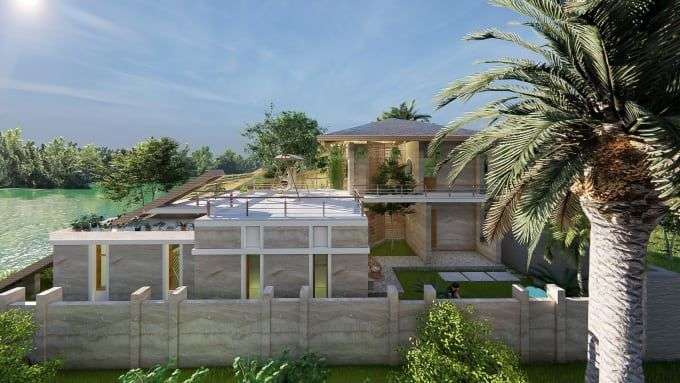
La Montse and Manel’s House: Courtyard and Climate

| Property | Details |
|---|---|
| Architects | OBO Estudi |
| Area | 112 m² |
| Year | 2023 |
| Photographs | Andres Flajszer |
| Manufacturers | Cerámicas Arcís |
| Lead Architects | Oriol Troyano, Bernat Sancho / Òscar Farrés |
| Category | Houses |
| City | Sant Esteve de Palautordera |
| Country | Spain |
Urban Context of the Site
The building is located near the center of Sant Esteve de Palautordera, close to the Montseny Natural Park. Despite the distinctive nature of the surroundings, the urban fabric of the area is characterized by closely spaced houses with minimal gaps between them.
Moreover, planning regulations required the building to be a single-story structure, a constraint that often leads to adopting design solutions that compensate for the limited height while maintaining the quality of the interior spaces.
The Central Courtyard as an Organizing Element
Given the absence of distant views of the landscape, the house is organized around a rectangular central courtyard that serves as the axis of the architectural layout. Four interconnected wings are arranged around this courtyard, making it the main point of connection between the different parts of the house.
Enhancing the Sense of Spaciousness
The courtyard is not merely a secondary space but represents the vibrant heart of the home. It creates reciprocal visual relationships between rooms, which enhances the sense of spaciousness and contributes to a broader spatial perception within the residence.

Circulation Within the House
The house is accessed from the northern façade, where an angled entrance leads directly to the central courtyard, setting the tone for understanding the internal organization from the moment of entry. From this point, spaces are distributed into two main wings that accommodate the kitchen with the dining area and the living room.
Spaces then transition according to levels of privacy; movement flows from more open areas to quieter zones, culminating in the master bedroom located at the corner opposite the entrance.
Transitional Spaces Between Interior and Exterior
The southern wing includes a semi-open area designed as a covered veranda with movable wooden shutters. This solution not only allows natural light to permeate the house but also creates a pleasant transitional zone between the interior and exterior.
Consequently, traditional boundaries between public and private spaces are softened, enhancing the sense of openness and spatial continuity.
Material Selection Amid Economic Challenges
In the context of rising construction costs following the COVID-19 pandemic, the design opted for traditional materials that are cost-controllable and easy to implement.
The project also relied on the expertise of a local builder specializing in brickwork, which enabled the execution of a ceramic façade that meets the building’s technical and climatic requirements while maintaining economic and structural efficiency.


Façade and Structural System
The design employs solid brick cladding for the façade, which serves not only an aesthetic function but also contributes to supporting the vertical loads of the roof. This use creates a regular visual rhythm that reinforces the structural character of the façade.
These elements are connected to a system of wooden beams arranged perpendicular to the direction of the wings, clearly illustrating the relationship between the structural framework and the organization of spaces within the building.
Ventilation and Shading Elements
Due to the slenderness of the columns, a commonly used construction element, perforated bricks (jiru), was employed to support the load-bearing façade and enhance its stability. When installed vertically, these elements contribute to the façade’s identity, while forming a ventilated shadow layer that, in certain areas, acts as a lattice allowing the passage of air and light.
This solution thus performs a dual role, regulating both privacy and natural lighting while maintaining ventilation.
Simplicity of Materials in the Interior
Inside the house, the same approach of simplicity and harmony continues in the selection of materials. Polished concrete flooring functions as a thermal mass, helping to stabilize indoor temperatures, while ceramic walls coated with lime mortar provide an irregular texture that adds visual warmth to the spaces.
Simultaneously, the wooden roof structure is left exposed, forming a visual extension that enhances the presence of the ceramic columns on the façade and links the interior with the exterior through a coherent material language.


Climatic Changes and Their Impact on Design
Over the past decade, areas at the foot of Montseny have experienced notable climatic changes: summers have become hotter with an increase in tropical nights, while winters have grown shorter and milder. In light of these shifts, integrating environmental strategies into architectural design has become essential to enhance thermal comfort within buildings.
The Courtyard and Trees as Bioclimatic Elements
In this context, a deciduous elm tree planted in the central courtyard functions as a local climatic regulator for the house. It provides shade during the summer while allowing sunlight to enter in winter after shedding its leaves, achieving a natural balance of light and heat throughout the year.
The house is also surrounded by horizontal movable shutters inspired by local architecture, which can be adjusted according to the seasons. This element helps control the amount of light and heat entering the interior spaces.
Natural Ventilation and Thermal Regulation
The design also relies on a careful distribution of windows between the closely spaced wings, enhancing airflow through the thermal gap between the exterior façade and the interior courtyard. This creates effective natural ventilation that helps reduce heat accumulation inside the building.
Additionally, the ventilated façade reduces thermal gain from external surfaces, while lime mortar used in the finishes helps regulate humidity within the spaces, contributing to a more stable and comfortable indoor environment.


✦ ArchUp Editorial Insight
The project’s emphasis on utilizing the central courtyard and organizing spaces around it can be seen as a unifying element connecting the wings while providing natural ventilation, reflecting an awareness of fundamental bioclimatic strategies. Similarly, the use of traditional materials and the execution of the ceramic façade by local craftsmen reinforce the harmony between the design approach and the available construction capabilities.
However, the design also raises several considerations for architects and potential users. For instance, the reliance on a single-story layout and the close proximity of the wings may limit possibilities for future expansion or redistribution of spaces, as well as constrain privacy and functional flexibility in daily use. Additionally, the central courtyard, as the sole axis for lighting and ventilation, may have limited effectiveness under certain extreme climatic conditions, necessitating careful monitoring of light and thermal balance throughout the year.
Furthermore, while the focus on traditional materials provides economic advantages, it may restrict the use of innovative or sustainable techniques that could enhance the home’s long-term thermal and environmental performance. From an architectural perspective, the project offers a valuable case study for understanding the challenges of designing low-rise homes in nature-adjacent sites, highlighting the need to balance tradition and innovation, aesthetic and functional considerations, and environmental performance with future flexibility.