Leveraging the City and University Connection for Impact الاستفادة من ارتباط المدينة والجامعة من أجل التأثير

Leveraging the City and University Connection for Impact

Home » Events » Leveraging the City and University Connection for Impact

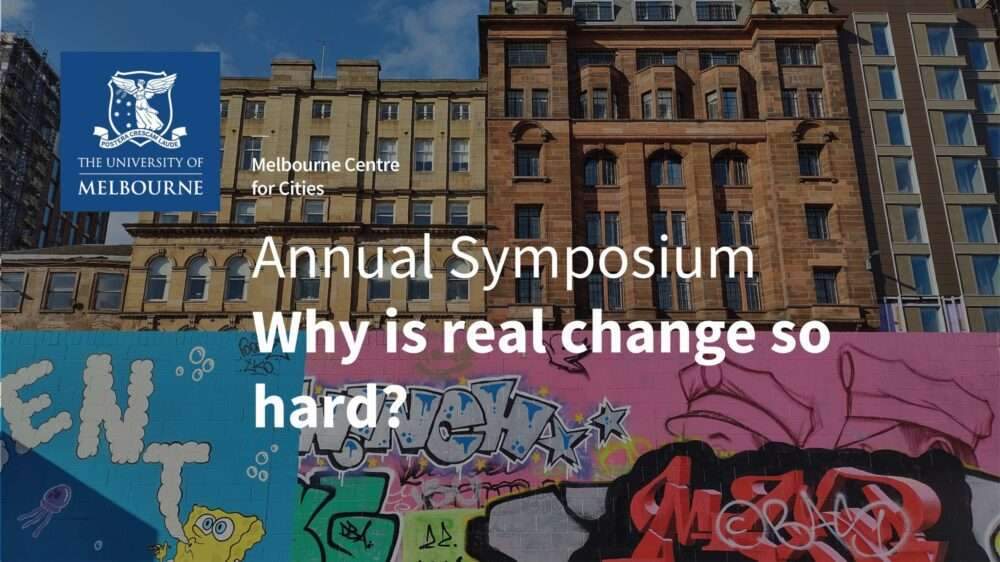
Leveraging the City and University Connection for Impact 

A public event by Melbourne Centre for Cities for those interested in how Universities and Cities collaborate for impact.

This one-day symposium features thought-provoking speakers, cutting-edge research and practice, and participatory discussions, to think about opportunities and challenges that arise when universities and cities work together to address important urban issues.

Keynote speakers include:

– Professor Harriet Bulkeley (FBA, Professor in the Department of Geography,
Durham University, and at the Copernicus Institute of Sustainable Development,
Utrecht University)
– Inala Cooper (Director Murrup Barak, Melbourne Institute for Indigenous
Development)
– Jason Eades (Director Aboriginal Melbourne, City of Melbourne)

Universities play a vital role in shaping the economic, social, and cultural landscape of their communities, and their impact can be felt far beyond the boundaries of their campuses.

At the same time, cities provide universities with a rich and diverse environment that supports their research, teaching, and projects.

So, why is real change so hard? And how do we better leverage the city and university connection for greater impact?

The rise of new technologies, shifting demographics, and changing patterns of work. And mobility is all opportunities for universities and cities to collaborate and innovate. Equally, matters such as climate change, decreasing urban biodiversity, increasing social inequalities, and shifts in urban governance dynamics. Present complex challenges that require better collaboration between practice, theory, and research to achieve creative solutions.

This symposium will challenge delegates to engage, discuss, and act, through a day of moderated sessions and showcases at the Parkville campus of the University of Melbourne. We convene key voices on the future of cities to debate world-class evidence, coming from universities, local government, civil society, and the private sector. Urban challenges from cities big and small will be addressed through a suite of activities geared towards action and implementation, based on graspable evidence.


Read more on Archup:


Further Reading From ArchUp

  • Reflective Nostalgia: Neri & Hu Design and Research Office at AEDES

    Reflective Nostalgia: Neri & Hu Design and Research Office at AEDES Exhibition View © Erik-Jan Ouwerkerk Share ShareFacebookTwitterMailPinterestWhatsappOrhttps://www.archdaily.com/991435/reflective-nostalgia-neri-and-hu-design-and-research-office-at-aedesWith Neri&Hu Design and Research Office, the Chinese avantgarde in architecture, research and teaching, product and interior design has arrived in Europe. In the exhibition Reflective Nostalgia, Lyndon Neri and Rossana Hu are convincing in the way they

  • Hamptons 20th Century Modern Home Tour 2023

    Hamptons 20th Century Modern Home Tour 2023 Antler House by Andrew Geller, East HamptonJoin Hamptons 20th Century Modern on a tour of 6 iconic modernist properties in the Hamptons. All private residences, guests will be granted rare access into these early architectural gems and learn about the history and design of each home from their

  • Ippodo Gallery Presents Extreme Surfaces Exhibit at Design Miami

    Ippodo Gallery Presents Extreme Surfaces Exhibit at Design Miami Kodai Ujiie, Ofukei Lacquer Jar Share ShareFacebookTwitterMailPinterestWhatsappOrhttps://www.archdaily.com/992006/ippodo-gallery-presents-extreme-surfaces-exhibit-at-design-miamiTokyo and New York-based Ippodo Gallery will present Extreme Surfaces, an exhibition of contemporary Japanese kogei (art and craft), November 30–December 4 at Design Miami 2022 (booth G36). The installation will feature works by twenty two living artists including Kodai

  • USC School of Architecture: Border Walk Virtual Discussion

    From a modest fence built in the early 1900s to a sophisticated surveillance, tracking, and barricade system today, the US-Mexico border is both a work of architecture and an exercise of planned obsolescence. It is a continually updated construction zone, a seemingly impenetrable infrastructure that nevertheless allows thousands of undocumented and stateless people to move

Leave a Reply

Your email address will not be published. Required fields are marked *