

Ludwig II: The Architect King

History rarely produces a monarch who is remembered not for his battles, alliances, or political achievements, but for the architecture he imagined, financed, and obsessed over until it consumed his kingdom and his sanity. Ludwig II of Bavaria, often called the Swan King or the Fairy Tale King, stands almost alone in this category. When he ascended the throne in 1864, he was only eighteen years old, strikingly handsome, nearly 190 centimeters tall, and so admired for his appearance that Bavarian newspapers described him as a sculpture who had come to life. Yet beneath this beauty lived a mind that would reshape the architectural imagination of Europe, leaving a legacy that would one day inspire Walt Disney and define Germany’s romantic identity.
To understand Ludwig, one must first understand the emotional universe he inhabited. He was consumed by the music of Richard Wagner, whose operas he discovered at a young age and whose mythological worlds began to overshadow the political reality of Bavaria. The king invited Wagner to Munich almost immediately after taking the throne, offering him financial support, protection, and a level of devotion that blurred the boundaries between patronage and psychological dependence. Wagner recognized this influence quickly. For a brief period, he wielded extraordinary power over the king, inspiring Ludwig not only musically but architecturally. The two men shared grand dreams of opera houses, mythic landscapes, and theatrical spaces that merged narrative with construction. Wagner proposed a vision of performance that transformed the audience into participants, and Ludwig fell deeply under the spell of that artistic ambition.

It was during this phase that Ludwig first imagined building a private opera house designed solely for Wagner’s works. The idea was revolutionary. The king envisioned a hall with controlled acoustics, raked seating, and an architectural geometry that placed psychological tension at the center of the experience. In 1868, Ludwig wrote a letter to Wagner describing his dream of constructing a monumental site that embodied the mythic German world Wagner had created. He promised that construction would take three years. He promised that no cost would be spared. He promised a palace, not for royalty, but for imagination itself.

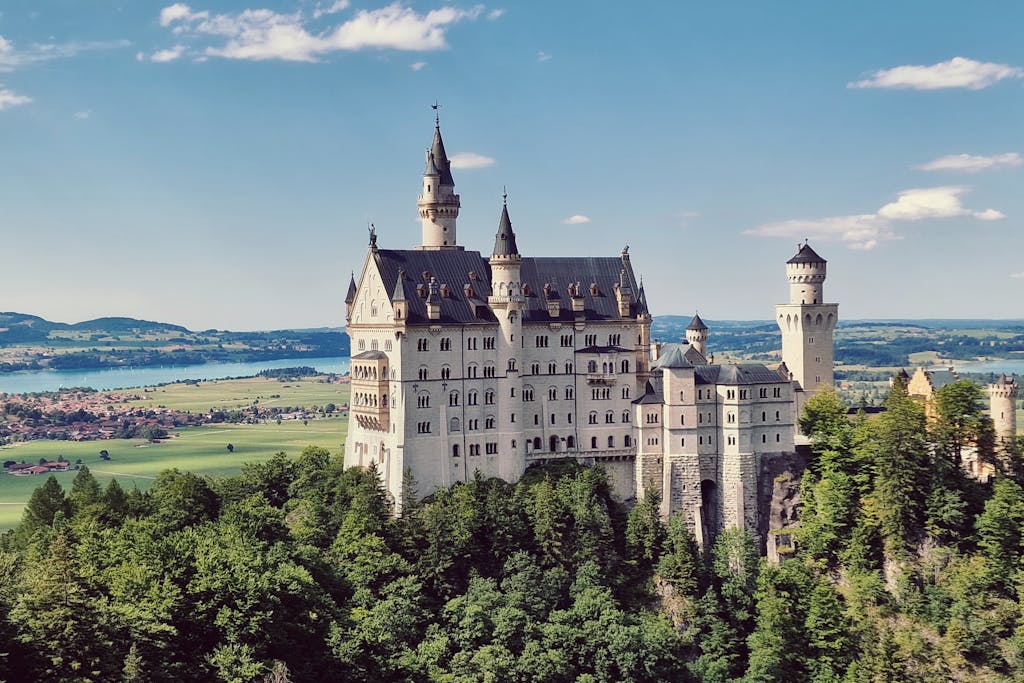
From this letter emerged the concept of Neuschwanstein, a castle so improbable that it continues to baffle historians and architects alike. Positioned a thousand meters above sea level, Neuschwanstein is not merely a building. It is an architectural hallucination made real, a structure that fuses medieval romanticism with nineteenth century engineering, opera with stone, myth with masonry. It was Ludwig’s attempt to carve Wagner’s world into the Bavarian Alps, turning music into architecture and vision into geography. Readers who explore the historical interplay between architecture and cultural identity will find this phenomenon echoed across Architecture and the evolving conversations on European heritage within Cities.

Ludwig’s inspirations were rich and varied. After visiting the Wartburg Castle in 1876, he became enchanted by its towers and battlements, absorbing every detail into his architectural vocabulary. He traveled to the Château de Pierrefonds in France, restored under Napoleon III, and studied its spires, cylindrical turrets, and dramatic silhouettes. These encounters shaped the aesthetic DNA of Neuschwanstein, infusing it with French romanticism layered atop German medievalism, all interpreted through Ludwig’s highly personal lens. What resulted was not a copy but an interpretation, an architectural opera in stone.
Contrary to the popular myth that Ludwig was merely a romantic dreamer, he was obsessively involved in the technical and logistical aspects of construction. He reviewed blueprints, interrogated contractors, and pushed architects to match the visions he held in his mind. He dismissed architects frequently, preferring to work with lesser known designers whom he could control more easily. The king imposed his will upon every detail, influenced by diverse building styles he admired, from Rococo ornamentation to industrial innovations. He embraced modernity when it served his purposes, incorporating iron trusses to support dramatic spans and using a synthetic marble known as scagliola for interior columns, giving the castle a sublime grandeur without the cost of real marble.

The steam engine played a crucial role in bringing Ludwig’s fantasies to life. It allowed materials to be transported into the mountains, overcoming logistical impossibilities that had halted previous generations. Neuschwanstein is often described as medieval, but its bones are industrial, an architectural contradiction that reveals the king’s complex sensibility: old in spirit, modern in technology. Those interested in how construction innovation shapes meaning will find parallel insights in Construction and the materials debates documented in Building Materials.
Despite the castle’s theatrical exterior, Ludwig ensured it was astonishingly practical on the inside. He installed one of the first telephone lines in Bavaria so that he could call the kitchen to request meals without human interaction. He implemented a central heating system, rare for the 1870s, to warm the castle efficiently. He designed a mechanical dumbwaiter to deliver food directly to his dining room. These innovations sit strangely alongside his refusal to adopt electric lighting, choosing candles even after Vienna, Paris, and royal residences across Europe were illuminated. Ludwig wanted the emotional ambiance of candlelight, resisting technological convenience for atmospheric authenticity.
He lived in the finished castle for only 172 days. By then he was drowning in debt. His relentless construction projects had drained the royal treasury, pushing Bavaria into financial instability. In 1886, his ministers declared him unfit to rule, citing erratic behavior and financial irresponsibility. Days later, Ludwig was found dead in Lake Starnberg under mysterious circumstances. His death, ruled a suicide by some and a political assassination by others, marked the birth of a legend. Neuschwanstein, which had nearly bankrupted a kingdom, became the icon of Germany, the embodiment of romantic myth, and the global symbol that Walt Disney would later transform into the Sleeping Beauty Castle.

Today, Neuschwanstein stands as the most visited architectural site in Germany, a paradox of national pride built by a king many once dismissed as insane. It is both a physical structure and a psychological monument, a projection of Ludwig’s inner world rendered in limestone, brick, steel, and fantasy. Its doors include one that opens to nowhere, a literal architectural metaphor for Ludwig’s escapism. The castle remains a study in imagination, obsession, and architectural transcendence.
To contextualize Ludwig’s influence within broader heritage debates, readers may explore Architecture News for similar global narratives or consult Archive for articles exploring the intersection of myth, place, and built form.
Ludwig II built Neuschwanstein as an act of self creation, a spatial biography written in stone. He died believing he had failed. Yet the world he carved into the mountains became Bavaria’s greatest cultural asset. History often gives architects posthumous justice, but Ludwig was not merely a patron. He was an architect in spirit, a dreamer with a drafting table in his mind, a king whose buildings outlived his throne, his fortune, and his fragile psyche.
✦ ArchUp Editorial Insight
This article skillfully traces the romantic saga of Ludwig II, Bavaria’s enigmatic “Architect King,” whose vision blurred the boundaries between monarchy and myth. The piece excels in weaving historical fascination with architectural consequence, positioning castles like Neuschwanstein as both personal sanctuaries and national symbols of escapism. However, the article leans heavily into narrative charm without sufficiently questioning the architectural utility or sustainability of such extravagance. A more critical lens on the economic burdens and technical indulgences would have deepened the piece’s authority, especially in light of how architecture today is pressured to justify both cost and purpose. Still, the article offers a memorable portrait of a ruler who made architecture his emotional language. Ten years from now, as virtual kingdoms and immersive environments rise, the story of Ludwig II may find uncanny relevance in the blurred frontier between power, fantasy, and the built world.


